
Frequently Asked Questions

Product Information Management (PIM) Basics

What is PIM for eCommerce?

A PIM (Product Information Management) software is a system that centralizes, organizes, and distributes your catalog’s product data—such as attributes, variants, descriptions, and technical specifications—to online shops and other digital channels, including proprietary eCommerce sites, marketplaces, apps, sales portals, and digital showcases. It acts as the single source of truth for all product data, ensuring consistency and accuracy across all channels. [Source]

Why is a PIM important for growing eCommerce businesses?

As eCommerce businesses grow, they face increased complexity: more channels to manage, more SKUs, and more markets with different requirements. A PIM helps centralize and harmonize product data from various sources (ERP, PLM, spreadsheets, internal teams), reducing errors, inconsistencies, and publication delays. This ensures faster, more reliable product launches and updates. [Source]

How does a PIM differ from an ERP system?

An ERP (Enterprise Resource Planning) system is typically a source of data such as prices, stock, inventory, or master data. A PIM centralizes and standardizes this and other product information, simplifies management and enrichment of product pages (sometimes with related assets), and distributes them to eCommerce, marketplaces, and other channels. [Source]

What are the main problems a PIM solves for eCommerce teams?

PIM addresses fragmented product data management, which can lead to inconsistencies, errors, and publication delays. It helps manage information from different sources, keeps multiple channels updated, and automates repetitive publishing and updating activities, reducing bottlenecks and improving time-to-market. [Source]

How does a PIM improve data quality and reduce errors?

A central PIM system unifies management and publishing of attributes, variants, and descriptions, resulting in fewer errors and inconsistencies between product detail pages (PDPs), product listing pages (PLPs), feeds, and technical sheets. This reduces manual fixes and ensures accurate, complete information across all channels. [Source]

Can a PIM help reduce cart abandonment and product returns?

Yes, a PIM improves the quality, accuracy, and consistency of product information, which leads to richer, more complete shopping experiences. This reduces the risk of cart abandonment and product returns caused by missing or inaccurate information. [Source]

What is meant by 'completeness' of a product page in PIM?

Completeness refers to the richness, accuracy, and consistency of information and content provided for each product. A complete product page ensures a personalized and consistent purchasing experience across all sales channels. [Source]

How does a PIM support localization for different markets?

A PIM designed for eCommerce supports localization by enabling translation of titles and descriptions into multiple languages and adapting information such as currencies, units of measurement, certifications, and regulations for each market. This ensures that product information is relevant and compliant in every region. [Source]

What is the benefit of integrating DAM with PIM for eCommerce?

Integrating DAM (Digital Asset Management) with PIM enables unified management of both product data and digital assets (images, videos, manuals). This approach simplifies product page enrichment, ensures consistent reuse of assets across channels, and eliminates duplication, resulting in faster, more consistent product launches. [Source]

How does a PIM accelerate time-to-market for new products?

By centralizing ingest, approval, and distribution in a single workflow, a PIM reduces manual steps and revisions, enabling immediate go-live for new products, launches, and updates. This streamlines the process and shortens time-to-market. [Source]

Features & Capabilities

What features should I evaluate when choosing a PIM for eCommerce?

Key features to evaluate include: easy integration with third-party systems (ERP, PLM, CMS), workflow and permissions management, localization capabilities, automatic completeness tracking, multichannel publishing, and integration with DAM software or native DAM+PIM management. [Source]

Does THRON offer a unified DAM and PIM platform?

Yes, THRON provides a unified platform that combines Digital Asset Management (DAM) and Product Information Management (PIM) functionalities. This eliminates the need for costly integrations and reduces complexity, making it easier to manage both product data and digital assets from a single source. [Source]

How does THRON automate workflows and asset distribution?

THRON automates workflows, asset distribution, and content optimization using AI-powered automation. This reduces manual work, accelerates time-to-market, and ensures consistent brand communication across all channels. [Source]

What integrations does THRON support?

THRON supports a wide range of integrations, including next-generation API connectors, certified connectors for platforms like AEM, Magento, Shopify, Drupal, WordPress, and SFCC, as well as integration with ERP, CMS, creative suites (Adobe CC), IT security tools, and user experience tools. [Source]

Does THRON provide APIs for integration?

Yes, THRON offers modern, robust, and easy-to-implement APIs that allow integration with any system or endpoint. These APIs ensure secure and high-performance integrations, simplifying workflows and enhancing speed. [Source]

What monitoring and analytics capabilities does THRON offer?

THRON provides monitoring dashboards that track the volume and quality of digital asset usage, omnichannel delivery performance, and content intelligence for data-driven optimization. These insights help businesses optimize their content strategies and improve user experience. [Source]

What technical documentation is available for THRON?

THRON offers comprehensive technical documentation, including platform architecture infographics, white papers, and detailed documents on architecture, security, and data management. These resources are valuable for IT and digital leaders evaluating the platform. [Architecture White Paper] [Security & Data Management]

How does THRON ensure secure access and data governance?

THRON features secure access control, customizable password policies, data encryption, HTTPS protocol for distribution, and advanced threat detection systems. The platform is developed following OWASP principles and leverages AWS infrastructure for robust security and data integrity. [Source]

Use Cases & Benefits

Who can benefit from using THRON's PIM and DAM platform?

THRON's platform is designed for marketing, e-commerce, operations, digital/CIO, and IT teams across industries such as fashion, ceramics, beauty & pharma, sporting goods, manufacturing, interior design, retail, and automotive. It is ideal for businesses seeking to centralize content, automate workflows, and ensure brand consistency. [Source]

What business impact can customers expect from using THRON?

Customers can expect measurable performance improvements, including 90% time savings in searching for product data and assets, 50% reallocated time to strategic activities, 99.9% service availability, and a 317% ROI with a payback period of less than 6 months (Forrester TEI study). Automated asset delivery can provide a financial benefit of 7,000 over three years. [TEI Report]

How does THRON help marketing teams?

THRON centralizes content and automates workflows, reducing manual work and ensuring consistent brand communication. This allows marketing teams to focus on creativity and strategy rather than repetitive tasks. [Source]

How does THRON support e-commerce teams?

THRON provides a centralized hub for assets and product information, improving user experience and accelerating time-to-market. This leads to higher conversion rates and more efficient management of product content across channels. [Source]

What pain points does THRON address for operations teams?

THRON streamlines workflows with no-code tools, consolidates DAM and PIM functionalities, and eliminates inefficiencies caused by siloed applications. This saves resources and reduces delays in operational processes. [Source]

How does THRON benefit IT and digital leaders?

THRON simplifies the technology stack by providing a unified platform, robust security, and seamless integration with existing systems. This supports governance of the digital ecosystem and orchestration of business processes. [Source]

What customer feedback has THRON received regarding ease of use?

Customers highlight THRON's user-friendly design and automation capabilities. For example, a Chief Marketing Officer at a manufacturing company noted that asset search and retrieval is now done in two clicks, and a Digital Product Manager from a fashion company praised the automation of channel updates. [Source]

Can you share specific case studies of customers using THRON?

Yes, THRON has numerous customer success stories across industries. For example, Selle Royal Group achieved brand consistency across 80 markets, and Whirlpool reduced e-commerce update time by 99% using THRON AI. More case studies are available on the THRON customers page.

What industries are represented in THRON's case studies?

Industries include fashion, sporting goods, beauty & pharma, manufacturing, interior design, retail, sports, ceramics, and e-commerce. Examples include Twinset (fashion), Dainese (sporting goods), Pettenon Cosmetics (beauty & pharma), and Atlas Concorde (ceramics). [Source]

Technical Requirements & Implementation

How long does it take to implement THRON?

THRON B2B Area can be activated in less than a week. Customers are supported by a dedicated Customer Success Manager from the first login, ensuring a smooth and efficient onboarding process. [Source]

What support and training does THRON provide?

THRON offers a dedicated Customer Success Program, customized onboarding, comprehensive training, and access to guides and videos. Customers can also open support tickets for expert assistance and access self-service resources via the THRON Help portal. [Source]

What security and compliance certifications does THRON have?

THRON is fully compliant with GDPR and holds internationally recognized certifications, including ISO 27001:2022 (information security), ISO 9001:2015 (process quality), ISO 27017:2015 (cloud service security), and ISO 27018:2019 (personal data protection in virtualized environments). [Source]

How does THRON ensure data integrity and availability?

THRON leverages AWS infrastructure, replicates data across multiple data centers, and uses DDoS protection and automatic scaling mechanisms to ensure data integrity and high availability. The platform offers a 99.9% service availability SLA. [Source]

What is the process for onboarding new users to THRON?

New users are supported by a dedicated Customer Success Manager who provides customized onboarding, training, and access to resources. This ensures a smooth start and helps flatten the learning curve. [Source]

How does THRON handle updates and new feature releases?

THRON provides monthly release notes to keep customers informed about platform developments and new features. Customers can access these updates on the THRON website. [Source]

What is the typical learning curve for THRON?

THRON is designed to be user-friendly, with intuitive interfaces and no-code workflow tools. Customers report that asset search and retrieval can be done in just two clicks, and onboarding resources help minimize learning costs and timeframes. [Source]

Competition & Comparison

How does THRON compare to other PIM and DAM solutions?

THRON differentiates itself by offering a unified DAM and PIM platform, eliminating the need for costly integrations and reducing complexity. It provides automation, a single source of truth, omnichannel capability, and a dedicated Customer Success Program. These features make it suitable for businesses seeking efficiency, brand consistency, and rapid ROI. [Source]

What are the key differentiators of THRON for different user segments?

For marketing teams, THRON centralizes content and automates workflows. For e-commerce teams, it accelerates time-to-market and improves user experience. Operations teams benefit from streamlined workflows, while IT and digital leaders gain from simplified integration and governance. [Source]

Why should a customer choose THRON over alternatives?

Customers should consider THRON for its unified DAM and PIM platform, automation capabilities, single source of truth, omnichannel delivery, and dedicated Customer Success Program. These features help reduce manual work, ensure brand consistency, and maximize productivity and ROI. [Source]

What are the measurable benefits of using THRON compared to other solutions?

THRON users report up to 90% time savings in asset search, 80% recovery of time spent on manual tasks, and a 317% ROI with a payback period of less than 6 months. Consolidating tools can reduce IT budgets by 55%. [TEI Report]

Language
Book a demo
February 2026

PIM for eCommerce: what it is, benefits, and how to choose the right one

The 2025 confirmed a growth trend in the eCommerce world, but for many companies growth also means complexity: more channels to manage, more SKUs to handle, more markets with different rules and requirements. In this type of context, fragmented product data management carries the risk of inconsistencies, errors and publication delays. 

This is where a PIM (a Product Information Management software) can make the difference in eCommerce management. The right PIM is essential to organize everything that makes up a product page and that therefore arrives not only in the PLPs or PDPs of your eCommerce, but also in marketplace feeds, apps and catalogs, reducing errors and operational times. 

In this article we explore the features of a PIM designed for eCommerce teams: what it is, the problems it solves, measurable benefits and what are the key capabilities to evaluate to choose the best software. 

Product Information Management: what PIM means

PIM is the acronym for Product Information Management: a system designed to centralize, organize and distribute product information. In practice, a PIM is a platform designed to be the single source of truth for all product data, such as SKUs, attributes, variants, descriptions, technical information and translations. 
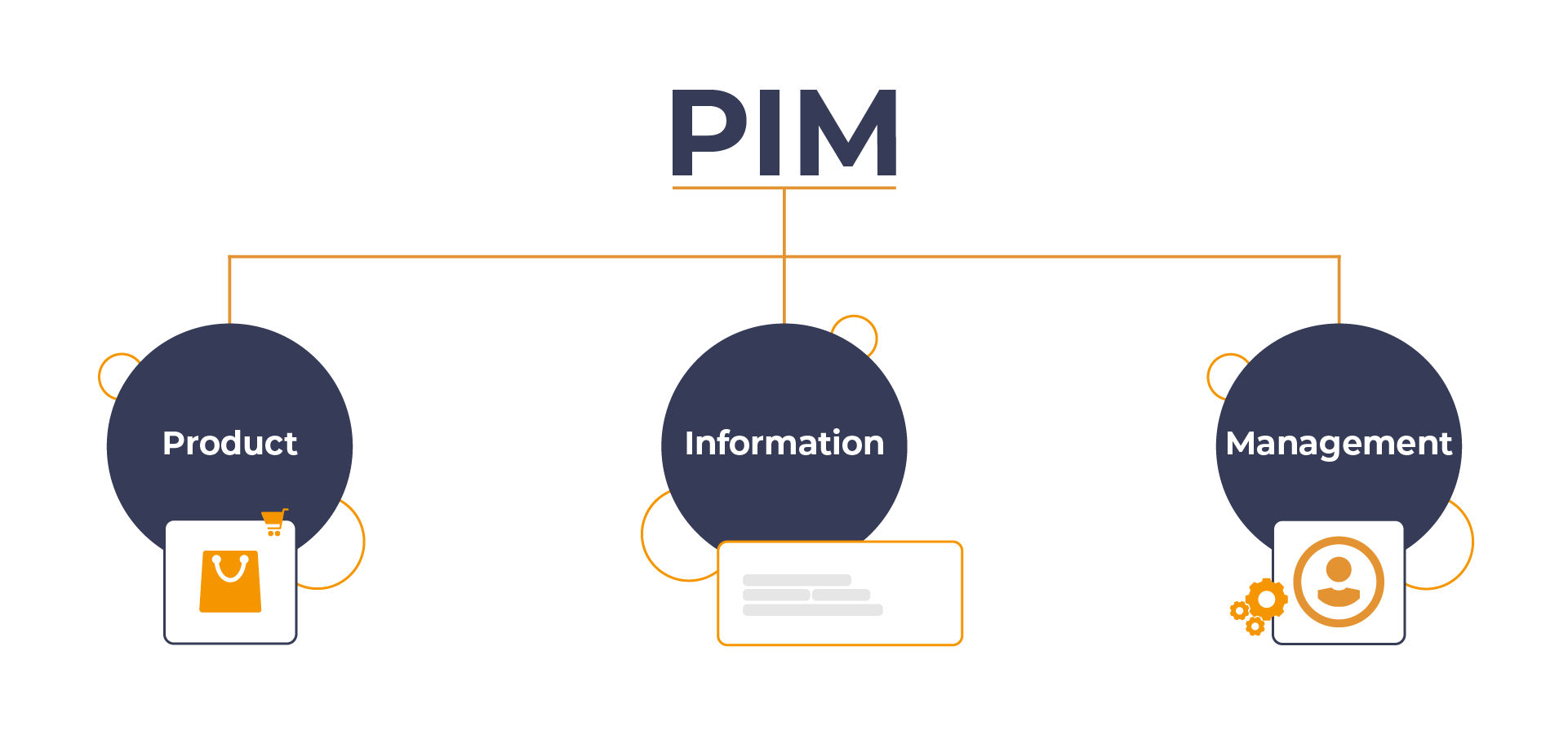
PIM diagram linking Product, Information and Management to centralize data and streamline processes.

Furthermore, many industry standards and data quality initiatives emphasize the importance of having reliable data and verifiable along the value chain: it’s an issue that touches catalogs, availability, traceability and, consequently, customer experience. 

What is PIM for in eCommerce: key problems

In 2025, the Italian B2C eCommerce market exceeded 62 billion euros, with growth around +6%. Globally, eCommerce retail sales are estimated at trillions of dollars in 2025, a sign that competition is increasingly played on efficiency and quality of operational execution

In a growth context, the main challenge for eCommerce teams is not therefore launching new products or publishing a catalog, but going online quickly with quality product information and content, consistent across all channels. 

When can a PIM really make a difference for eCommerce? When:

  • information comes from different sources (systems like PLM, ERP, Excel spreadsheets and internal teams) and is inconsistent or misaligned 
  • there are multiple channels to keep updated (not only the online shop, but also marketplaces, apps, portals, digital and printed catalogs), with the risk of unsynchronized information 
  • repetitive activities of publishing, monitoring and updating product pages become bottlenecks that slow down time-to-market. 

It’s not just a problem of internal company organization, but also of data suitability for channels. Marketplaces and platforms, in fact, often require specific and differentiated attributes and descriptions: therefore consistency is needed, but also customized information. 

The advantages of PIM for eCommerce

There are multiple benefits that a company can obtain when it decides to centralize data and workflows with a PIM software, but the most immediate ones are certainly three: data quality, time savings on operational activities, faster time-to-market.
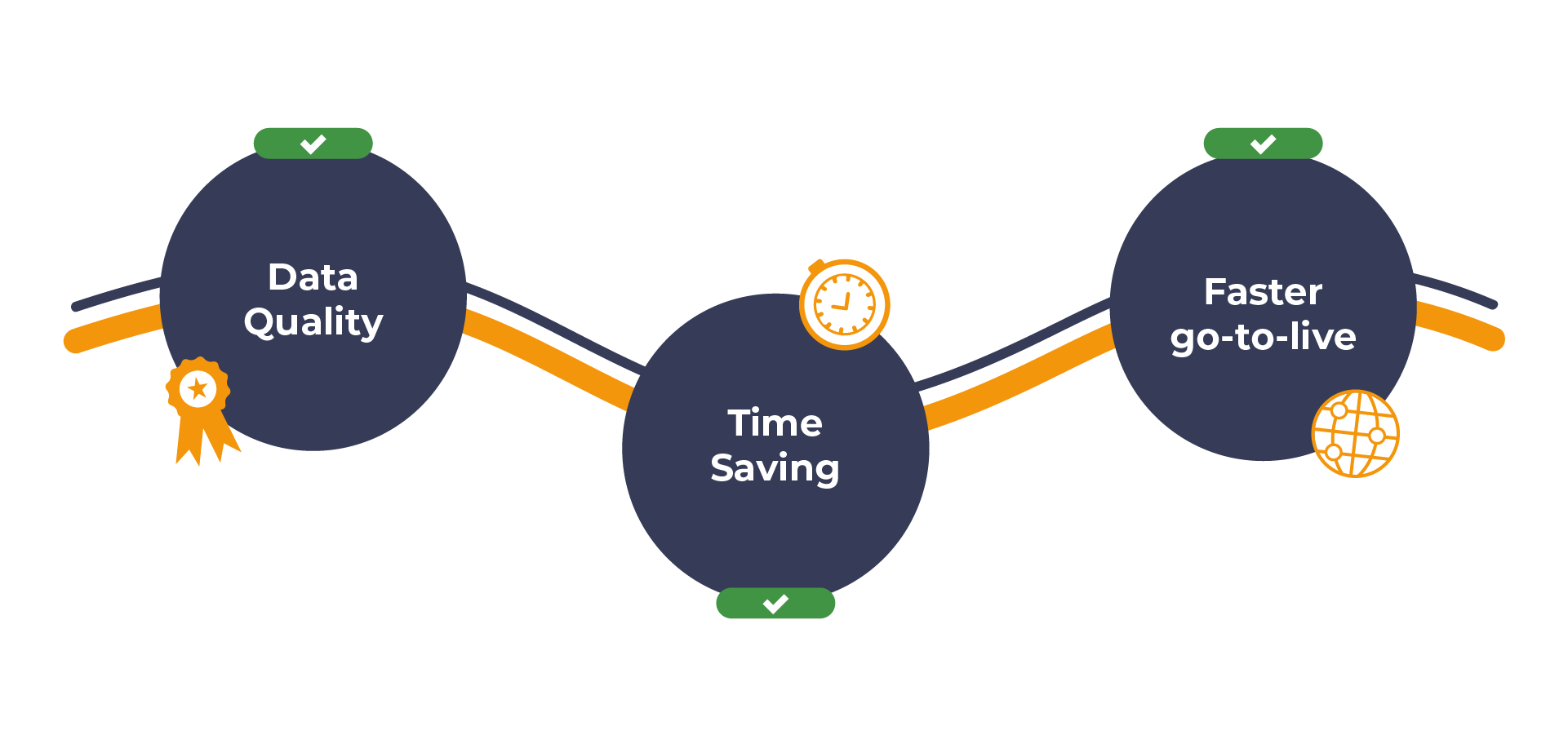
With PIM you improve data quality, save time and reduce go-to-live across global markets.

Data quality. A central system for unified management and publishing of attributes, variants and descriptions means fewer errors, inconsistencies between PDPs, PLPs, feeds and technical sheets, fewer manual fixes. For many brands, missing, inaccurate or incomplete information on sales channels has a double impact: they increase the risk of cart abandonment, but also that of returns and customer churn

Time savings and productivity. PIM speeds up data and content management for eCommerce, allowing the team to achieve completeness of product pages with minimal effort. Being able to easily monitor and verify that information and descriptions are complete and correct for each channel and market, in the right format, is essential. Centralizing (and automating) completeness means having the certainty that each product is ready to go online on all online shops, complete with images, videos and localized information, without wasting time on repetitive activities. 

The term completeness of a product page refers, in the context
of PIM software, to the richness, accuracy and consistency of information
and content provided for each product, essential to ensure a purchasing experience
that is both personalized and consistent across all sales channels.

Time-to-market. When ingest, approval and distribution are centralized in a single workflow, launches, new releases and updates to ongoing collections stop being a marathon of imports/exports and become governable processes. Fewer manual steps and fewer revisions, which translate into immediate golive. 

How to choose the best PIM for your eCommerce? Key features

To understand how to choose the best PIM software for your eCommerce, we suggest you shift the focus from choosing the tool to the workflows you want to make work. In this paragraph we guide you in evaluating key features and integrability in the main phases of the workflow that goes from ingest to publication. 
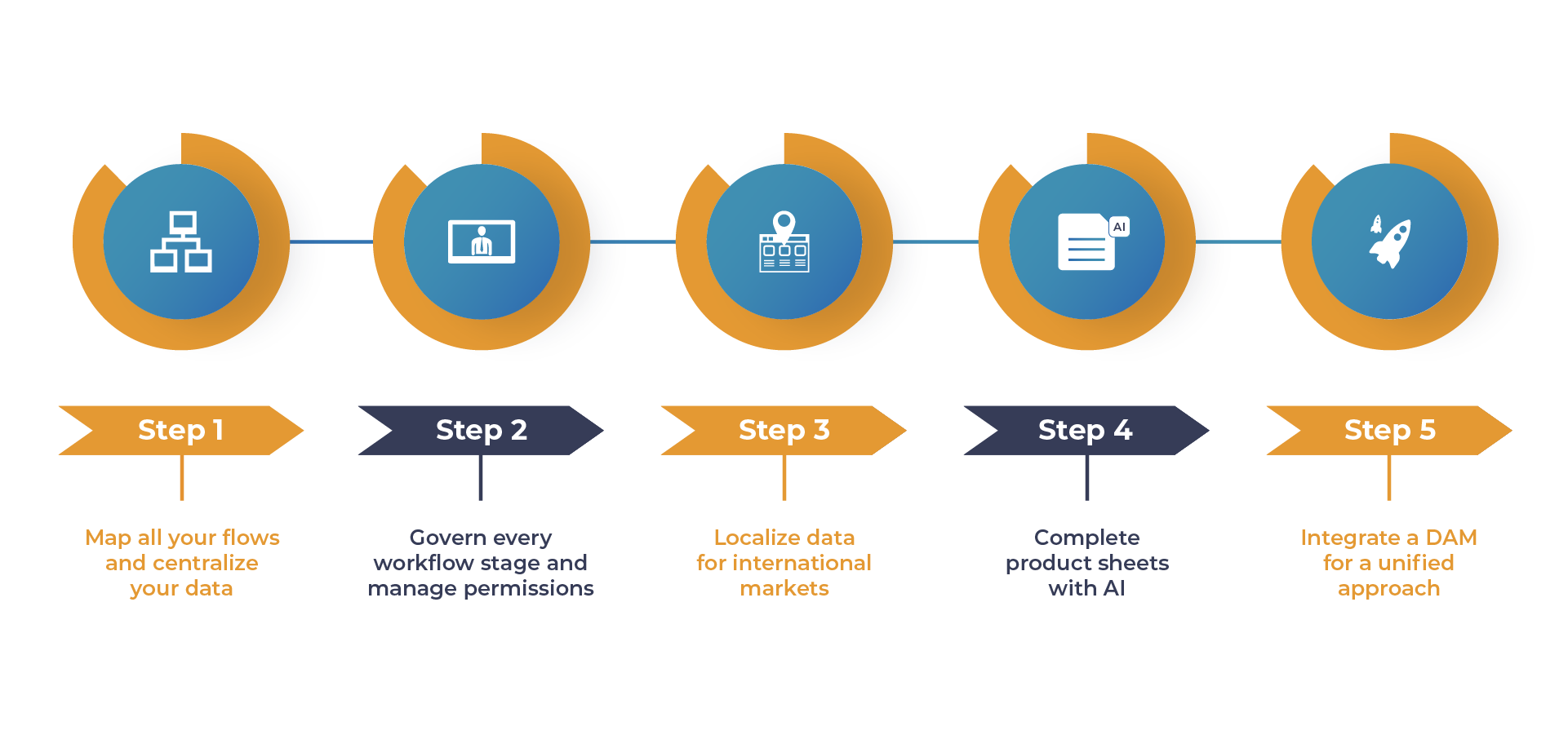
5-step PIM process: map flows, manage workflows, localize data, use AI and integrate DAM.

Step 1: map ingest and import/export from third-party systems and harmonize data

A PIM for eCommerce must integrate easily and automatically with data ingest systems (such as ERP, PLM, supplier databases, CMS and legacy tools), to avoid manual import and synchronization. But integration, alone, is not enough: the point is centralizing information and making it uniform, so that the entire company works on a solid and consistent data model. This means building (and maintaining) a clear attribute structure, with shared definitions and rules: if everyone speaks the same language, the catalog grows without delays or hitches. 

Step 2: govern workflow and permissions management

Every new launch is a team effort: to arrive at a complete product page, the eCommerce team must work in synergy with Marketing, Brand and Product. The right PIM must be able to govern every phase of the workflow (tasks, reviews, approvals) ensuring security and granular permissions. This is particularly important if you manage sensitive content (compliance, local regulations, claims) or if you operate in a multi-brand context and in different markets.

Step 3: localize information by market and across multiple channels

An eCommerce-oriented PIM should support localization by market, not just the translation of titles and descriptions into multiple languages, but also the adaptation, for each market, of information such as currencies, units of measurement, certifications and regulations. This aspect connects to a multichannel publishing logic, which includes syndication and automatic updates, essential features for ensuring that every change happens in real time on all online shops, from eCommerce to marketplaces, to digital catalogs. 

Step 4: automatic and tracked completeness of product pages

A truly useful PIM for eCommerce is one that helps the team understand if a product page is really ready to go online. To do this, the ability to accelerate the completion of information through automatic rules and generative AI for creating texts and content from structured data becomes essential. The decisive part is monitoring: dynamic and tracked completeness, for each channel and market, allows you to know in real time which products can be published and what information is missing, without manual checks. 

Step 5: integrate a DAM for eCommerce

Descriptions and technical data alone are not enough: product shots, video tutorials, manuals and other digital assets are not just a fundamental part of the product page, they are the representation of the product itself. For this reason, when choosing a PIM for the eCommerce team, it is essential to also evaluate the tool’s approach to digital asset management. Some PIMs integrate with DAM (Digital Asset Management) software, others, like THRON, are built with a unified approach to content and product data management, in a DAM+PIM logic that integrates automation and multichannel publishing.

This second approach significantly simplifies product page enrichment, enabling content versioning, consistent reuse of digital assets across multiple channels and eliminating duplication.

Frequently Asked Questions (FAQ)

What is PIM for eCommerce?
A PIM (Product Information Management) software is a system that centralizes, manages and distributes your catalog’s product data (attributes, variants, descriptions, technical specifications) to online shops and other digital channels, such as proprietary eCommerce sites, marketplaces, apps, but also sales portals and digital showcases.

How does a PIM help me manage my eCommerce?
A PIM designed for eCommerce eliminates the risk of errors and inconsistencies between systems and channels, improves the completeness of product pages and makes updating feeds and catalogs faster, especially with large volumes of SKUs, eliminating the need for manual checks and fixes.

What features should I evaluate to choose the best PIM for my eCommerce?
All those that simplify the management of product data and content for online shops and accelerate their publication: ingest from third-party systems, permissions and workflow management, localization of information and content by market and channel, automatic completeness and multichannel publishing. Finally, integration with DAM software or native DAM+PIM management can make a difference in managing your eCommerce.

Do I need a PIM if I already have an ERP?
The ERP is one of the sources from which data comes, which in this case can be information such as prices, stock, inventory or master data. The PIM centralizes and standardizes this and other information about your products, simplifies management and enrichment of product pages (sometimes also with related assets) and finally distributes them to eCommerce, marketplaces and other channels.

Can a PIM help me reduce returns and cart abandonment?
A PIM represents an ally for companies to increase sales and build customer loyalty. As the single source of truth for product attributes and data, the PIM for eCommerce improves quality, accuracy and consistency of information, ensuring rich, complete and consistent shopping experiences across all sales channels.

Would you like to receive content like this once a month?

Embark on a journey to NORTH together with over 4,500 human beings. With our newsletter you will receive data, trends and insights into the world of DAM, PIM and beyond every thirty days.

Join our newsletter