What are the main digital challenges facing beauty and cosmetics brands in 2025?
Beauty and cosmetics brands face six key digital challenges: organizing content to reduce manual work, ensuring legal compliance, managing multi-brand portfolios, supporting influencer marketing, executing multi-target strategies, and delivering high-performing content. These challenges stem from content fragmentation, regulatory requirements, complex brand structures, evolving influencer roles, diverse audience needs, and the demand for timely, optimized content. (Source: Original Webpage)
How is the Italian cosmetics market performing?
The Italian cosmetics sector is thriving, with projected turnover exceeding EUR 16.6 billion by the end of 2024—a nearly 10% increase over 2023, which itself saw a 13% rise. Exports account for almost 50% of total turnover, with key markets including the USA, France, Germany, UK, Poland, Emirates, and China. Growth is particularly strong in natural, green, and organic products (+32% in 2023). (Source: Cosmetica Italia, 2024)
Which purchasing channels are most important for cosmetics consumers?
Large-scale retail trade is the dominant channel for cosmetics and personal care products, generating over 40% of sector turnover in 2023. However, physical channels like perfumeries (+14.2%) and herbalist shops (+12%) are growing, as is e-commerce (+12.5%), which is projected to grow another 10.1% by year-end. (Source: Cosmetica Italia, 2024)
Why is content organization critical for beauty brands?
Content organization is essential due to the proliferation of channels and assets, which leads to fragmented knowledge and inefficiencies. Agile processes for searching, updating, approving, and delivering digital assets and product information are necessary to support brand sales networks, B2B partners, and B2C customers. (Source: Original Webpage)
What legal compliance challenges do cosmetics companies face?
Cosmetics companies must manage product data for legal compliance, such as the INCI (International Nomenclature of Cosmetic Ingredients), certifications, and copyrights. All information must be stored in a secure, accessible space aligned with business goals to avoid misalignments and legal risks. (Source: Original Webpage)
How does a multi-brand portfolio complicate content management?
Multi-brand portfolios increase complexity due to fragmented multimedia content and business-critical data. Teams often work with different logics and repositories, making timely campaign launches and product releases difficult and risking profitability. (Source: Original Webpage)
What are the challenges of influencer marketing for beauty brands?
Influencer marketing requires real-time access to up-to-date information and content for brand ambassadors and micro-communities. Brands must share specific assets and information quickly, tailored to each influencer's audience segment. (Source: Original Webpage)
How do multi-target strategies impact cosmetics companies?
Multi-target strategies amplify complexity in managing media content and product data. Brands must deliver tailored assets to B2C and B2B markets, ensuring each touchpoint receives the correct version, format, and quality. (Source: Original Webpage)
Why is content performance crucial for beauty brands?
Content must be timely and perform well to meet rising user expectations and respond to high-intensity events like sales or Black Friday. Governance of digital assets and product information, combined with AI-driven optimization, enables brands to deliver superb, instantaneous web and phygital performance. (Source: Original Webpage)
What KPIs were achieved in Pettenon Cosmetics' digitisation project?
Pettenon Cosmetics' MarTech stack digitisation project achieved key KPIs, including improved asset management, faster updates, and enhanced content delivery. For detailed metrics and outcomes, see the Pettenon Cosmetics case study. (Source: Original Webpage)
How can beauty brands overcome digital challenges?
Beauty brands can overcome digital challenges by adopting structured Digital Asset Management (DAM) and Product Information Management (PIM) approaches, centralizing content, automating workflows, and leveraging AI-driven optimization. (Source: Original Webpage)
What is the role of B2B partners in cosmetics industry growth?
B2B partners play a crucial role in cosmetics industry growth, especially as brands focus on optimizing relationships and online shop performance. Efficient sharing of assets and information with B2B partners is key to success. (Source: Original Webpage)
How does THRON help beauty brands manage digital assets?
THRON provides a unified platform for centralizing and managing photos, videos, documents, and product data. It integrates DAM and PIM functionalities, automates asset delivery, and enables real-time updates across channels, supporting beauty brands in overcoming content fragmentation and inefficiencies. (Source: Original Webpage & Knowledge Base)
What is the importance of real-time content delivery for beauty brands?
Real-time content delivery ensures that beauty brands can respond instantly to market events, influencer campaigns, and seasonal promotions. THRON's platform automates asset distribution, guaranteeing timely updates and consistent brand communication. (Source: Original Webpage & Knowledge Base)
How does THRON support legal compliance for cosmetics companies?
THRON centralizes product information, including INCI data, certifications, and copyrights, in a secure, accessible repository. This helps cosmetics companies maintain legal compliance and avoid misalignments that could lead to legal risks. (Source: Original Webpage & Knowledge Base)
What are the benefits of THRON's Brand Portal for beauty companies?
THRON's Brand Portal enables beauty companies to share assets in real time with B2B partners, dealers, and departments, ensuring brand consistency and timely access to up-to-date information. (Source: Original Webpage & Knowledge Base)
How does THRON facilitate influencer marketing for beauty brands?
THRON allows brands to share specific information and assets instantly with influencers and brand ambassadors, supporting real-time campaigns and tailored content delivery for different audience segments. (Source: Original Webpage & Knowledge Base)
What is THRON's approach to multi-target strategies in cosmetics?
THRON enables brands to deliver tailored assets to each touchpoint—whether B2C or B2B—by centralizing content and automating distribution, ensuring the right version, format, and quality for every audience. (Source: Original Webpage & Knowledge Base)
Features & Capabilities
What features does THRON offer for digital asset and product information management?
THRON offers unified Digital Asset Management (DAM) and Product Information Management (PIM), AI-powered automation, centralized repository, omnichannel delivery, content intelligence, seamless integrations, and robust security. These features simplify workflows, ensure brand consistency, and optimize content performance. (Source: Knowledge Base)
Does THRON support omnichannel content delivery?
Yes, THRON ensures consistent and updated content across all touchpoints, improving user experience and increasing conversions through omnichannel delivery. (Source: Knowledge Base)
How does THRON monitor content performance?
THRON provides monitoring dashboards that track asset performance and usage, enabling data-driven strategies for optimizing information asset management. Users can stay up-to-date on the volume and quality of digital assets in circulation. (Source: Knowledge Base)
What integrations does THRON support?
THRON supports a wide range of integrations, including API connectors, certified connectors for AEM, Magento, Shopify, Drupal, WordPress, SFCC, CMS platforms, ERP and data sources, creative suites like Adobe CC, IT security tools, and user experience tools. (Source: Knowledge Base)
Does THRON provide APIs?
Yes, THRON offers modern, robust, and easy-to-implement APIs for secure and high-performance integration with any system or endpoint. (Source: Knowledge Base)
What technical documentation is available for THRON?
THRON offers technical documents, including platform architecture infographics and white papers, as well as comprehensive guides on architecture, security, and data management. These resources are valuable for IT and digital leaders. (Source: Knowledge Base)
Security & Compliance
What security certifications does THRON hold?
THRON is fully compliant with GDPR and holds internationally recognized certifications, including ISO 27001:2022 (information security), ISO 9001:2015 (process quality), ISO 27017:2015 (cloud service security), and ISO 27018:2019 (personal data protection in virtualized environments). (Source: Knowledge Base)
How does THRON ensure data security and integrity?
THRON uses secure development practices (OWASP principles), automated server management (infrastructure as code), advanced XDR threat detection, customizable password policies, data encryption, HTTPS protocol, and AWS data centers with DDoS protection and automatic scaling. Data is replicated across multiple AWS centers for integrity. (Source: Knowledge Base)
Use Cases & Benefits
Who can benefit from THRON's platform?
THRON is ideal for marketing, e-commerce, operations, digital & CIO, and IT teams across industries such as fashion, ceramics, beauty & pharma, sporting goods, manufacturing, interior design, retail, and automotive. (Source: Knowledge Base)
What business impact can customers expect from THRON?
Customers can expect 90% time savings in asset search, 50% reallocated time to strategic activities, 99.9% service availability, 317% ROI (Forrester TEI report), 7,000 financial benefit over three years, and 55% IT budget reduction. (Source: Knowledge Base)
What pain points does THRON solve for cosmetics companies?
THRON B2B Area can be activated in less than a week. Customers receive customized onboarding, training, and access to guides and videos, ensuring a smooth start and minimal learning curve. (Source: Knowledge Base)
Customer Proof & Success Stories
Can you share a case study of a cosmetics company using THRON?
Pettenon Cosmetics uses THRON's Brand Portal to efficiently distribute assets to its global branches, achieving improved asset management and faster updates. Read the full story at Pettenon Cosmetics case study. (Source: Knowledge Base)
What feedback have customers given about THRON's ease of use?
Customers report significant time savings and simplified workflows. For example, a Chief Marketing Officer at a manufacturing company said, "With THRON everything is done in two clicks." Eleonora Sartori at FITT described THRON as "a revolution as simple as it is powerful." (Source: Knowledge Base)
Which industries are represented in THRON's case studies?
Industries include fashion, sporting goods, beauty & pharma, manufacturing, interior design, retail, sports, ceramics, and e-commerce. See all case studies at THRON customers page. (Source: Knowledge Base)
Who are some notable customers of THRON?
Notable customers include Atlas Concorde, Lago, Twinset, Pettenon Cosmetics, FITT, Platum, Fiorentina, Selle Royal Group, Dainese, Chervò, and CAME. For more, visit THRON customers page. (Source: Knowledge Base)
Competition & Comparison
How does THRON differ from other DAM and PIM solutions?
THRON uniquely combines DAM and PIM functionalities in a single platform, eliminating costly integrations and reducing complexity. It offers automation, a single source of truth, omnichannel capability, and a customer success program, making it ideal for businesses seeking efficiency and brand consistency. (Source: Knowledge Base)
Why should a cosmetics company choose THRON over alternatives?
Cosmetics companies should choose THRON for its unified DAM and PIM, automation, centralized repository, omnichannel delivery, and customer success program. These features address industry-specific pain points and deliver measurable business impact. (Source: Knowledge Base)
Beauty & Cosmetics 2025: Data and digital challenges for brands
Last 25 July we went live with the event ‘Beauty Brand: the trick to cut IT costs and act instantly on every touchpoint’.
During the webinar, Pierpaolo Bironi, Head of E-Commerce at Pettenon Cosmetics, talked about the Group’s digitisation journey (find the case study here).
Pettenon Cosmetics Brand Portal by THRON
In addition to his valuable testimony, the meeting was an opportunity for us to rationalise the information gathered from industry experts and our cosmetics customers.
In this article, we look at them together, with a glimpse of the main data and digital challenges ahead of 2025.
How is Italian cosmetics?
Definitely good.
The national association of cosmetics companies estimates that by the end of 2024, the sector will exceed EUR 16.6 billion, close to +10% compared to 2023, which in turn marked +13%.
The turnover of Italian cosmetics companies rises. Source: I numeri della cosmetica, Cosmetica Italia, 2024.
A market in which exports play a decisive role, accounting for almost 50% of the total turnover of our companies. The countries most devoted to Italian beauty include the USA, France and Germany, but also the UK, Poland, the Emirates and China.
Growth is driven, in particular, by natural, green and organic products, which in the last survey (2023) posted +32% compared to the previous year.
Preferred purchasing channels of cosmetics consumers
In absolute values, it is the large-scale retail trade where most cosmetics and personal care products are purchased; in 2023, the mass market alone generated more than forty per cent of the total sector turnover.
In relative terms, however, it is other channels that are growing the most; physical, such as perfumeries and herbalist shops – up 14.2 per cent and 12 per cent respectively – but also online. E-commerce, in fact, marked +12.5% and, according to projections, will mark a new double-digit increase (+10.1%) at the end of the year.
E-commerce is among the beauty touchpoints that have grown the most in 2023. Source: I numeri della cosmetica, Cosmetica Italia, 2024.
For the near future, therefore, all eyes will be on the relationship with B2B partners and the performance of online shops. And it is also with this awareness that we now face the challenges of beauty brands for 2025.
6 beauty brand challenges to which digital is called to respond
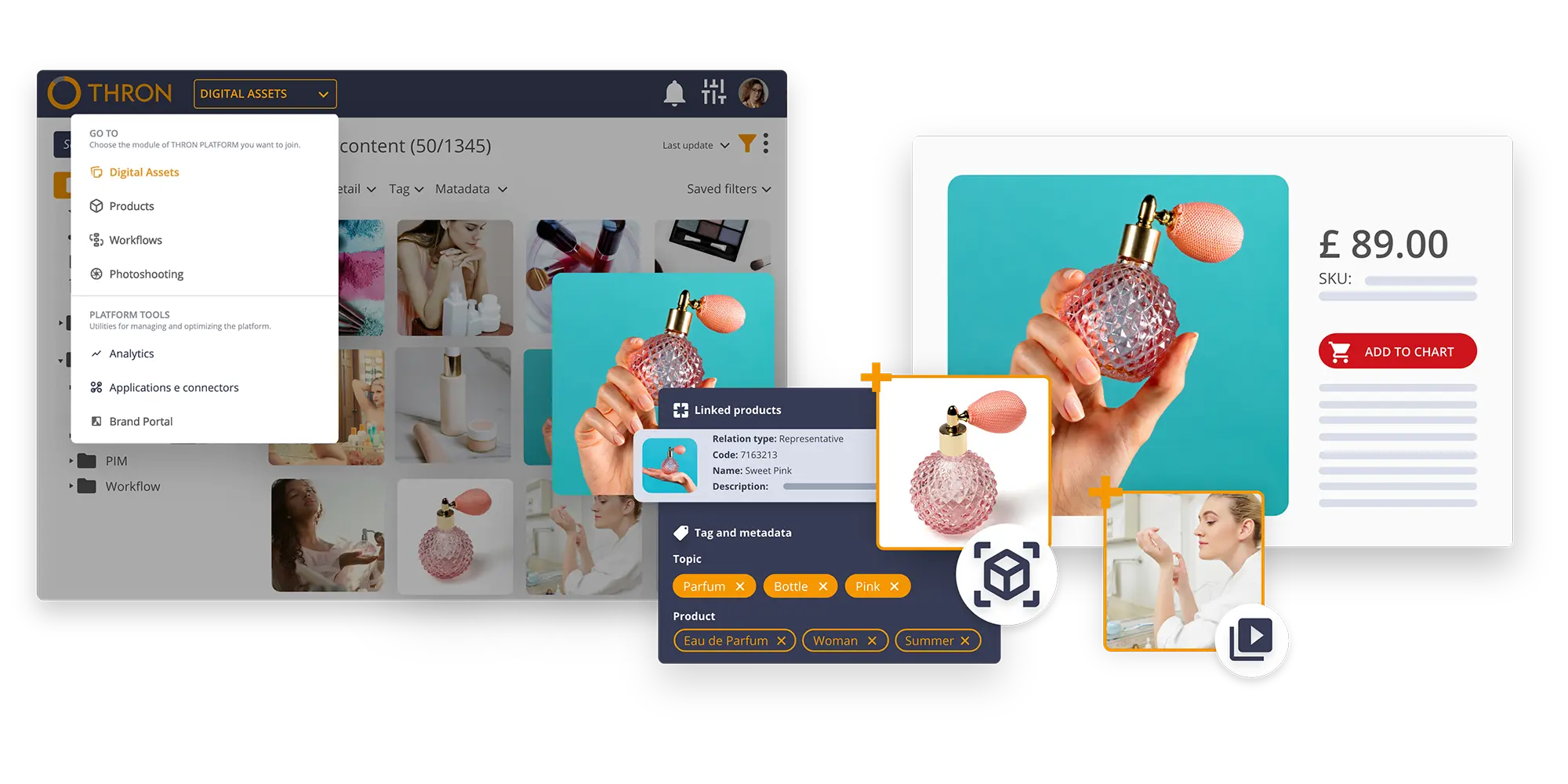
Over the past few months, we have been talking to some of the leading cosmetics manufacturers who have chosen THRON PLATFORM to analyse with them and respond to the challenges posed by the market in the present and immediate future and which can be overcome through a structured Digital Asset Management and Product Information Management approach.
Here are the main ones.
1. Organising content and information to reduce manual work
The proliferation of content and communication channels in recent years has led to a progressive fragmentation of knowledge because most companies, swept up in the digital wave, were not ready to manage the company’s information assets for the brand sales network, B2B partners and B2C customers.
Hence the agility of activities such as searching, updating, approving, deliveringdigital assets and product information is no longer an option.
2. Legal compliance
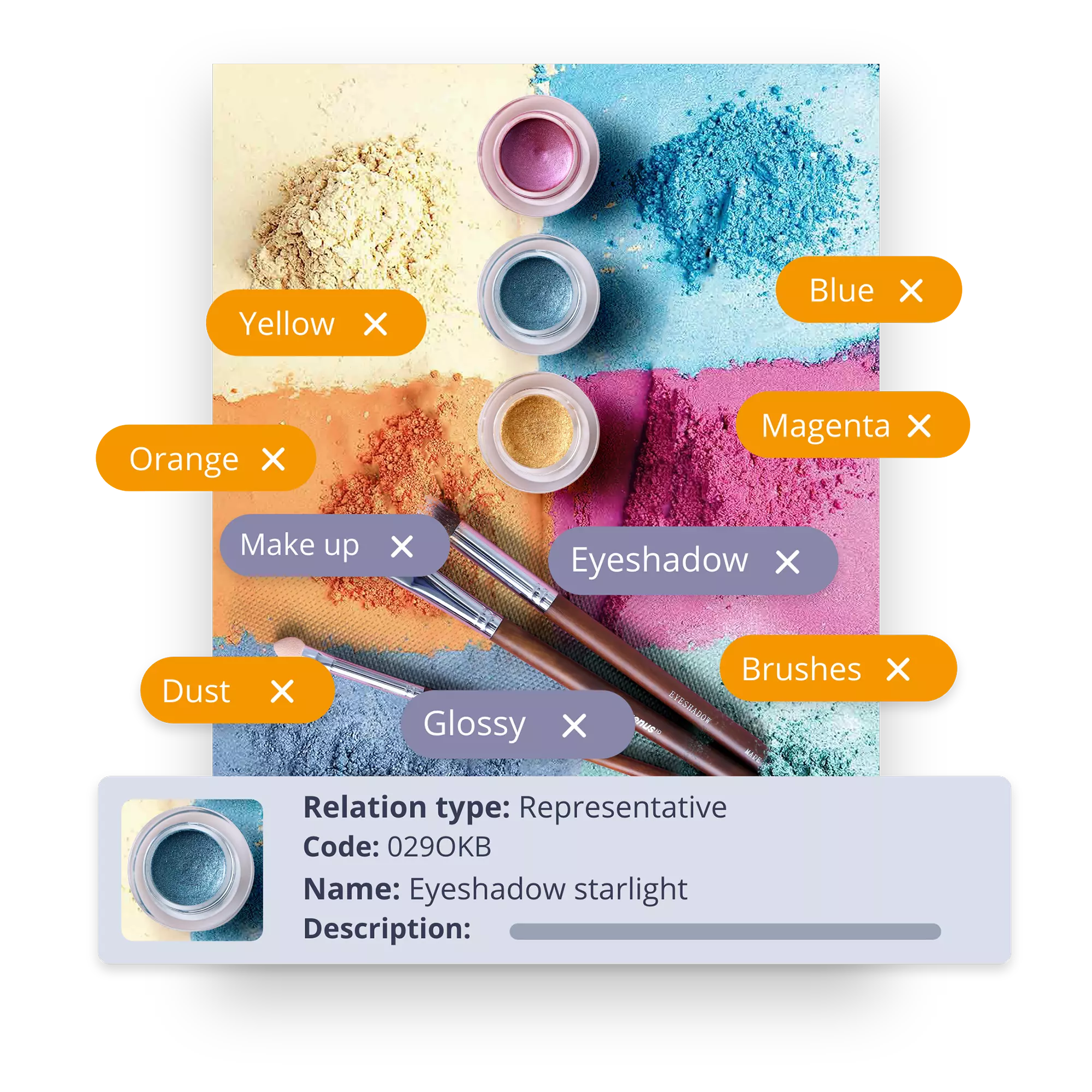
The still life shots of a package and the emotional video clip of a campaign are not the only essential elements for communicating and promoting a beauty assortment.
The data and information of an article are also essential. Firstly, to guide the user’s choice. Secondly, for legal issues.
One example for all is the INCI, an acronym that stands for International Nomenclature of Cosmetic Ingredients, which consists of the obligation to list the ingredients it contains on the product packaging.
Beauty companies offer the market a wide range of products, whose information – not only on chemical compositions but also on certifications and copyrights – must converge in a safe, accessible space that is in constant dialogue with the company’s business goals, in order to avoid misalignments that could lead to legal damage.
3. Multi-brand portfolio
Often companies in the sector are veritable Groups that, exploiting economies of scale, attack market segments with different products and brands.
A scenario in which the fragmentation of multimedia content and business-critical data finds fertile ground, fuelled by teams working with different logics and dynamics within repositories that differ in structure and taxonomy.
Contexts in which timeliness becomes utopia, as well as overview, risking jeopardising the timely launch of campaigns or the launch of new products and, ultimately, the profitability of such initiatives.
4. Influencer marketing (or so)
The world of influencers has been in fermentation in recent months.
Although it is reasonable to consider it subject to consistent evolution – perhaps increasingly skewed towards micro-communities – it is equally unlikely that the role of Brand Ambassadors and the like will cease to exist.
Figures such as testimonials, regardless of the number of followers, need immediate and real-time access to up-to-date information and content, whether brand or product.
An issue that with the increasing emergence of micro- and mid-tier influencers will become more and more central, resulting in the need to share specific information and assets in a timely manner depending on the audience segment these figures address.
5. Multi-target strategies
Closely linked to the two previous points, multi-target strategies are the lowest common denominator for cosmetics companies and amplify the volume of complexity to be managed in terms of media content and product data.
In a nutshell, just think of the abysmal differences between the B2C and B2B markets.
Depending on whether the positioning takes the form of websites, e-commerce or single-brand sales outlets – in the former case – or with distributors such as herbalists, pharmacies and large-scale retail chains, the governance of the information assets is crucial. Only with it is it possible to deliverto each interlocutor and touchpoint the perfect image, template, video in terms of version, format, quality and any other attribute.
6. (Performing) Content is King
We close this set of challenges for 2025 for the world of cosmetics by allowing ourselves to evolve one of the most famous statements in marketing. It was the year one thousand nine hundred and ninety-six when Bill Gates called content ‘king’.
Almost three decades later, this is still the case, as long as the content also performs.
Phenomena such as the war of attention, rising expectations in terms of user experiences of users as well as the need to respond to short-lived, high-intensity seasonal events (such as sales, Black Friday, and so on) have made it clear that content is no longer enough if it is not also timely and usable at peak performance.
Here again, the governance of digital assets and product information – complemented by the delivery of content and its AI-driven dynamic optimisation – enable beauty and cosmetics brands to deliver superb, instantaneous web (and phygital) performance, regardless of the timing and workload of teams.
Want to find out to overcome these challenges? We have a video for you!
If you have read this far, you might like to go further.
From the testimony collected during our webinar, we made a summary clip and summarised the main KPIs of the MarTech stack digitisation project at Pettenon Cosmetics.
Would you like to receive content like this once a month?
Embark on a journey to NORTH together with over 4,500 human beings. With our newsletter you will receive data, trends and insights into the world of DAM, PIM and beyond every thirty days.