What is a DAM workflow and why is it important for marketing?
A DAM (Digital Asset Management) workflow is a digital process that structures the creation, approval, and distribution of digital assets such as images, videos, and documents. In marketing, DAM workflows are essential because they combine control and flexibility, enabling teams to collaborate efficiently, minimize costs, and increase the ROI of content by streamlining asset management across their lifecycle. [Source]
How does THRON enable flexible DAM workflows?
THRON enables flexible DAM workflows by allowing users to design, configure, and manage workflows independently in a no-code environment. This flexibility ensures that workflows can be tailored to specific objectives, teams, or clients, supporting real-time collaboration and agile content approval processes. [Source]
What are the main types of workflow collaboration in marketing teams?
Marketing teams typically collaborate using four types of workflows: (1) No workflow (minimal collaboration, no approval process), (2) Unstructured collaborative tools (flexible but lacking control), (3) Rigid workflows (controlled but inflexible), and (4) Flexible workflows (full control and flexibility, ideal for marketing processes). [Source]
Why are flexible workflows critical for creative agencies?
Flexible workflows are critical for creative agencies because they allow team members to collaborate in an agile way, customize workflows for each client, and assign differentiated access rights. This ensures confidentiality and rapid adaptation to client needs without requiring IT intervention. [Source]
How do multi-brand companies benefit from DAM workflows?
Multi-brand companies benefit from DAM workflows by grouping activities by brand, enabling both internal and external collaborators to participate, and automating asset updates across all digital channels. This ensures brand consistency, faster time-to-market, and efficient management of complex marketing operations. [Source]
What are the consequences of using unstructured tools for content approval?
Using unstructured tools like email or chat for content approval leads to productivity losses, lack of control, difficulty tracking feedback, and increased risk of errors or delays. Structured DAM workflows address these issues by centralizing and formalizing the approval process. [Source]
How does THRON support no-code workflow configuration?
THRON supports no-code workflow configuration, allowing users to independently design and modify workflows without programming knowledge. This empowers marketing and creative teams to adapt processes quickly to changing needs. [Source]
What is the impact of DAM workflows on content ROI?
DAM workflows reduce the cost and time required to manage digital assets, directly increasing content ROI by improving productivity, reducing errors, and ensuring faster publication and distribution. [Source]
How does THRON integrate workflow management with digital asset management?
THRON integrates workflow management directly into its DAM platform, enabling users to manage asset creation, approval, and distribution from a single environment. This integration ensures seamless collaboration and real-time updates across all channels. [Source]
What industry recognition has THRON received for its workflow capabilities?
THRON was included in Forrester's “Now Tech: Marketing Resource Management 1Q 2022” report, which highlights leading global MRM solution providers, confirming THRON's versatility and workflow strengths. [Source]
How does THRON help manage priorities and deadlines in marketing workflows?
THRON's workflow features help manage priorities and deadlines by providing real-time status monitoring, structured approval processes, and automated notifications, reducing the risk of missed deadlines and ensuring efficient project management. [Source]
What are the benefits of integrating asset approval and distribution in one platform?
Integrating asset approval and distribution in one platform, as THRON does, ensures automatic updates across all channels, reduces manual errors, and accelerates time-to-market for new content, supporting brand consistency and operational efficiency. [Source]
How does THRON support collaboration across internal and external teams?
THRON supports collaboration by enabling differentiated access rights for internal teams and external partners (such as agencies or photographers), allowing secure and efficient participation in workflows while maintaining confidentiality and control. [Source]
What is the role of MRM (Marketing Resource Management) in DAM workflows?
MRM features in DAM workflows, as provided by THRON, enable comprehensive management of marketing resources, including asset creation, approval, and distribution, maximizing collaboration and ensuring all marketing activities are aligned and efficient. [Source]
How does THRON help prevent errors and inefficiencies in content management?
THRON helps prevent errors and inefficiencies by centralizing feedback, approvals, and asset updates within structured workflows, eliminating the noise and confusion caused by unstructured communication tools. [Source]
What are the key benefits of using THRON for digital asset lifecycle management?
Key benefits include streamlined collaboration, flexible workflow configuration, real-time asset updates, centralized management, and improved productivity throughout the entire digital asset lifecycle—from creation to distribution. [Source]
How does THRON ensure brand consistency across multiple channels?
THRON ensures brand consistency by automating asset updates and distribution across all digital channels, so that approved content is instantly reflected everywhere, reducing the risk of outdated or inconsistent materials. [Source]
What makes THRON's workflow solution different from basic DAM systems?
Unlike basic DAM systems, THRON incorporates advanced workflow and MRM features, enabling flexible, no-code workflow design, real-time collaboration, and integrated asset approval and distribution, all within a single platform. [Source]
Features & Capabilities
What features does THRON offer for digital asset and product information management?
THRON offers a unified platform combining Digital Asset Management (DAM) and Product Information Management (PIM), AI-powered automation, centralized repository, omnichannel delivery, content intelligence, seamless integrations, and robust security. [Source]
Does THRON support omnichannel content delivery?
Yes, THRON ensures consistent and updated content across all touchpoints, improving user experience and increasing conversions through omnichannel delivery. [Source]
How does THRON automate workflows and asset distribution?
THRON automates workflows, asset distribution, and content optimization using AI-powered tools, reducing manual work and ensuring assets are delivered efficiently across all channels. [Source]
What integrations does THRON provide?
THRON provides next-generation API connectors and certified connectors for platforms like AEM, Magento, Shopify, Drupal, WordPress, and SFCC. It also integrates with ERP, creative suites, IT security tools, and user experience tools. [Source]
Does THRON offer APIs for integration?
Yes, THRON offers modern, robust, and easy-to-implement APIs for secure, high-performance integration with any system or endpoint. [Source]
How does THRON monitor content performance?
THRON provides monitoring dashboards and content intelligence tools to track asset performance, usage, and quality, enabling data-driven optimization strategies. [Source]
What technical documentation is available for THRON?
THRON offers detailed technical documentation, including platform architecture, security, and data management white papers and infographics, accessible via their website. [Source]
Use Cases & Benefits
Who can benefit from using THRON?
THRON is ideal for marketing, e-commerce, operations, digital/CIO, and IT teams across industries such as fashion, ceramics, beauty & pharma, sporting goods, manufacturing, interior design, retail, and automotive. [Source]
What problems does THRON solve for marketing teams?
THRON addresses excessive manual work, inconsistent brand communication, and time-consuming content management by centralizing assets, automating workflows, and ensuring brand consistency. [Source]
How does THRON help e-commerce teams?
THRON centralizes product data and assets, accelerates time-to-market, and ensures consistent information across channels, improving user experience and conversion rates for e-commerce teams. [Source]
What business impact can customers expect from THRON?
Customers can expect up to 90% time savings in asset search, 50% time reallocation to strategic tasks, 99.9% service availability, a 317% ROI (Forrester TEI study), and IT budget reductions of up to 55%. [Source]
Can you share specific customer success stories using THRON?
Yes, notable customers include Fiorentina (sports), Selle Royal Group (manufacturing), Chervò (fashion), CAME (manufacturing), LAGO (interior design), Platum (e-commerce), Whirlpool (appliances), Dainese (sporting goods), Pettenon Cosmetics (beauty & pharma), and Atlas Concorde (ceramics). Each has improved asset management, collaboration, and time-to-market. [Source]
What feedback have customers given about THRON's ease of use?
Customers praise THRON for simplifying asset search and retrieval, automating channel updates, and enabling intuitive no-code workflows. Testimonials highlight significant time savings and improved collaboration. [Source]
How quickly can THRON be implemented?
THRON's B2B Area can be activated in less than a week. Customers receive dedicated onboarding, training, and resources to ensure a smooth and efficient start. [Source]
What industries are represented in THRON's case studies?
Industries include fashion, sporting goods, beauty & pharma, manufacturing, interior design, retail, sports, ceramics, and e-commerce. [Source]
Competition & Comparison
How does THRON differ from other DAM and PIM solutions?
THRON uniquely combines DAM and PIM functionalities in a single platform, eliminating the need for costly integrations. It offers automation, a single source of truth, omnichannel capability, and a dedicated Customer Success Program, differentiating it from competitors. [Source]
Why choose THRON over alternative solutions?
THRON offers unified DAM and PIM, automation, centralized governance, omnichannel delivery, and a Customer Success Program, making it a comprehensive solution for businesses seeking efficiency, brand consistency, and innovation. [Source]
Technical Requirements & Security
What security certifications does THRON have?
THRON holds ISO 27001:2022, ISO 9001:2015, ISO 27017:2015, and ISO 27018:2019 certifications, and is fully GDPR compliant, ensuring robust information security and data protection. [Source]
How does THRON ensure data security and compliance?
THRON follows OWASP principles, uses infrastructure as code, advanced XDR threat detection, customizable password policies, data encryption, HTTPS, and AWS data center replication to ensure security and compliance throughout the asset lifecycle. [Source]
What infrastructure does THRON use for hosting and security?
THRON leverages Amazon Web Services (AWS) for secure data centers, DDoS protection, automatic scaling, and data replication across multiple centers for integrity and disaster recovery. [Source]
Support & Implementation
What support services does THRON provide?
THRON offers technical assistance, a Customer Success Program with dedicated onboarding and training, self-service resources, and monthly release notes to keep customers informed and supported. [Source]
How does THRON help new customers get started?
New customers are supported by a dedicated Customer Success Manager, receive customized onboarding and training, and have access to guides and videos to ensure a smooth start and rapid adoption. [Source]
Why DAM workflows are central to the future of marketing
More web traffic means more and higher value assets to be created, organised and distributed, strictly in collaborative mode.
This is why workflows are an essential part of a digital asset management system, able to combine control and flexibility, and why their importance is destined to grow even more.
For both creative agencies and production companies.
Digitale communication: a boom that goes on and on
As we write this article, every second (e-v-e-r-y s-e-c-o-n-d!) 95,000 videos are viewed on YouTube, 1,150 images on Instagram and 101,070 web and e-commerce site searches are performed on Google1.
Standing out in the midst of all this traffic is complex.
The average attention threshold is no more than 8 seconds2.
And to position themselves in consumers’ minds, brands in every sector play a constant game of capture the flag fuelled by the production of new assets that have to be created, published and organised in the right way.
In this blog, we have already talked a lot about the amazing growth in the number of contents in circulation on digital channels in recent times. And about the consequences of this for the DAM Platform market.
1 Internetlivestats.com 2Distratti cronici, la nostra soglia di attenzione dura 8 secondi, 11 novembre 2020, La Repubblica.
Collaboration as the keystone of digital asset management
Nowadays, many agencies and companies are using centralised digital asset storage solutions.
However, the importance of the activities involved in the creation and approval of these contents is often underestimated.
People tend to overlook falls in productivity caused by an unstructured exchange of feedbacks (via chat or email, for example). No consideration is given to the resources needed to manage different versions of the same file. Nor the time spent approving a content.
However, minimising the costs of the editorial management of contents is crucial, because guaranteeing the agility of digital assets’ lifecycle increases contents’ ROI.
Basically, if an asset costs me less to manage its overall performances will be better.
For this to be the case, the following are required:
there must be digital processes, that is workflows
workflows must be flexible and those involved must be able to manage them independently
workflows must be integrated in the digital asset management (DAM) solution.
After defining what a workflow is and providing an overview of possible marketing process management scenarios, we will examine two case studies to illustrate why flexible workflows integrated in digital asset management are crucial for the future of marketing.
The digital DAM workflows
But what is a workflow? A workflow is literally a process, a digital flow of work.
In content marketing, workflows are the flows of activities that lead, through collaboration between different teams, to the creation and approval of digital assets such as images, videos, audios or documents.
Marketing process management
Whether or not they are aware of it, almost all marketers take part in approval processes.
But with some differences.
In this chart we schematically classify the different modes of collaboration within marketing teams, on the basis of two fundamental concepts: control and flexibility.
No workflow. Without control and flexibility, the level of collaboration is minimal and there are no approval processes as such and certainly no workflows.
Unstructured collaborative tools. This is the situation of marketers who, although they take part in approval processes, do not collaborate with each other by means of workflows integrated in the overall management of contents. Feedbacks are exchanged by means of tools such as email and company chats, flexibly but without any formal structure. Contents are managed and approved quickly but separately from the DAM system. These tools provide flexibility but imply a total lack of control of the approval flow.
Rigid workflows. This category includes marketers who, although they have workflow tools, work in accordance with flows predefined at a high level, with a complex configuration which individual users cannot manage independently. These tools’ main limitation is this lack of flexibility for users. Although they are able to keep workflows under control, they can only participate in them passively and not shape them to their needs.
Flexible workflows. The category comprises the ideal scenario for marketing processes: full control and total flexibility. Collaborating by means of flexible workflows allows users to structure activities in accordance with their objectives while still monitoring their current status in real time. In fact, these solutions are defined in this way because every workflow can be configured independently, in no code mode, with no need for familiarity with programming languages.
The win-win solution for marketing collaboration also embraces DAM Platforms, which include workflow functions that fit into this last scenario, guaranteeing flexibility and control through assets’ entire lifecycle.
And this is where the future of marketing lies. In both agencies and production companies.
Two case studies for flexible DAM workflows application: agency and company
Let’s take a close look at flexible workflows through two practical case studies.
Use case #1: why a creative agency needs flexible workflows
Envisage a creative agency that produces images, videos, audios and documents for dozens and dozens of clients.
On receipt of a brief, its creators get to work to produce digital assets, which must be approved by various roles within the client brand organisations.
An approach without workflows complicates the collection of feedbacks, which happens in an unstructured way, making accurate analysis of the progress of activities.
With a rigid workflow, on the other hand, although the activities to be performed are structured and tracked, it is difficult to customise the digital workflow for every single client.
For example, to add a different approval step or change a rule for establishing whether or not an asset can be considered approved, the marketers have to call in colleagues from the IT area or external consultants who know how to code.
For a creative agency, a flexible workflow is important for at least three reasons:
it enables every member of the team to collaborate in an agile way
it enables every single workflow to be customised, to every specific client’s needs very rapidly
it allows each client to be assigned differentiated rights of access to the relevant workflows and contents, guaranteeing complete confidentiality.
Use case #2: why a multi-brand company needs flexible workflows
Now let’s envisage a multi-brand production company that communicates via various digital channels: web and e-commerce sites, digital catalogue, social media, and so on.
In this organisation, digital assets are being produced all the time and effective management of workflows is advisable, first and foremost to group together activities that share a common objective. For example, the group’s marketing activities may be organised by brand, with dedicated workflows (such as for new product launches) for each of them.
This scenario requires structured but flexible digital workflows that enable both in-house teams and external players like photographers or agencies, who need to have access and viewing rights on differentiated workflows, to collaborate and to design new workflows in a completely independent way.
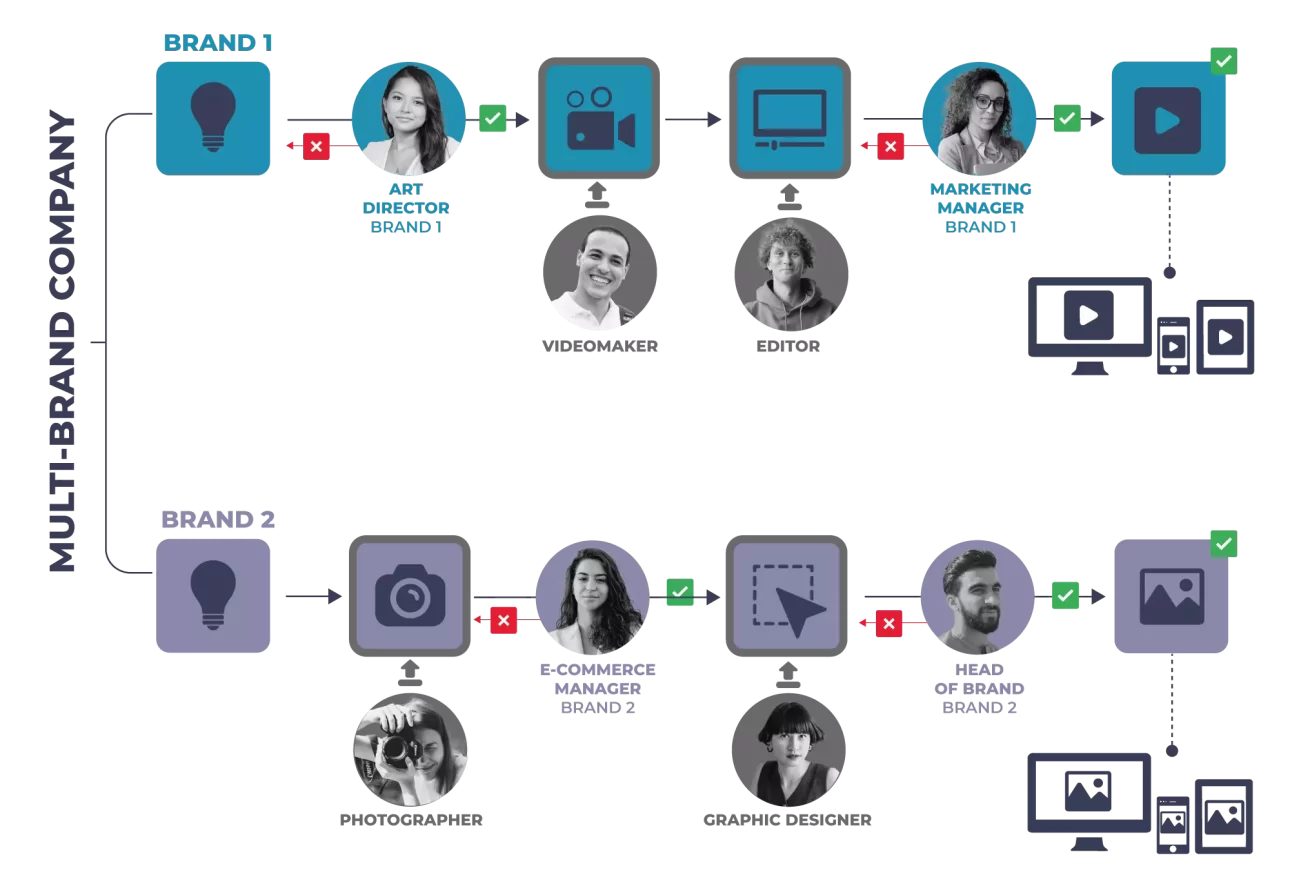
Here again, flexible management of workflows must be enabled by the DAM Platform.
In fact, if the solution where assets are stored is the same as the one where they are approved and distributed on the final channels, the company will benefit from automatic updating not only of its hub but also of its touchpoints.
In practical terms, for a workflow that has the creation of a visual for a new product photograph as its objective, it can be established that after approval by one or more designated people, not only will the asset be published in the DAM, but it will also – automatically – replace the old image already published on channels such as the web and e-commerce sites and digital catalogues.
This means that DAM platforms that offer flexible workflow functions are the future of marketing, because they increase productivity and reduce time to market.
DAM workflows: a successful and essential combination for digital assets
So it is essential to move beyond a basic DAM system and choose a DAM software that also incorporate MRM features, for all-embracing management of marketing resources.
This is what THRON does: as well as managing all digital assets, it is strongly collaboration-oriented. Therefore, via the Workflow, expansion, it enables the construction of coherent, flexible no-code workflows.
An accolade that is very important to us, because it confirms the versatility of THRON and its expansions. As well as providing the management of digital assets – like any DAM package – THRON enables workflow management to maximise the collaboration between colleagues, the key objective of MRM tools.
This is one of the reasons why Forrester has included THRON in its “Now Tech: Marketing Resource Management 1Q 2022” report, an overview that recommends 28 MRM solution providers at the global level.
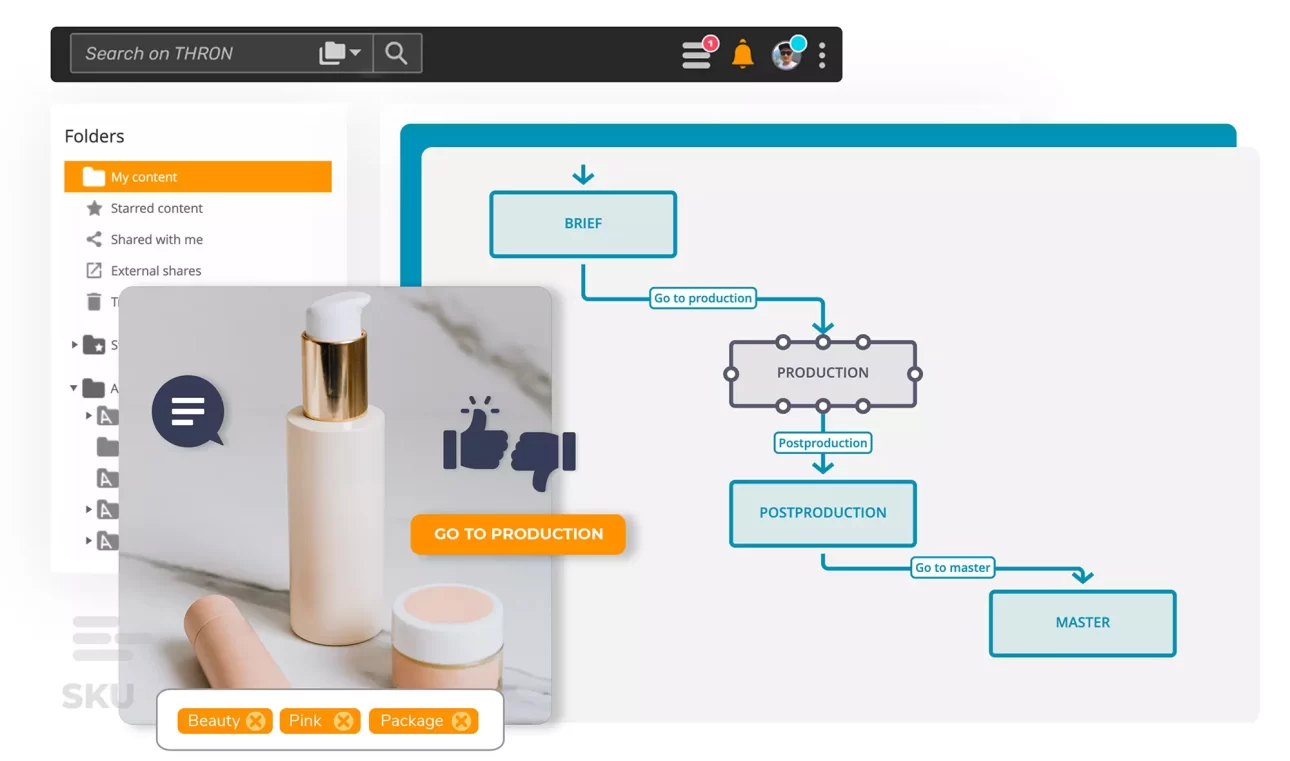
These features are essential for managing priorities without forgetting deadlines, preventing the noise generated by the lack of control, and avoiding the use of unstructured tools for sharing and requesting feedback.
In other words, user companies enjoy the benefits of collaboration extended to digital assets’ entire lifecycle: from creation to distribution on the final channels, by way of their approval and organisation.
Would you like to receive content like this once a month?
Embark on a journey to NORTH together with over 4,500 human beings. With our newsletter you will receive data, trends and insights into the world of DAM, PIM and beyond every thirty days.