Language


Every company is sitting on a goldmine. Assets that already exist: years of images, videos, product sheets, documents, and product data. All paid for, all produced, but completely invisible. The result? Nobody can find them, so everything gets recreated from scratch.
In an era where artificial intelligence promises to do the work for you, only one thing matters: your assets need to be ready to respond, to you, to your customers, and to an intelligent agent.
Today, in most organizations, those assets are not ready. The right time to get them in order is now, before bringing in AI that would only amplify the problem.
The campaign launches tomorrow. You shot the video six months ago and already spent the budget. Now you need it, but nobody knows where it is. So you remake it from scratch: you pay for the same thing twice, and nobody ever puts it on the books.
This isn’t an isolated incident. It happens every day when your assets aren’t a usable resource but a warehouse in the dark: you search, you ask around, you find nothing, and you start over. According to Gartner, 63% of companies don’t have their information assets under control. This isn’t a statistic about IT; it’s a snapshot of how every team works, on every project.
You need to plan a new campaign. It would help to know which creatives performed well, which formats converted, which messages resonated. But there’s no historical record.
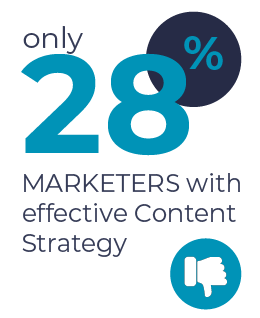
The Content Marketing Institute finds that only 28% of marketers consider their content strategy effective.
But when the historical record is accessible, every new project starts already halfway there.
Forrester estimates that 70% of the content produced by marketing never gets used by the sales team: outdated price lists, obsolete presentations, messaging the website stopped using long ago.
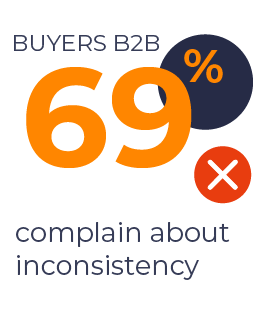
According to Gartner, 69% of B2B buyers report inconsistencies between the information on a company’s website and what they hear from the sales rep. At the same time, 39% of B2B marketers cite the absence of solid alignment between marketing and sales systems, according to the Content Marketing Institute.
Every marketplace has its own specifications. Keeping everything up to date and consistent, starting from a fragmented asset base, turns into a manual update job for every single channel.
Without a shared structure that makes content available in the right version, growth produces duplicates instead of order. With one in place, every new channel becomes a natural extension of what already exists.
AI systems deliver results in proportion to the quality of the information they operate on. If the data is fragmented and contradictory, AI doesn’t fix the mess; it puts the mess into production.
According to McKinsey, 8 out of 10 companies identify fragmented data as the main barrier to agentic AI. This isn’t a technology problem; it’s a problem of order.
According to Gartner, by 2026 60% of AI projects will be abandoned due to a lack of AI-ready data. But companies that invest in strong information foundations achieve up to 65% better business outcomes.
Everything is already there: images, videos, data, product sheets, documents. The question isn’t whether they exist, but whether your organization knows where they are, whether they’re usable, and whether they’re ready to be distributed or processed by a team, a partner, or an AI.
The answer isn’t to produce more; it’s to unlock the value of what already exists. With a platform like THRON, your entire information asset base gets collected, organized, and transformed into an archive that thinks.
If you’re reading this, these scenarios apply to you.
Talk it over with one of our experts in a 30-minute demo, no commitment required.
See how other companies have taken back
control of their assets.
Starting from the same place you are: everything was already there. They just needed to know it.

Does this problem affect mid-sized organizations too?
Informational disorganization doesn’t depend on size; it depends on growth. Every time a new team, tool, or channel is added, complexity increases. Growing organizations feel it sooner and more acutely, regardless of headcount.
How can THRON help me?
THRON brings together in a single environment the content and product data you already have, making it findable, distributable, and ready to use across any channel. It doesn’t replace the work people do: it eliminates the time wasted searching, recreating, and realigning, freeing up resources for what actually matters.
Is it worth addressing now, while we’re already investing in AI?
Now is exactly the right time. A fragmented information asset base isn’t just an operational problem: it becomes a bottleneck for any intelligent system that relies on it. THRON is designed to make an organization’s information assets findable, consistent, and ready to use, so that every subsequent technology investment starts on solid ground.