Frequently Asked Questions

Product Information & Digital Asset Management (DAM) Basics

What is Digital Asset Management (DAM)?

Digital Asset Management (DAM) is a software platform that helps organizations create, organize, and distribute digital content—such as images, videos, audio, and documents—across all channels. It centralizes all multimedia content, acting as a library of digital assets enriched with metadata for productivity and communication purposes. [Source]

What types of digital assets can a DAM manage?

A DAM can manage any type of digital file format, including images, videos, audio files, and documents. These assets are enriched with metadata, making them easily searchable and shareable within the organization. [Source]

How does DAM differ from MAM (Media Asset Management)?

While DAM manages all types of digital assets, MAM (Media Asset Management) is focused specifically on audio and video content. DAM provides broader functionality for managing a wide range of digital files. [Source]

What are the core features of DAM software?

Core features of DAM software include importing, organizing, tagging (metadata), searching, versioning, collaborating, protecting (access control), sharing, and delivering digital assets across channels. [Source]

How does DAM software help with asset versioning?

DAM software keeps track of all updates to an asset, ensuring that the most up-to-date version is always available while maintaining access to previous versions when needed. [Source]

What are the main benefits of using SaaS DAM software?

SaaS DAM software offers cloud-based benefits such as zero maintenance costs, maximum performance, centralized content management, and real-time updates across all organizational touchpoints. [Source]

How does DAM software improve collaboration?

DAM software centralizes digital assets, automates workflows, and enables structured collaboration among teams, reducing reliance on unstructured tools like email and chat. [Source]

How does DAM software help with brand consistency?

By centralizing all assets and ensuring real-time updates across all channels, DAM software helps organizations maintain consistent brand communication and user experience. [Source]

What are common signs that an organization needs DAM software?

Common signs include content scattered across network folders, difficulty finding assets, challenges sharing large files, reliance on email for collaboration, and the need to optimize content for multiple channels. [Source]

Which teams benefit most from DAM software?

Marketing, E-commerce, Operations, Digital & CIO, and Information Technology teams all benefit from DAM software by improving collaboration, efficiency, and security. [Source]

Features & Capabilities

What features does THRON offer beyond standard DAM capabilities?

THRON offers a unified platform that combines Digital Asset Management (DAM) and Product Information Management (PIM), AI-powered automation, omnichannel delivery, content intelligence, and robust security features. [Source]

Does THRON support asset delivery and real-time updates?

Yes, THRON automates asset delivery across channels and ensures that touchpoints are updated in real time whenever an asset is modified, supporting consistent brand communication. [Source]

How does THRON help reduce manual work?

THRON digitizes operational activities related to the content lifecycle, automates workflows, and updates communication channels automatically, saving significant time and reducing manual intervention. [Source]

What is the advantage of combining DAM and PIM in one platform?

Combining DAM and PIM in one platform simplifies the technology stack, breaks down silos between teams, eliminates integration costs, and enables unified management of assets and product data. [Source]

How does THRON enable omnichannel experiences?

THRON ensures that content is optimized and updated across all touchpoints in real time, providing a consistent and seamless experience for partners, B2B, and B2C customers. [Source]

What is content intelligence in THRON?

Content intelligence in THRON refers to the collection and analysis of performance data on digital assets, enabling data-driven strategies for optimizing information asset management. [Source]

How does THRON support asset protection and access control?

THRON allows organizations to establish access and permission rules for content, ensuring that only authorized users and groups can view or modify specific assets. [Source]

Can THRON automate asset optimization for different channels?

Yes, THRON can automatically optimize assets so that content is adapted to the requirements of each channel, reducing manual work and ensuring consistency. [Source]

What monitoring capabilities does THRON provide?

THRON provides monitoring dashboards that allow users to track the volume and quality of digital asset usage, enabling continuous optimization of content strategies. [Source]

Integrations & Technical Requirements

What integrations does THRON support?

THRON supports integrations with CMS platforms (WordPress, Drupal, AEM, Magento, Shopify, SFCC), ERP and data sources, creative suites like Adobe CC, IT security tools, user experience tools, and any other system via modern APIs. [Source]

Does THRON provide APIs for integration?

Yes, THRON provides modern, robust, and easy-to-implement APIs that allow integration with any system or endpoint, ensuring secure and high-performance workflows. [Source]

What technical documentation is available for THRON?

THRON offers detailed technical documentation, including platform architecture, security, and data management white papers and infographics. These resources are essential for IT and digital leaders. [Platform Architecture] [Security & Data Management]

How easy is it to implement THRON and get started?

THRON B2B Area can be activated in less than a week. Customers receive support from a dedicated Customer Success Manager, customized onboarding, training, and access to guides and videos for a smooth start. [Source]

What certified connectors does THRON offer?

THRON offers certified connectors for AEM (Valtech), Magento (Glam), Shopify (Cooder), Drupal (Hinto), WordPress (Palazzina Creativa), and SFCC (Skylabs), ensuring seamless integration with popular platforms. [Source]

Can THRON integrate with ERP and data sources?

Yes, THRON can integrate with ERP systems and other data sources to centralize product information and streamline workflows. [Source]

Security, Compliance & Governance

What security certifications does THRON have?

THRON holds internationally recognized certifications, including ISO 27001:2022 (information security), ISO 9001:2015 (process quality), ISO 27017:2015 (cloud service security), and ISO 27018:2019 (personal data protection in virtualized environments). THRON is also fully GDPR compliant. [Source]

How does THRON ensure data security and privacy?

THRON follows OWASP principles for secure development, uses infrastructure as code for server management, employs advanced XDR systems for threat detection, and leverages AWS data centers with DDoS protection and data replication for integrity. [Source]

Is THRON compliant with GDPR?

Yes, THRON is fully compliant with the General Data Protection Regulation (GDPR), ensuring data protection and privacy for all users. [Source]

How does THRON manage access and permissions?

THRON allows organizations to set customizable password policies, data encryption, and HTTPS protocols for secure distribution, with access and permissions managed at the user and group level. [Source]

What infrastructure does THRON use for hosting and security?

THRON partners with Amazon Web Services (AWS) for secure data centers, DDoS protection, automatic scaling, and data replication across multiple centers to ensure integrity and availability. [Source]

Use Cases, Industries & Customer Success

Which industries benefit from THRON's DAM and PIM solutions?

Industries benefiting from THRON include Fashion, Sporting Goods, Beauty & Pharma, Manufacturing, Interior Design, Retail, Sports, Ceramics, and E-commerce. [Source]

What are some real-world examples of companies using THRON?

Notable customers include Atlas Concorde (Ceramics), Lago (Interior Design), Twinset (Fashion), Pettenon Cosmetics (Beauty & Pharma), FITT (Manufacturing), Platum (E-commerce), Fiorentina (Sports), Selle Royal Group (Cycling), Dainese (Sporting Goods), Chervò (Golf Apparel), and CAME (Manufacturing). [Source]

Can you share specific customer success stories with THRON?

Yes, for example, Selle Royal Group achieved brand consistency across 80 markets and minimized time-to-market, while Whirlpool reduced e-commerce update time by 99% using THRON AI. More stories are available on the customers page.

What feedback have customers given about THRON's ease of use?

Customers highlight THRON's user-friendly design, automation capabilities, and efficiency. For example, a CMO at a manufacturing company noted that asset search and retrieval is now done in two clicks, and a digital product manager in fashion no longer worries about manual channel updates. [Source]

What business impact can customers expect from using THRON?

Customers can expect 90% time savings in asset search, 50% of time reallocated to strategic activities, 99.9% service availability, and a 317% ROI with a payback period of less than 6 months (Forrester TEI study). [Source]

What pain points does THRON address for its customers?

THRON addresses pain points such as excessive manual work, inconsistent brand communication, scattered product content, slow time-to-market, workflow inefficiencies, and the need for secure, centralized asset management. [Source]

Who is the target audience for THRON?

THRON is designed for marketing, e-commerce, operations, digital & CIO, and IT teams across industries such as fashion, ceramics, beauty & pharma, sporting goods, manufacturing, interior design, retail, and automotive. [Source]

Competition & Differentiation

How does THRON differ from other DAM solutions?

THRON uniquely combines DAM and PIM in a single platform, automates workflows, provides a single source of truth, offers omnichannel capabilities, and includes a customer success program. This reduces complexity and integration costs compared to separate solutions. [Source]

Why choose THRON over alternatives?

THRON offers unified DAM and PIM, automation, a centralized repository, omnichannel optimization, and a dedicated customer success program, making it a comprehensive solution for managing digital assets and product data. [Source]

What are THRON's key differentiators for different user segments?

For marketing teams, THRON centralizes content and automates workflows; for e-commerce, it accelerates time-to-market; for operations, it streamlines workflows; for IT, it simplifies the tech stack; and for digital/CIO roles, it enables governance and integration. [Source]

How does THRON help maximize productivity and ROI?

THRON recovers up to 80% of time spent on manual tasks, saves up to 3 months per user per year, and delivers a 317% ROI with a payback period of less than 6 months (Forrester TEI study). [Source]

What financial benefits does THRON provide?

THRON can reduce IT budgets by 55% by consolidating tools and eliminating integration costs. Automated asset delivery alone provides a financial benefit equivalent to 7,000 over three years (Forrester TEI study). [Source]

Support & Customer Success

What support services does THRON offer?

THRON provides technical assistance via a dedicated support team, a customer success program with onboarding and training, self-service resources, and monthly release notes. [Source]

How does THRON's Customer Success Program work?

Each customer is paired with a specialist who provides customized onboarding, training, proactive monitoring, and consultancy to ensure optimal use of the platform and accelerate ROI. [Source]

What self-service resources are available to THRON customers?

Customers have access to guides, videos, troubleshooting materials, and a help portal for self-service support. [Source]

How can customers stay updated on THRON platform developments?

Customers can stay informed through monthly release notes that detail the latest platform updates and features. [Source]

Language
Book a demo
Icone di play, fotografia, immagini, audio.

DAM: what does Digital Asset Management mean?

DAM stands for Digital Asset Management.
It is a software platform which helps people create, organise and distribute digital content on all channels.

DAM acronym: what does Digital Asset Management actually mean?

DAM is software which allows you to centralise all an organisation’s multimedia content, as if it were a sort of library of digital assets.

There are numerous DAM software on the market.

Some are limited to being simple archives, while others support the entire lifecycle of a digital asset because they allow any content to be centralised, enriched, searched for, shared and published.

What is the difference between a DAM and a MAM?

Often the term MAM is considered synonymous with DAM, but they are different tools.

The difference between DAM and MAM (Media Asset Management) is simple: while the first manages all types of digital assets, the second supports the management of audio and video content.

What is a digital assets and what does DAM software allow you to manage?

First and foremost, what is a digital asset?

In short, a digital asset is multimedia content (image, video, audio or document) created by the organisation for the purposes of productivity or communication.

Content can be called digital assets if it is enriched by one or more piece of metadata, a kind of label that enriches its informational reach

The best DAM software packages manage any digital file format and relative metadata.

Preview of three work sections within THRON Digital Asset Management.

The features of Digital Asset Management software allows you to:

Import

In other words, centralise and archive all content.

Organise

By structuring the repository into consistent spaces.

Tag

Enhancing the content with information (metadata).

Search

Filtering and finding any required asset immediately.

Versioning

To keep track of all an asset’s updates.

Collaborate

By drawing and structuring digital workflows.

Protect

By establishing access and permission for content.

Share

By making the assets available to teams and colleagues.

Deliver

By publishing on channels such as websites and e-commerce.

With the best Digital Assets Management software you can:

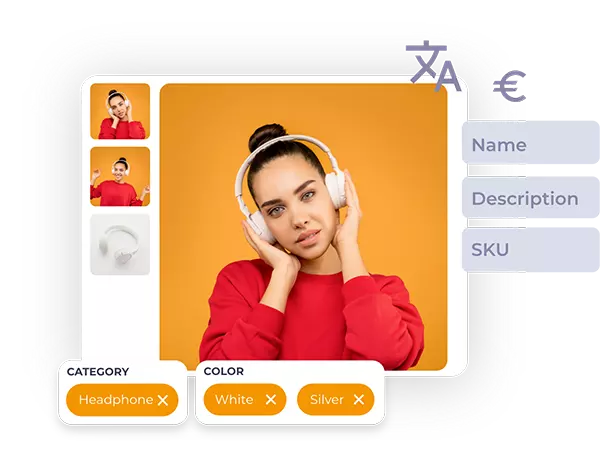
Image showing the photo of a person wearing a pair of white headphones, next to which you can see the product data entry sections that can be filled in with THRON’s best Digital Asset Management software.

Associate product data with assets

Without having to pay the licensing and integration costs of PIM software.
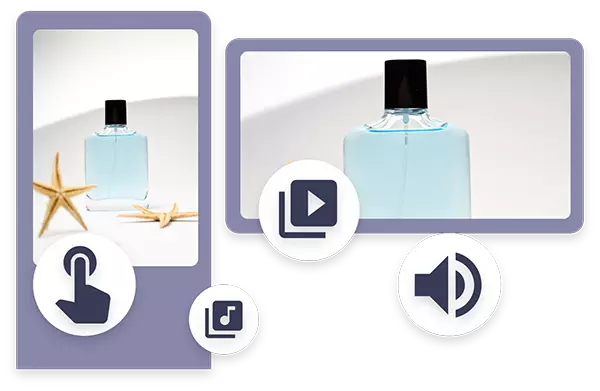
Image showing the adaptation of two photos of perfumes to different digital channels, automatically optimized by THRON’s Digital Asset Management software.

Automatically
optimise assets

Letting the platform adapt the content to each channel.
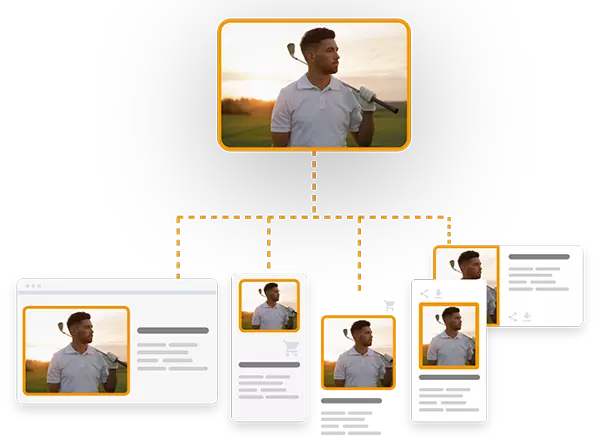
Image showing a photo of a person holding a golf club, from which several versions of the same branch, symbol of omni-channel publication guaranteed by the features of THRON’s Digital Asset Management.

Deliver straight
to the channels

And touchpoints are updated in real time whenever an asset is modified.

What are the advantages of SaaS Digital Asset Management software?

Now we know what DAM means and what Digital Asset Management software does, we can look at what benefits it can offer.

In particular, we will refer to the advantages of adopting a SaaS DAM software (Software as a Service), one of the applications which as well as offering the benefits of cloud platforms, in other words zero maintenance costs and maximum performance, has an impact on the entire organisation.

It is a corporate source of truth

A DAM is the sole source of truth for the organisation because it is a centralised system in which all file types converge.

With a DAM software, there are no copies – the system manages the most up-to-date version of all content, and, when required, the previous ones.

It preserves your know-how

Digital Asset Management solutions allow digital assets to be organised securely.

The spaces where the pieces of content are stored are accessible only to the users and groups who have been granted specific viewing permissions.

It makes searches instantaneous

A Digital Asset Management tool allows you to enrich digital content with a series of information which describes and contextualises it: metadata.

These data enable the indexing of the assets which, in turn, speeds up searches from any location or device.

It increases collaboration

The centralisation offered by a content management platform also involves collaboration.

A hub for digital asset automates activities and workflows, preventing the processes from being managed in an unstructured fashion on many different tools.

It reduces manual work

A DAM digitises operational activities relating to the lifecycle of content, allowing you to save time.

For example, distributing digital assets with a tool of this type allows all communication channels to be updated automatically, without manual intervention.

It offers an omnichannel experience

Not only the company benefits from a hub which centralises digital assets.

Updating the content present on all touchpoints in real time means users – whether they are partners or B2B or B2C customers – perceive the brand as consistent, regardless of the channel used.

A DAM is valuable for all teams

Marketing

Infinite assets, zero copies. One hub to collaborate, research and publish.

E-commerce

Marketplace and online shop updated in real time and without manual labour.

Operations

Approval and distribution flows are 100% digital. And efficiency flies.

Digital & CIO

It governs the ecosystem of digital business processes through APIs and connectors.

Information Technology

A single, secure platform for the company’s most valuable asset: its digital assets.

Let us tell you everything we know about DAM

We have been supporting companies like yours on Digital Asset Management issues for over 20 years.
We look forward to sharing everything we have learnt with you.

What software does a DAM integrate with?

The cross-cutting nature of a Digital Asset Management platform makes it central in organisations, to the point where the ability to integrate this software is a crucial aspect.

The most important integration: DAM and PIM

Having the DAM software communicate with the PIM software is essential.

By integrating the systems, it is indeed possible to associate all content with the product data it represents, simplifying the company’s activities on the various channels with which it communicates.

Image showing THRON’s Digital Asset Management and Product work areas, symbolizing the communication between the two.

But digital transformation can go further

In many organisations, PIM and DAM are two distinct tools. Nevertheless, there are solutions with both Digital Asset Management and Product Information Management functionality.

A platform which includes DAM and PIM, as well as enabling combined management of assets and data, simplifies the technological stack, breaks down the silos between different teams (e.g. marketing and product) and means zero costs for integrating different applications.


Here is an example.

Other software which a DAM can be integrated with

WEB SITE
CMS platforms for websites

To make publication on any site instantaneous.

E-commerce
CMS platforms for e-commerce

For constant delivery on online shops.

Adobe CC
Graphical suites for creative teams

To accelerate the creation and archiving tasks.

User experience
User Experience tools

To enrich the user exerience thanks to the assets.

Sicurezza
Tool for IT security

To securely manage access, permission and more.

API
Any other tool via API

With APIs, a SaaS DAM can be integrated with any tool.

A DAM system supports lots of sectors

You, however, do not stop at categories.

These areas were just examples.
Digital Asset Management is crucial for every company.

Clues that your organisation need a Digital Asset Management software

Now we know what the term DAM means, and that a tool for managing assets is more than just an archive for sharing files or rich media, how can you understand whether your company needs one? 

Every organisation is unique, but there are some clues which can guide us.

Content spread everywhere

If the content is stored in network folders and file sharing services, it is not available to everyone in the organisation who could need it.

With a DAM, you can organise marketing materials into accessible spaces according to predetermined visibility rules and other permissions. You also avoid any duplication.

Finding assets takes time

Another clue that a Digital Asset Management platform would be a good idea is the time required to find an image, video, audio file or other file or document you need.

Does it take more than just a few seconds? A DAM’s indexing and filters can save your productivity.

Sharing is a hassle

If sharing larger files within the company is a problem, a DAM is the ideal solution. .

The same applies if exchanging content between marketing teams of different divisions with the sales team, dealers or any other partner requires a lot of manual work.

You “collaborate” with… e-mail

E-mail messages are not ideal for collaboration – they are just for distributing information.

Things already get complicated with content – particularly when it comes to large file sizes or unusual formats. If you need to assign activities, manage approvals or exchange feedback on the digital assets, then forget it!

Multiple communication channels

With so many touchpoints, each piece of content must be optimised according to the attributes required by the specific channel and published on a case-by-case basis.

A web app to manage digital assets lowers operating time. Particularly when it also supports product information management.

With THRON you go beyond DAM

Want to know more about our unique platform? DAM and PIM in one software, so you can rule all your digital assets and any data or information from your products together and without duplication.