

The 2025 confirmed a growth trend in the eCommerce world, but for many companies growth also means complexity: more channels to manage, more SKUs to handle, more markets with different rules and requirements. In this type of context, fragmented product data management carries the risk of inconsistencies, errors and publication delays.
This is where a PIM (a Product Information Management software) can make the difference in eCommerce management. The right PIM is essential to organize everything that makes up a product page and that therefore arrives not only in the PLPs or PDPs of your eCommerce, but also in marketplace feeds, apps and catalogs, reducing errors and operational times.
In this article we explore the features of a PIM designed for eCommerce teams: what it is, the problems it solves, measurable benefits and what are the key capabilities to evaluate to choose the best software.
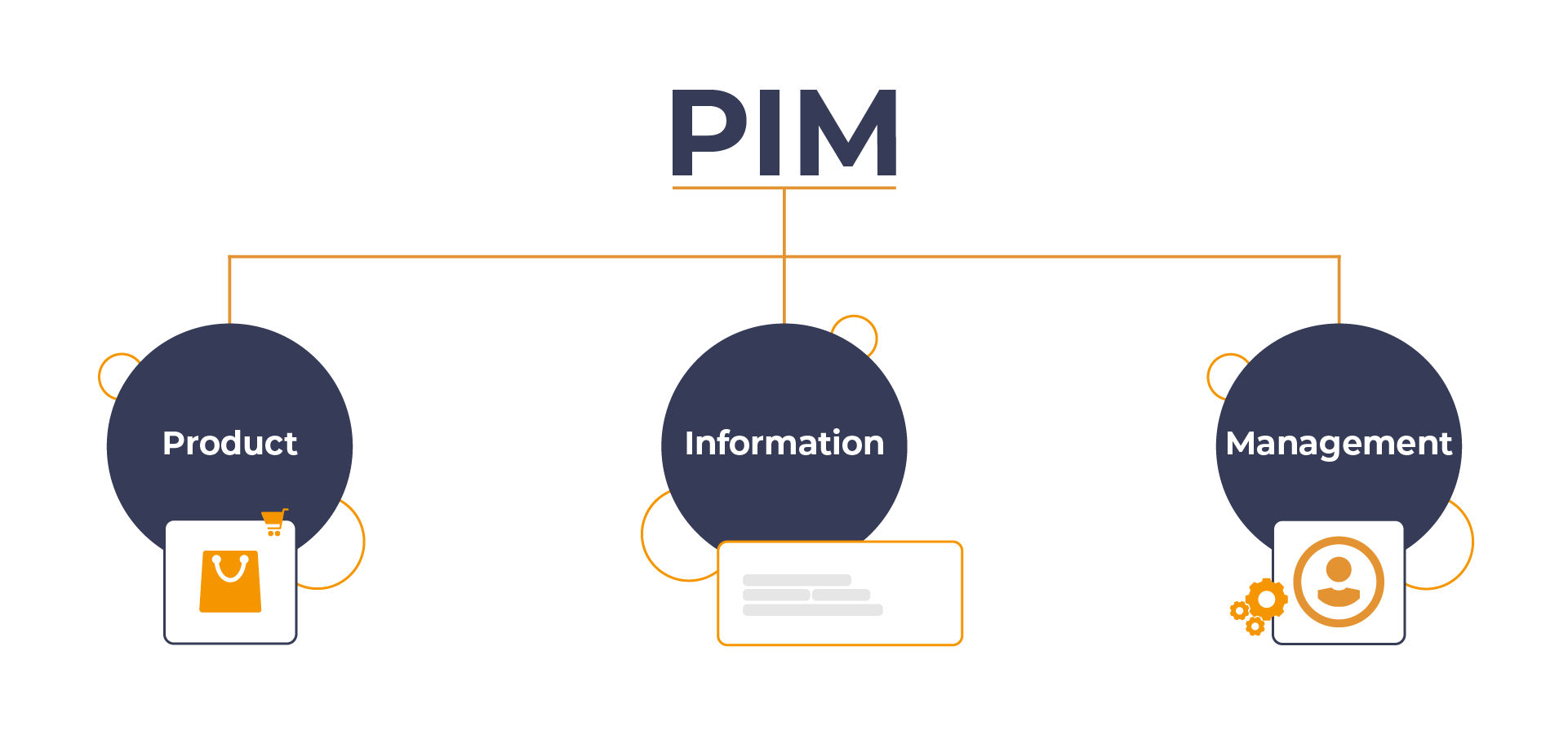
PIM is the acronym for Product Information Management: a system designed to centralize, organize and distribute product information. In practice, a PIM is a platform designed to be the single source of truth for all product data, such as SKUs, attributes, variants, descriptions, technical information and translations.
When the number of product codes in the catalog grows, or when new channels are added to the export ecosystem, spreadsheets are no longer enough. The reason is simple: when a company needs to manage hundreds or thousands of products, not only does information come from different sources (management systems, ERP or PLM), but it also needs to be managed and shared by different teams (Marketing, eCommerce, R&D and Retail) to be published on multiple channels and portals (eCommerce and marketplace PDPs, catalogs, retail and commercial portals). Precarious and fragmented management carries the risk of duplications, errors, inconsistencies and missed updates.
Furthermore, many industry standards and data quality initiatives emphasize the importance of having reliable data and verifiable along the value chain: it’s an issue that touches catalogs, availability, traceability and, consequently, customer experience.
In 2025, the Italian B2C eCommerce market exceeded 62 billion euros, with growth around +6%. Globally, eCommerce retail sales are estimated at trillions of dollars in 2025, a sign that competition is increasingly played on efficiency and quality of operational execution.
In a growth context, the main challenge for eCommerce teams is not therefore launching new products or publishing a catalog, but going online quickly with quality product information and content, consistent across all channels.
When can a PIM really make a difference for eCommerce? When:
It’s not just a problem of internal company organization, but also of data suitability for channels. Marketplaces and platforms, in fact, often require specific and differentiated attributes and descriptions: therefore consistency is needed, but also customized information.
There are multiple benefits that a company can obtain when it decides to centralize data and workflows with a PIM software, but the most immediate ones are certainly three: data quality, time savings on operational activities, faster time-to-market.
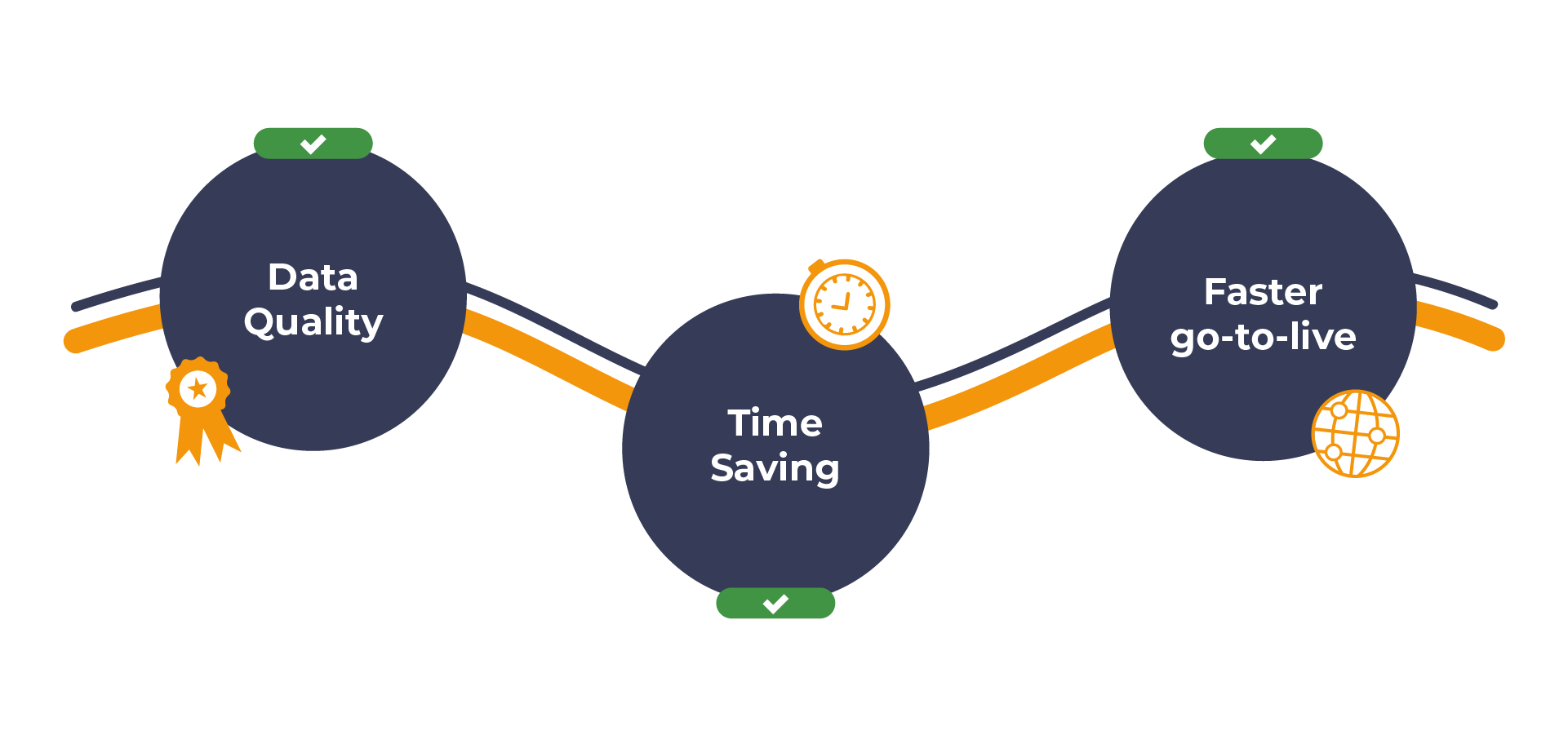
Data quality. A central system for unified management and publishing of attributes, variants and descriptions means fewer errors, inconsistencies between PDPs, PLPs, feeds and technical sheets, fewer manual fixes. For many brands, missing, inaccurate or incomplete information on sales channels has a double impact: they increase the risk of cart abandonment, but also that of returns and customer churn.
Time savings and productivity. PIM speeds up data and content management for eCommerce, allowing the team to achieve completeness of product pages with minimal effort. Being able to easily monitor and verify that information and descriptions are complete and correct for each channel and market, in the right format, is essential. Centralizing (and automating) completeness means having the certainty that each product is ready to go online on all online shops, complete with images, videos and localized information, without wasting time on repetitive activities.
Time-to-market. When ingest, approval and distribution are centralized in a single workflow, launches, new releases and updates to ongoing collections stop being a marathon of imports/exports and become governable processes. Fewer manual steps and fewer revisions, which translate into immediate golive.
To understand how to choose the best PIM software for your eCommerce, we suggest you shift the focus from choosing the tool to the workflows you want to make work. In this paragraph we guide you in evaluating key features and integrability in the main phases of the workflow that goes from ingest to publication.
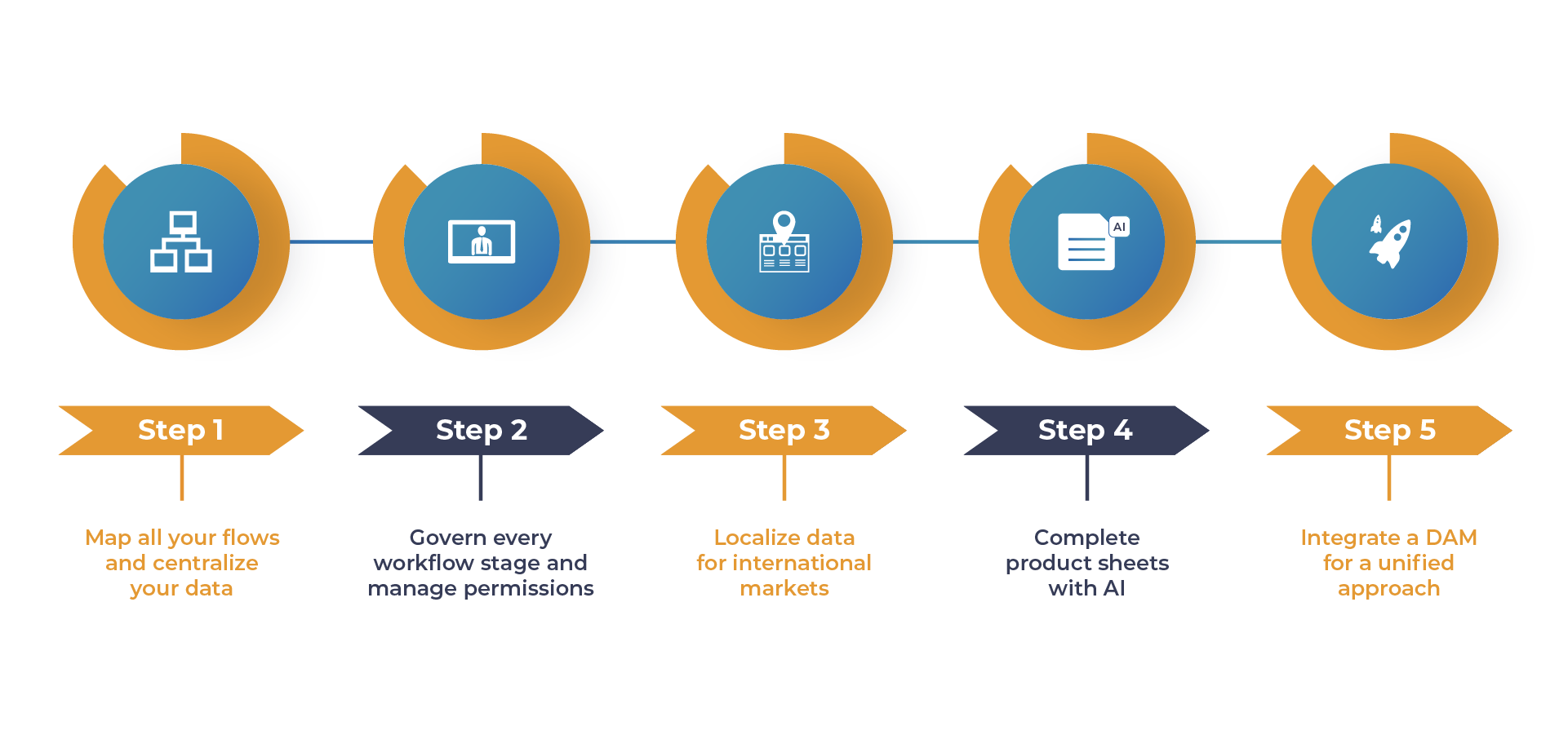
A PIM for eCommerce must integrate easily and automatically with data ingest systems (such as ERP, PLM, supplier databases, CMS and legacy tools), to avoid manual import and synchronization. But integration, alone, is not enough: the point is centralizing information and making it uniform, so that the entire company works on a solid and consistent data model. This means building (and maintaining) a clear attribute structure, with shared definitions and rules: if everyone speaks the same language, the catalog grows without delays or hitches.
Every new launch is a team effort: to arrive at a complete product page, the eCommerce team must work in synergy with Marketing, Brand and Product. The right PIM must be able to govern every phase of the workflow (tasks, reviews, approvals) ensuring security and granular permissions. This is particularly important if you manage sensitive content (compliance, local regulations, claims) or if you operate in a multi-brand context and in different markets.
An eCommerce-oriented PIM should support localization by market, not just the translation of titles and descriptions into multiple languages, but also the adaptation, for each market, of information such as currencies, units of measurement, certifications and regulations. This aspect connects to a multichannel publishing logic, which includes syndication and automatic updates, essential features for ensuring that every change happens in real time on all online shops, from eCommerce to marketplaces, to digital catalogs.
A truly useful PIM for eCommerce is one that helps the team understand if a product page is really ready to go online. To do this, the ability to accelerate the completion of information through automatic rules and generative AI for creating texts and content from structured data becomes essential. The decisive part is monitoring: dynamic and tracked completeness, for each channel and market, allows you to know in real time which products can be published and what information is missing, without manual checks.
Descriptions and technical data alone are not enough: product shots, video tutorials, manuals and other digital assets are not just a fundamental part of the product page, they are the representation of the product itself. For this reason, when choosing a PIM for the eCommerce team, it is essential to also evaluate the tool’s approach to digital asset management. Some PIMs integrate with DAM (Digital Asset Management) software, others, like THRON, are built with a unified approach to content and product data management, in a DAM+PIM logic that integrates automation and multichannel publishing.
This second approach significantly simplifies product page enrichment, enabling content versioning, consistent reuse of digital assets across multiple channels and eliminating duplication.

What is PIM for eCommerce?
A PIM (Product Information Management) software is a system that centralizes, manages and distributes your catalog’s product data (attributes, variants, descriptions, technical specifications) to online shops and other digital channels, such as proprietary eCommerce sites, marketplaces, apps, but also sales portals and digital showcases.
How does a PIM help me manage my eCommerce?
A PIM designed for eCommerce eliminates the risk of errors and inconsistencies between systems and channels, improves the completeness of product pages and makes updating feeds and catalogs faster, especially with large volumes of SKUs, eliminating the need for manual checks and fixes.
What features should I evaluate to choose the best PIM for my eCommerce?
All those that simplify the management of product data and content for online shops and accelerate their publication: ingest from third-party systems, permissions and workflow management, localization of information and content by market and channel, automatic completeness and multichannel publishing. Finally, integration with DAM software or native DAM+PIM management can make a difference in managing your eCommerce.
Do I need a PIM if I already have an ERP?
The ERP is one of the sources from which data comes, which in this case can be information such as prices, stock, inventory or master data. The PIM centralizes and standardizes this and other information about your products, simplifies management and enrichment of product pages (sometimes also with related assets) and finally distributes them to eCommerce, marketplaces and other channels.
Can a PIM help me reduce returns and cart abandonment?
A PIM represents an ally for companies to increase sales and build customer loyalty. As the single source of truth for product attributes and data, the PIM for eCommerce improves quality, accuracy and consistency of information, ensuring rich, complete and consistent shopping experiences across all sales channels.