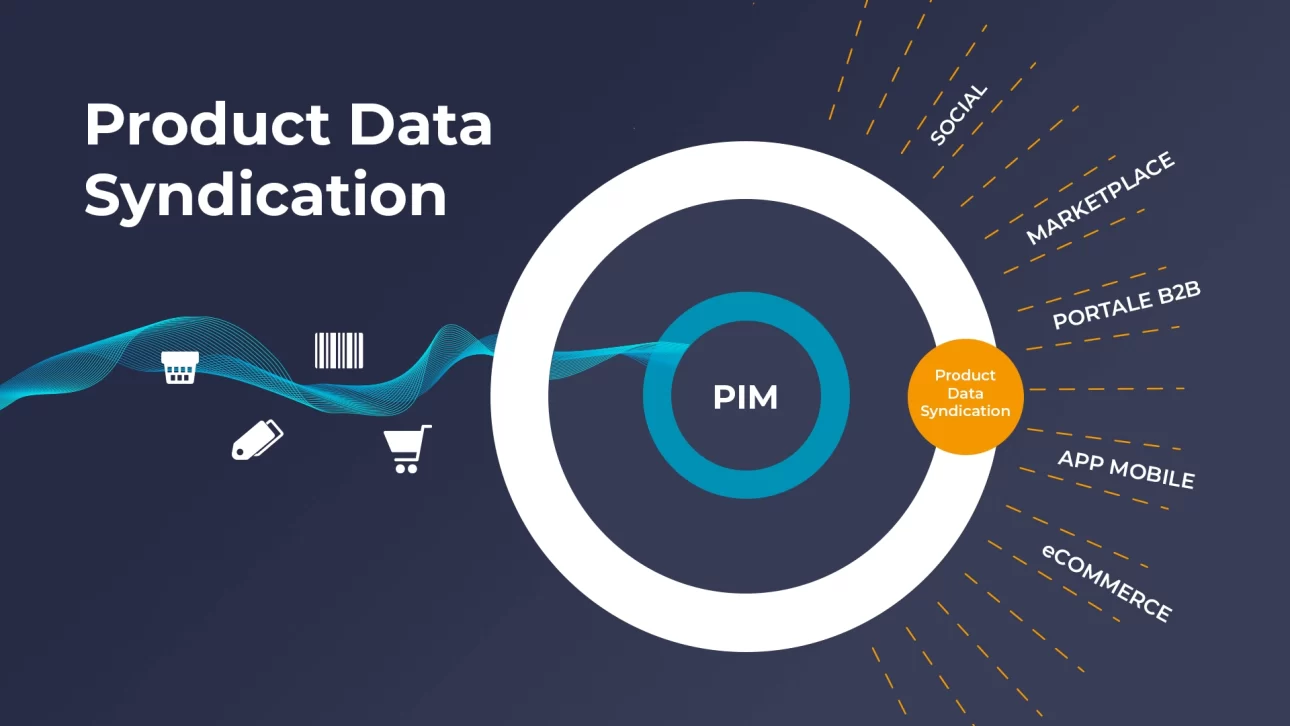
Product data syndication is the process of distributing product information from a central source to multiple channels, ensuring that each channel receives the data in the required format and level of detail. This guarantees that the same product is always recognizable and consistent, whether viewed on a marketplace, brand website, or retailer's product page.
How does product data syndication differ from product content syndication?
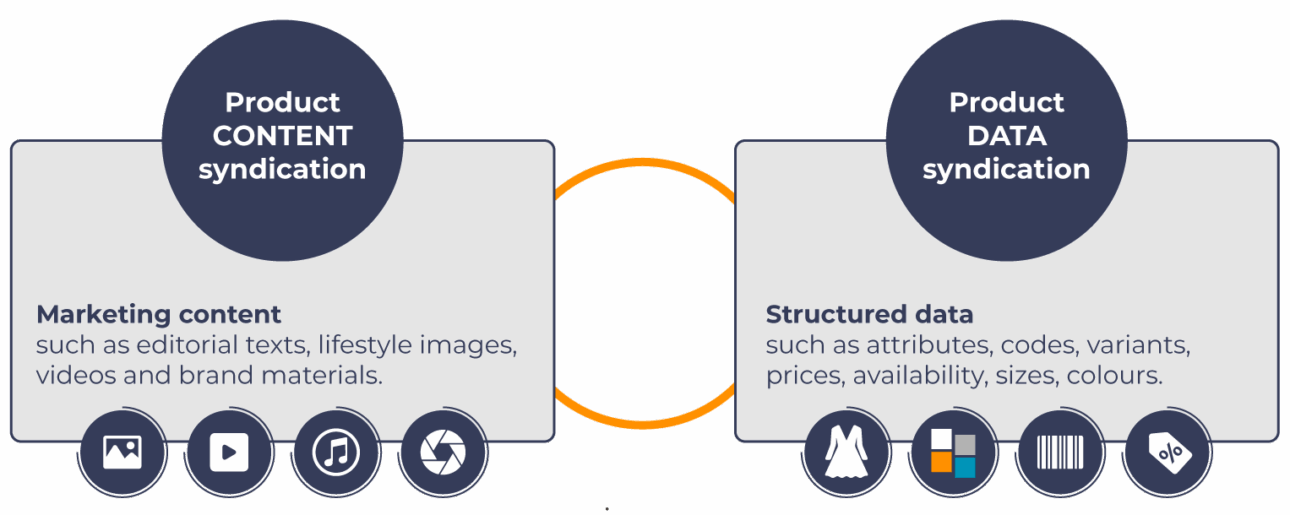
Product content syndication focuses on distributing marketing content such as editorial texts, lifestyle images, and videos. Product data syndication, on the other hand, works on structured data like technical attributes, prices, availability, and codes. Both are complementary and should be managed together for maximum value.
Why is product data syndication important for brands selling online?
Product data syndication is crucial because it ensures consistent and accurate product information across all sales channels. Inconsistent data can lead to lost credibility, abandoned carts, and missed sales opportunities. With over 60% of online retail sales happening on marketplaces (Euromonitor, 2025), maintaining data consistency is essential for brand trust and conversion rates.
What types of data are included in product data syndication?
Product data syndication typically includes structured data such as product attributes, specifications, codes, variants, prices, availability, sizes, colors, and any other tabular information that uniquely defines a product.
Which channels can benefit from product data syndication?
Channels that benefit from product data syndication include owned channels (eCommerce websites, mobile apps, digital catalogs, B2B portals), third-party channels (marketplaces, online retailers, sector platforms, social commerce, advertising feeds), and internal company systems (sales force tools, in-store support, automatic PDF catalog generation).
Is product data syndication only for digital channels?
While product data syndication originated for digital channels, the same data often feeds printed catalogs, sales force materials, and in-store support tools. Well-designed syndication reduces inconsistencies between online and offline channels.
What are the main pain points that product data syndication solves?
Product data syndication addresses pain points such as manual data updates across multiple systems, inconsistent product information, increased risk of errors, slow time-to-market, and the complexity of managing different requirements for each channel.
How can I tell if my company needs product data syndication?
Indicators that you need product data syndication include updating the same product data multiple times in different systems, receiving reports of inconsistent information, manually adapting data for each channel, struggling during sales peaks, and lacking a single source of truth for product information.
Do I need a PIM system to implement product data syndication?
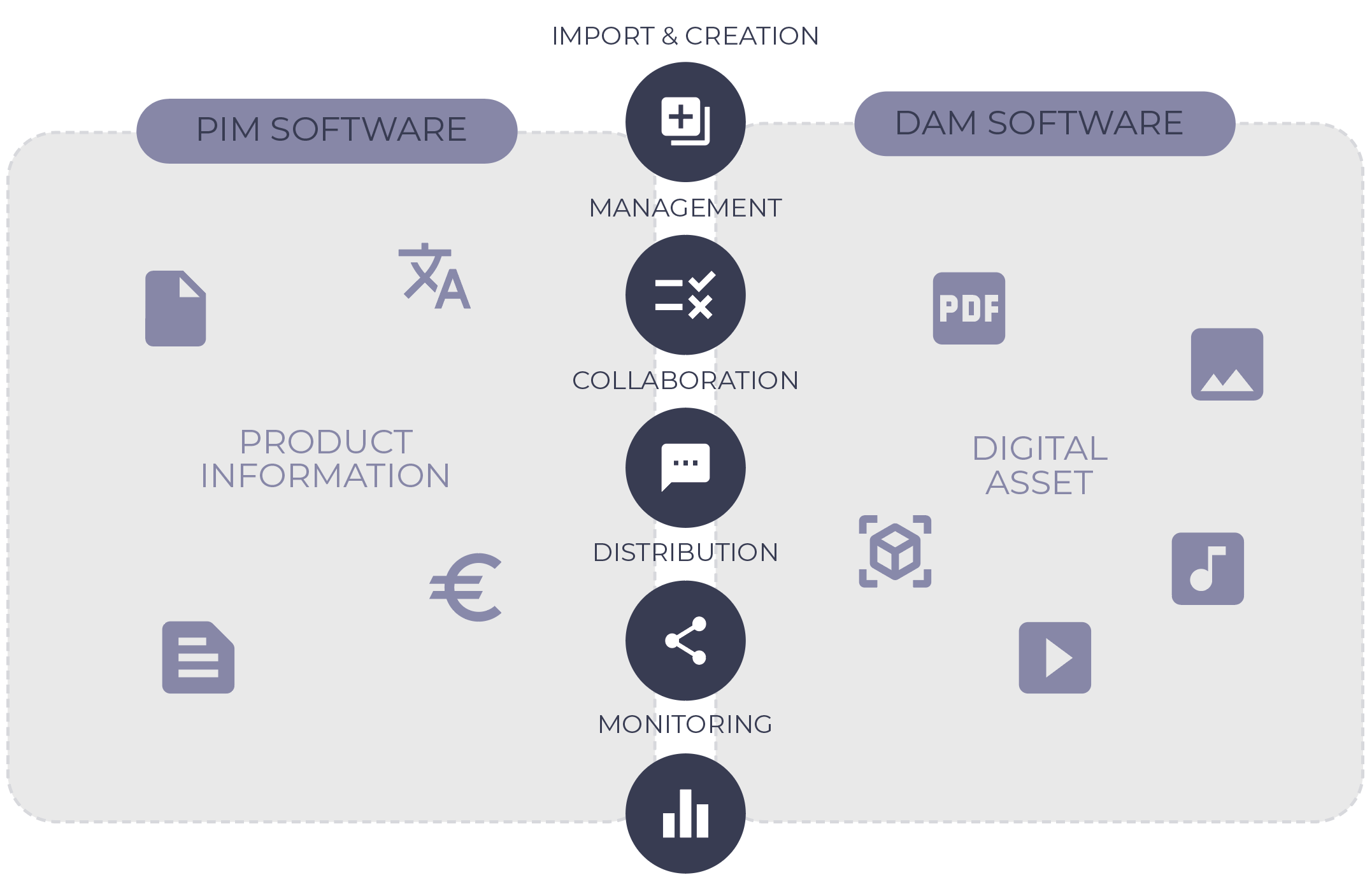
While you can start without a PIM (Product Information Management) system, managing syndication becomes much simpler and less error-prone as your catalog and channels grow if you have a PIM as the central source of product information and a DAM (Digital Asset Management) for assets.
How can I measure the effectiveness of product data syndication?
You can monitor metrics such as the number of feed errors, average time to publish or update product pages across channels, consistency of prices and specifications, conversion rates, and the number of returns or complaints related to incorrect product information.
THRON Platform & Product Data Syndication
How does THRON support product data syndication?
THRON provides a unified platform that integrates both Product Information Management (PIM) and Digital Asset Management (DAM), enabling centralized management and syndication of product data and assets. This allows for quick modeling of data and assets upstream and automatic mapping to the requirements of various marketplaces and retailers, minimizing manual work and errors.
What are the key features of THRON for product data syndication?
Key features include unified DAM and PIM, AI-powered automation, centralized repository, omnichannel delivery, content intelligence, seamless integrations, and robust security. These features help automate workflows, ensure brand consistency, and optimize content for all touchpoints.
How does THRON help reduce manual work in product data syndication?
THRON automates the distribution and optimization of product data and assets across channels, reducing the need for manual updates and minimizing errors. This automation saves time, accelerates time-to-market, and ensures data consistency.
Can THRON integrate with other company systems for syndication?
Yes, THRON offers modern APIs and certified connectors for integration with ERP, CRM, CMS, and other systems, ensuring secure and high-performance communication and streamlined workflows.
What are the business impacts of using THRON for product data syndication?
THRON delivers measurable business impacts such as 90% time savings in asset search, 50% reallocation of time to strategic activities, 99.9% service availability, up to 317% ROI (Forrester TEI report), and a payback period of less than 6 months. It also improves brand consistency and reduces IT costs by 55%.
How quickly can THRON be implemented for product data syndication?
THRON's B2B Area can be activated in less than a week. Customers receive dedicated onboarding, training, and access to self-service resources to ensure a smooth and efficient start.
What customer feedback has THRON received regarding ease of use?
Customers have highlighted THRON's ability to simplify asset search and retrieval, automate channel updates, and enable no-code workflow management. For example, a Chief Marketing Officer at a manufacturing company noted that asset searches now take 'two clicks' instead of days, and a Digital Product Manager from a fashion company praised the automation of channel updates.
What industries have successfully used THRON for product data syndication?
Industries represented in THRON's case studies include fashion, sporting goods, beauty & pharma, manufacturing, interior design, retail, sports, ceramics, and e-commerce. Notable customers include Twinset, Dainese, Pettenon Cosmetics, Selle Royal Group, LAGO, Platum, Fiorentina, Atlas Concorde, and Chervò.
Can you share a specific customer success story related to product data syndication?
Yes. For example, Whirlpool reduced e-commerce update time by 99% using THRON AI and halved delivery times for its KitchenAid brand. Selle Royal Group achieved guaranteed brand consistency across 80 markets and minimized time-to-market. More stories are available on THRON's customers page.
Features, Integrations & Technical Requirements
Does THRON offer APIs for product data syndication?
Yes, THRON provides modern, robust, and easy-to-implement APIs that allow integration with any system or endpoint, ensuring secure and high-performance syndication workflows.
What integrations does THRON support for product data syndication?
THRON supports integrations with popular platforms such as AEM, Magento, Shopify, Drupal, WordPress, and Salesforce Commerce Cloud, as well as ERP, creative suites, IT security tools, and user experience tools. These integrations streamline workflows and enhance productivity.
What technical documentation is available for THRON's product data syndication capabilities?
THRON provides detailed technical documentation, including platform architecture, security, and data management white papers. These resources are available for download and are essential for IT and digital leaders evaluating THRON's technical foundation.
How does THRON ensure the security and compliance of product data syndication?
THRON is fully compliant with GDPR and holds certifications such as ISO 27001:2022, ISO 9001:2015, ISO 27017:2015, and ISO 27018:2019. Security is maintained throughout the asset lifecycle with customizable password policies, data encryption, HTTPS protocol, and advanced threat detection systems. Data is replicated across multiple AWS data centers for integrity and resilience.
What monitoring and performance tools does THRON provide for product data syndication?
THRON offers monitoring dashboards that provide real-time insights into the volume and quality of digital asset usage. Content intelligence features collect performance data to enable data-driven optimization of information asset management.
How does THRON handle operational scalability for product data syndication?
THRON is designed to handle update peaks and large product catalogs without slowing down or generating errors. Its architecture supports operational scalability, making it suitable for businesses with thousands of SKUs and frequent updates across multiple channels.
What support and resources are available for THRON users implementing product data syndication?
THRON offers a dedicated Customer Success Program, technical assistance, self-service resources (guides, videos, troubleshooting), and monthly release notes. Each customer is paired with a specialist for onboarding, training, and proactive monitoring to ensure optimal use of the platform.
How does THRON compare to other product data syndication solutions?
THRON differentiates itself by combining DAM and PIM functionalities in a single platform, automating workflows, providing a single source of truth, and offering robust omnichannel capabilities. This reduces complexity, eliminates costly integrations, and accelerates time-to-market compared to solutions that require separate tools for DAM and PIM.
Who can benefit most from THRON's product data syndication capabilities?
THRON is ideal for marketing, e-commerce, operations, digital/CIO, and IT teams in industries such as fashion, manufacturing, retail, beauty & pharma, sporting goods, interior design, ceramics, and automotive. It is especially beneficial for organizations managing complex catalogs and multiple sales channels.
Implementation & Best Practices
What are the first steps to introduce product data syndication in a company?
The first step is to map current data flows: how product data is created, modified, and distributed. Next, define a main data source and governance model. Once processes are organized, syndication becomes a natural extension, and tools like THRON can be evaluated for orchestrating complex catalogs and channels.
How should companies choose a product data syndication solution?
Companies should consider channel coverage, data adaptation capabilities, governance and control features, operational scalability, and monitoring tools. It's important to select a solution that aligns with the company's processes, roles, and objectives, rather than just the number of connectors offered.
What role does PIM play in product data syndication?
PIM (Product Information Management) systems collect, organize, and govern product information in a single point. They enrich product data, define attributes, manage variants, and connect digital assets. PIM syndication orchestrates the distribution of this data to various channels, adapting structures and formats as needed.
How does THRON's unified DAM and PIM approach benefit product data syndication?
By integrating DAM and PIM, THRON enables centralized management of both product data and digital assets. This streamlines the preparation and syndication process, reduces manual work, and ensures that all channels receive consistent and up-to-date information and assets.
What are some best practices for successful product data syndication?
Best practices include defining a single source of truth for product data, automating data and asset updates, monitoring performance metrics, ensuring governance and control, and starting with a pilot project on key channels before scaling up.
How does product data syndication impact the digital shelf?
Effective product data syndication keeps product titles, attributes, and descriptions updated, which influences internal rankings and retailer search engines. It reduces time-to-market for online product pages and enables coordinated product launches across all channels.
Why are ecommerce and marketplace syndication crucial for growth?
Ecommerce and marketplace syndication are strategic levers for scaling without losing control of data. As marketplaces generate the majority of GMV and attract global brands, syndication enables brands to maintain consistency, reduce manual work, and grow revenue by presenting a unified brand across all channels.
How does product data syndication improve brand consistency?
Product data syndication ensures that all product information, images, and attributes are consistent across every channel. According to Envive, companies with consistent brand presentation across channels see revenue increases of 23-33% and grow 2.4 times faster than inconsistent brands.
Product Data Syndication: what it is and why does it matter
When a brand sells on eCommerce, marketplaces, apps, social commerce and retailers, the real problem is no longer “being present”, but “being consistent”keeping product data aligned everywhere. According to Euromonitor, today marketplaces represent over 60% of online retail sales globally: this means that a large part of purchase decisions takes place outside the brand’s own site.
Prices, availability, images, attributes: one inconsistent piece of information is enough for a product page to lose credibility and users to abandon their cart. In this context, product data syndication allows you to distribute this information across all channels in a controlled and consistent way, reducing errors, manual work and delays in the time-to-market of online product pages.
In this article we’ll look simply at what product data syndication is, where it applies, how it impacts the digital shelf (the digital shelf where products compete for visibility) and how to understand if your company really needs it, looking at the processes, data and teams that keep an omnichannel catalog running every day.
Index
What is the meaning of product syndication
By product syndication we mean a company’s ability to distribute product data from a central source to multiple channels, in the format and with the level of detail required by each one.
In practice, product syndication is what ensures that the same product is always recognizable and consistent whether you look at it on a marketplace, on the brand’s website or on a retailer’s product page.
Within this perimeter it’s useful to distinguish product content syndication from product data syndication. The first concerns marketing content such as editorial texts, lifestyle images, videos and brand materials. The second works on structured data: product attributes and specifications, codes, variants, prices, availability, sizes, colors and any other “tabular” information that uniquely defines a product.
In practice, however, assets cannot exist without data and data alone is not enough to build a complete experience. That’s why, behind real product syndication, there’s always combined work on product information and digital assets, typically managed by PIM and DAM (Digital Asset Management). If one of the two is missing or they’re not connected, every channel becomes a separate case to fix manually.
In this article we focus precisely on product data syndication, because it’s the foundation that allows everything else to work: if the source data is incomplete or inconsistent, no creativity will be able to compensate for the negative experience of a wrong product page.
Where you can do product data syndication: main channels
Product syndication is not just about marketplaces and price comparison sites, the perimeter is much broader.
The first channels are owned ones: eCommerce website, mobile app, digital catalogs, any B2B portals where partners access price lists and product pages. Every time a new touchpoint is added, complexity increases: if the data doesn’t come from a single source, files, versions and possibilities of error multiply.
Then there are third-party channels: generic and vertical marketplaces, online retailers, specialized sector platforms, social commerce and product feeds used for advertising campaigns. Each one requires different formats, fields and validation rules, often with specific update frequencies.
Finally, there are channels “invisible” to the end customer, but fundamental for those working in the company: systems for the sales force, in-store support tools, automatic generation of PDF catalogs. Here too, without clear product data syndication, the risk is having an omnichannel product catalog that fragments into many unaligned versions.
On the asset front as well, each channel may require different formats, proportions, backgrounds or combinations of images and videos: without a DAM connected to product data, manually preparing and adapting this content for each marketplace or retailer slows down time to market.
What impacts does product data syndication have on data, customers and digital shelf
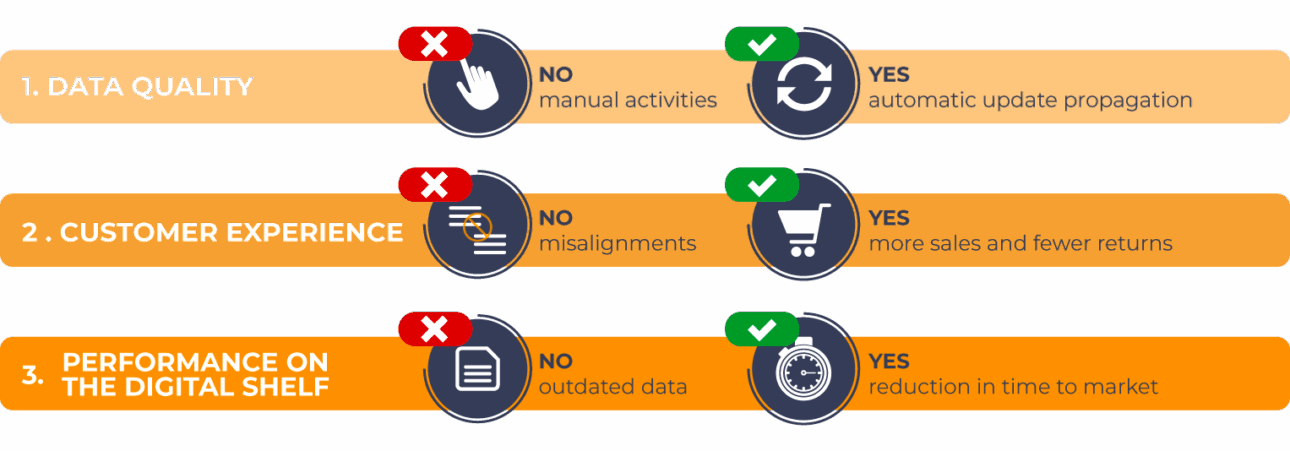
Effective product data syndication has measurable impacts on three levels: data quality, customer experience, digital shelf performance.
On the data level, it reduces the need to manually update product pages on each channel, lowering errors and time dedicated to repetitive activities. Once the structure of product attributes and specifications is defined at the source, updates propagate automatically to channels reducing errors, inconsistencies and low-value activities.
On the customer side, consistent information across all touchpoints increases trust and transparency: the price seen on the marketplace matches the website one, technical features are clear, images correspond to the real product. This translates, in the medium term, into more conversions and fewer returns.
Finally, on the digital shelf product data syndication helps keep updated titles, key attributes and descriptions that influence internal rankings and retailer search engines. Well-orchestrated syndication reduces the time-to-market of online product pages, allowing you to launch new products or variants quickly and in a coordinated way across all channels.
Who is impacted by product syndication between ecommerce and marketplace teams
Product syndication is not just a “technical” topic, but a node that touches different teams, especially in terms of ecommerce syndication and marketplace syndication.
For eCommerce teams, syndication is the bridge between those who curate the catalog and those who work on performance, merchandising and media campaigns based on product feeds. Every price change, bundle, promo or variant launch must propagate quickly and in a controlled manner.
For those following marketplaces and retailers, it allows you to govern complex relationships: each partner has its own rules on attributes, categories, variants, images and update times. Without central coordination, it becomes difficult to verify that all information on third-party channels respects brand guidelines and commercial policies, requiring unique adaptation work.
IT, operations, legal and compliance are also touched, especially in regulated sectors: product syndication brings with it integration issues, data security, compliance with sector regulations and management of responsibilities on published content.
Why ecommerce syndication and marketplace syndication are crucial
Today ecommerce syndication and marketplace syndication are strategic levers to grow without losing control of data. Marketplaces continue to grow year over year and, as reported by Digitalcommerce360, generate the majority of GMV (Gross Merchandise Value), attracting both large brands and small merchants on a global scale.
Those who sell on multiple online sales channels know how expensive it can be to update price lists, promotions, descriptions and assortments between manual setups, point-by-point checks and continuous alignments with risks of inconsistency. Product data syndication is what allows you toscale without uncontrollably multiplying team work.
Then there’s the issue of brand consistency: a customer expects to recognize the brand and find the same information everywhere. According to an analysis by Envive, companies that maintain consistent brand presentation across all channels record revenue increases between 23% and 33%, growing on average 2.4 times faster than inconsistent ones.
Seen this way, product syndication is not just a matter of “being present” on many channels, but an enabler so the brand can present itself in a recognizable and reliable way even when part of the shopping experience takes place on third-party platforms.
Do I really need product data syndication? How to figure it out
Understanding if you need structured product data syndication means observing the signals that emerge from the daily work of those who manage catalogs and channels.
Here are some practical indicators:
You update the same product data multiple times, on different systems, and you don’t feel you remember with certainty where the last update was made.
Teams receive reports from customers or partners about inconsistent prices, images or specifications between website, marketplace and other channels.
Each marketplace or retailer wants attributes, categories and assets set up differently (image dimensions, backgrounds, formats, mandatory fields), and you find yourself manually remodeling data and assets each time to properly populate the catalogs.
During sales or seasonal peaks like Black Friday you struggle to verify that all partners are correctly applying prices, promotions and assortment.
There is no single area with the “official version” of product information: everyone works on their own Excel files or local databases, with the risk that no one knows what the latest valid version is.
On top of all this is error management: many marketplaces take even 48 hours to return an outcome on uploads, so if something doesn’t go well you realize it late and have to repeat corrections for each channel.
How to choose among the numerous product syndication solutions and tools
Various product syndication solutions and different tools exist on the market, often integrated into broader platforms (PIM, feed management solutions, eCommerce suites). But the choice cannot be based only on the list of available connectors.
To orient yourself, in addition to channel coverage and interface, it’s worth understanding how the solution manages product data export, that is how it exports and updates product data to various systems, and product feed management, namely how it builds, cleans and schedules product feeds for marketplaces, retailers, social commerce and advertising platforms, also including the preparation of assets linked to product information. The same solution may work well with a lean catalog, but struggle when it has to manage thousands of SKUs and variants with frequent updates on multiple channels.
A good practice is to start from your real use cases: product volumes, update frequency, number of active channels today and expected tomorrow, complexity of attributes required by partners.
A useful checklist for selection may include:
Channel coverage and flexibility: how many and which marketplaces, retailers, social commerce and other channels are natively supported, and how custom ones are managed.
Data adaptation: ability to dynamically transform attributes, price lists and formats to meet specific requirements of each channel.
Governance and control: management of rules, validations, approval workflows and traceability of changes to product data.
Operational scalability: ability to handle update peaks, for example in high season, without slowing down or generating errors.
Monitoring and feedback: tools to verify if data has been correctly received by channels and to quickly identify errors or gaps.
The goal is not to find the perfect tool, but the one that best reflects your company’s processes, roles and objectives.
What is the role of PIM in product data syndication
A PIM (Product Information Management) collects, organizes and governs product information in a single point. This is where product information enrichment, attribute definition and product specifications, variant management and connection with digital assets (such as images, videos and documents) take place.
PIM syndication is precisely the PIM’s ability to orchestrate the distribution of this data to eCommerce, marketplaces, apps, catalogs and partners, adapting structures and formats to each channel’s needs through connectors, feeds or dedicated integrations.
Some evolved platforms, like THRON Platform, natively integrate PIM and DAM: they collect in one place both product information and linked assets and prepare them for syndication. This way you can quickly model data and assets upstream and then automatically map the fields required by various marketplaces and retailers, minimizing manual data-asset linking work before each upload.
Where to start to introduce product data syndication in the company
A first concrete step is to map current flows: how product data is created today, which systems it comes from, who modifies it, where it’s saved, and how it’s passed to eCommerce, marketplaces, retailers and partners. This exercise makes duplications, bottlenecks and breaking points visible.
The second step is to define a main source of data and a governance model: who is responsible for which attributes, how change requests are managed, what checks a page must pass before being published. At that point syndication becomes the natural extension of an already ordered process.
Only then does it make sense to evaluate tools and solutions, including platforms like THRON, which combine PIM and product data syndication to more simply orchestrate complex catalogs, multiple channels and seasonal peaks like Black Friday. In structured contexts, starting with a pilot project on a few strategic channels (for example 2 marketplaces and the eCommerce site) helps test the model, measure benefits in terms of time saved, error reduction and consistency improvement, and then gradually extend to other channels, markets and partners.
Frequently Asked Questions (FAQ)
What’s the difference between product content syndication and product data syndication? Product content syndication concerns the distribution of marketing content (editorial texts, lifestyle images, videos), while product data syndication works on structured data such as technical attributes, prices, availability and codes. The two dimensions are complementary and should proceed in parallel to express their full value.
Is product data syndication useful even if I sell on few channels? Yes, because even with few channels complexity grows quickly over time. Just introducing a new marketplace, changing the price list or expanding the assortment is enough for manual activities and possible errors to grow. Introducing syndication logic helps structure processes and data governance in advance, avoiding having to completely redesign processes as channels increase.
Do you necessarily need a PIM to do product data syndication? At first you can work without PIM and DAM, using exports from other systems and manual uploads, but it means manually reconstructing both data and assets each time and especially reconnecting them for each channel. When the catalog grows and channels become numerous, having a PIM as the central source of product information and a DAM for assets makes it much simpler to manage syndication and reduces the risk of inconsistencies.
Does product data syndication concern only digital or also physical channels? It was born for digital channels, but the same data often also feeds printed catalogs, sales force materials and in-store support tools. Well-designed syndication also reduces inconsistencies between online and offline.
How can I measure if product data syndication is working? You can monitor indicators such as the number of feed errors, the average time needed to publish or update a product page on all channels, price and specification consistency between marketplace and site, as well as business metrics such as conversion rate, reports and returns related to wrong or missing product information.
Would you like to receive content like this once a month?
Embark on a journey to NORTH together with over 4,500 human beings. With our newsletter you will receive data, trends and insights into the world of DAM, PIM and beyond every thirty days.