Media Asset Management (MAM) software is a platform designed to govern the lifecycle of specific digital assets, primarily audios and videos. It enables companies to store, manage, organize, and deliver content formats for listening or viewing, making these strategic assets easily accessible and manageable for organizations. (source)
What types of content does a MAM platform manage?
A MAM platform primarily manages audio and video content, supporting the storage, organization, and delivery of these formats for various business needs. (source)
Who typically uses Media Asset Management platforms?
MAM platforms are mainly used by teams involved in the creation, approval, and delivery of audiovisual projects, such as creative, news, broadcasting, or film production agencies. (source)
What are the main features of a MAM tool?
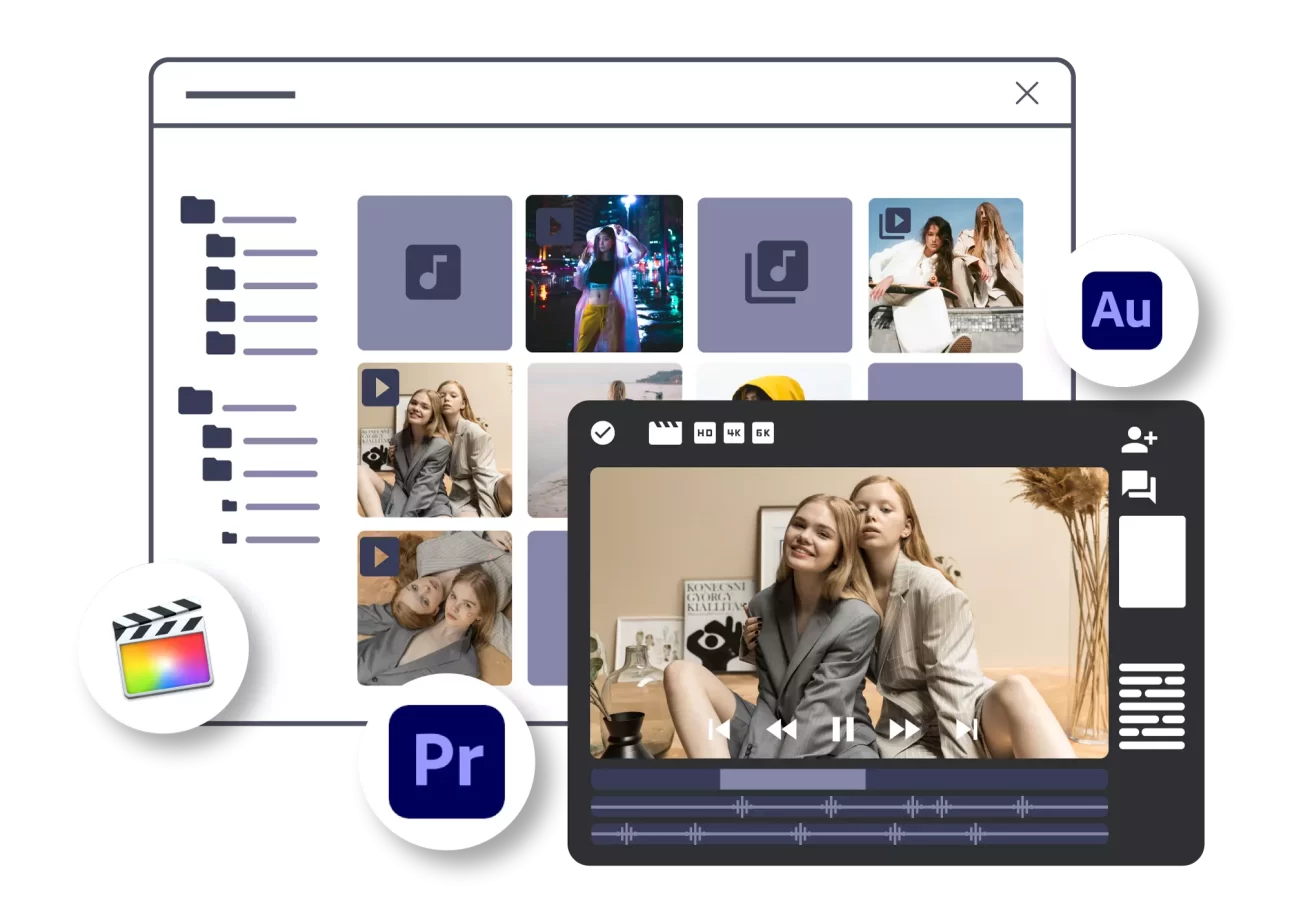
Key features of MAM tools include centralization of audio-visual media and metadata, secure cloud-based access, advanced search, digital workflows for collaboration, and integration with third-party creative tools like Adobe Premiere Pro and Final Cut Pro. (source)
How does a MAM differ from a DAM (Digital Asset Management) platform?
While both MAM and DAM platforms centralize, manage, approve, and deliver content, MAMs are focused on audio and video, whereas DAMs manage all types of digital assets, including images, documents, and graphics. DAMs are more versatile and support broader communication processes. (source)
Can a DAM platform handle audio and video like a MAM?
Yes, advanced DAM platforms can manage audio and video content and often include features like transcoding and integration with creative suites, which were traditionally exclusive to MAM tools. (source)
Why is it important to centralize all digital assets in one platform?
Centralizing all digital assets reduces IT costs, eliminates integration issues, prevents content duplication, and provides a single source of truth for teams to collaborate efficiently. (source)
What are the risks of using separate tools for different asset types?
Using separate tools can create application silos, increase integration costs, and lead to misalignments or duplication of content and information. (source)
What is the role of metadata in MAM platforms?
Metadata in MAM platforms enhances the value and availability of audio-visual content, making it easier to search, organize, and retrieve assets efficiently. (source)
How do MAM platforms support collaboration?
MAM platforms support collaboration by enabling digital workflows that centralize not only audio and video assets but also the collaborative processes around them, from creative briefs to delivery and subtitling. (source)
THRON Platform: Features & Capabilities
What is the THRON platform?
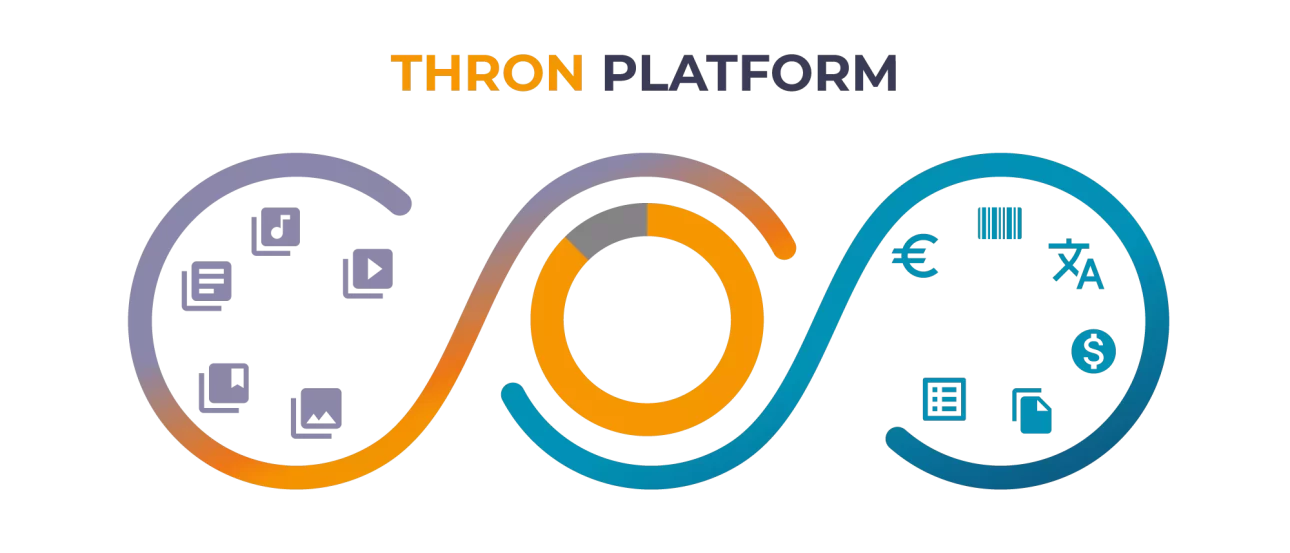
THRON is a SaaS platform that unifies Digital Asset Management (DAM) and Product Information Management (PIM) functionalities, allowing businesses to manage the entire lifecycle of digital assets and product data from a single hub. (source)
What features does THRON offer for managing media assets?
THRON offers centralized management of photos, videos, documents, and product data, AI-powered automation, omnichannel delivery, content intelligence, and robust integrations with creative suites and business systems. (source)
Does THRON support integration with third-party tools?
Yes, THRON provides next-generation API connectors and certified integrations with platforms such as Adobe CC, AEM, Magento, Shopify, Drupal, WordPress, and more, enabling seamless workflows across company systems. (source)
How does THRON help with omnichannel content delivery?
THRON automates asset delivery across all channels, ensuring consistent and updated content at every touchpoint, which improves user experience and increases conversions. (source)
What monitoring and analytics capabilities does THRON provide?
THRON offers monitoring dashboards and content intelligence features that track asset performance, usage, and quality, enabling data-driven optimization of content strategies. (source)
Does THRON offer APIs for custom integrations?
Yes, THRON provides modern, robust APIs that allow integration with any system or endpoint, ensuring secure and high-performance workflows. (source)
What technical documentation is available for THRON?
THRON offers detailed technical documentation, including platform architecture, security, and data management white papers, available for download and review. (source)
How does THRON ensure security and compliance?
THRON is certified for ISO 27001:2022, ISO 9001:2015, ISO 27017:2015, and ISO 27018:2019, and is fully GDPR compliant. Security is maintained through OWASP principles, XDR threat detection, encrypted data, and AWS infrastructure. (source)
What is the Customer Success Program offered by THRON?
THRON's Customer Success Program pairs each customer with a specialist for customized onboarding, training, proactive monitoring, and consultancy to ensure optimal platform use. (source)
Use Cases & Business Impact
What business problems does THRON solve?
THRON solves problems related to workflow inefficiency, brand inconsistency, collaboration barriers, manual content management, and integration complexity by centralizing assets and automating processes. (source)
What measurable business impact can customers expect from THRON?
Customers can expect up to 90% time savings in asset search, 317% ROI (Forrester TEI), 99.9% service availability, and a 55% reduction in IT budgets by consolidating tools. (source)
Who can benefit from using THRON?
THRON is ideal for marketing, e-commerce, operations, digital/CIO, and IT teams across industries such as fashion, manufacturing, retail, beauty & pharma, sporting goods, ceramics, interior design, and automotive. (source)
What are some real-world success stories with THRON?
Customers like Selle Royal Group, Dainese, Chervò, and Whirlpool have achieved faster time-to-market, improved brand consistency, and significant operational efficiencies using THRON. For example, Whirlpool reduced e-commerce update time by 99% and halved delivery times for KitchenAid. (source)
What feedback have customers given about THRON's ease of use?
Customers praise THRON for simplifying asset search and retrieval, automating updates, and enabling no-code workflow design. For example, a CMO at a manufacturing company noted, "With THRON everything is done in two clicks." (source)
How quickly can THRON be implemented?
THRON's B2B Area can be activated in less than a week, and customers receive dedicated onboarding and training to ensure a smooth start. (source)
What pain points does THRON address for marketing teams?
THRON addresses excessive manual work, inconsistent brand communication, and time-consuming content management, enabling marketers to focus on creativity and strategy. (source)
How does THRON help e-commerce teams?
THRON centralizes product data and assets, accelerates time-to-market, ensures consistent product information, and improves user experience, leading to higher conversion rates. (source)
Competition & Differentiation
How does THRON differ from traditional MAM and DAM solutions?
THRON uniquely combines DAM and PIM functionalities in a single platform, eliminating the need for multiple tools and costly integrations, and offers advanced automation and omnichannel capabilities. (source)
What are the key differentiators of THRON?
Key differentiators include unified DAM and PIM, AI-powered automation, single source of truth, omnichannel delivery, and a dedicated Customer Success Program. (source)
Why choose THRON over other asset management solutions?
THRON reduces complexity and costs by unifying DAM and PIM, automates workflows, accelerates ROI, and ensures brand consistency across all channels. (source)
Are there different advantages for different user segments?
Yes, marketing teams benefit from centralized content and automation, e-commerce teams from improved time-to-market, operations from streamlined workflows, and IT from simplified tech stacks and secure management. (source)
Technical & Support
What technical support does THRON provide?
THRON offers dedicated technical assistance, a Customer Success Program, self-service resources, and monthly release notes to keep customers informed and supported. (source)
What industries are represented in THRON's case studies?
Industries include fashion, sporting goods, beauty & pharma, manufacturing, interior design, retail, sports, ceramics, and e-commerce, with detailed case studies available on THRON's website. (source)
What certifications does THRON hold for security and compliance?
THRON holds ISO 27001:2022, ISO 9001:2015, ISO 27017:2015, ISO 27018:2019 certifications, and is fully GDPR compliant. (source)
How does THRON handle data integrity and disaster recovery?
THRON replicates data across multiple AWS data centers, ensuring data remains intact even after catastrophic events. (source)
How can customers access support resources for THRON?
Customers can access guides, videos, troubleshooting materials, and open support tickets via the THRON Help portal. (source)
Alla scoperta dei MAM software (di Media Asset Management), tool per governare due tipi di contenuti; i video, cuore pulsante delle strategie di marketing e gli audio, astri nascenti della comunicazione verso umani sempre più multitasking.
Media Asset Management: what is a MAM software?
In the software world, the acronym MAM stands for Media Asset Management tools.
This is one of the type of platforms that populate the galaxy of MarTech solutions.
With Media Asset Management software, it is possible to govern the lifecycle of specific categories of digital assets: audios and videos.
In concrete terms, with MAM platform a company stores, manages, organises and delivers various content formats for listening or viewing.
Despite their diversity, they are both strategic assets for organisations.
Videos, used by one in two marketers, are defined as the content that generates the highest ROI. Audios – especially through podcasts – are included in one in three communication budgets1.
1The state of marketing, 2023, HubSpot.
What are the features of MAM tool?
One of the most important features of Media Asset Management software (also called Media Asset Management solutions or systems) is thecentralisation of audio-visual media content and its metadata, additional information that enhances its value and subsequent availability.
These are platforms – usually cloud-based – that facilitate the search and access of audio and video in a secure manner, making each file accessible to a list of people established in the configuration phase.
The most advanced MAMs, however, are much more than just libraries.
Thanks to the possibility of building digital workflows they make it possible to centralise on a single platform not only audio and video but also all the collaborative processes that gravitate around them.
From the creative brief to delivery on one or more final channels, including subtitling.
Another key feature for a MAM software is the integrability– via connectors or APIs – with third-party platforms. Due to the nature of the content managed, a good Media Asset Management tool must dialogue with products such as Adobe Premiere Pro and Final Cut Pro.
Who needs a Media Asset Management platform
Media Asset Management is primarily chosen by users who need a digital hub where the can quickly store and retrieve audio and video media content.
In most cases, these are teams involved in the creation, approval and delivery of audiovisual projects, such as creative, news, broadcasting or film production agencies.
Save in exceptional cases, it is difficult for a MAM to be adopted within the marketing and communication processes of a company that produces or delivers products.
Despite the similarities between the two tools, in fact, a DAM is likely to be preferred.
MAM vs DAM: analogies and differences
From a functional point of view, a MAM software can be superimposed on a DAM (Digital Asset Management) software.
Both make it possible to centralise, manage, approve and deliver contents.
However, while Media Asset Management platforms are limited to managing audio or video contents, Digital Asset Management platforms allow to govern any type of digital assets.
In addition to managing audio and video as a MAM tool does, a DAM can also manage other types of contents, such as photos, illustrations, graphic designs and documents such as PDFs, spreadsheets, presentations.
In other words, although some MAMs also partially support image formats, a DAM is by far a more versatile tool, capable of supporting the internal and external communication processes of companies in a more horizontal manner.
Among other things, given the growing importance of assets such as audios and videos, the best DAMs are equipped with features that in the past were exclusive to MAM tools, such as transcoding of multimedia files and integration with graphic or creative suites.
A clarification on digital assets.
Although product data are to all intents and purposes part of the information assets of a corporate organisation and form part of its digital assets2, they are almost always managed outside of Digital Asset Management software.
In fact, data, information and descriptions relating to a company’s offerings often flow into Product Information Management.
However, the use of different tools generates application silos, as well as integration costs between different systems and the risk of misalignments caused by duplication of contents and information.
Therefore, it is definitely advisable to manage all digital assets jointly.
2Prepararsi all”era “Phygital”, 2020, studio condotto da Forrester commissionato da THRON.
Beyond MAM, DAM and PIM: our platform
Considering that all digital assets – including product data – flow into communication channels, we would like to add one last thought, which is also useful for those who are approaching the world of Media Asset Management software for the first time.
Dealer portals, websites, e-commerce and marketplaces are populated with media content and information that promote, describe and generally communicate products with their B2B or B2C customers.
That is why we consider it particularly important for companies to have a single platform to securely and efficiently manage their media content and related product data.
Managing all types of assets from a single platform, brings with it many advantages.
From an internal point of view, fewer tools reduce IT costs that would otherwise be spent on fees, licenses and integration between different systems.
Furthermore, each team can rely on a single source of truth and has a hub in which to collaborate with others.
Externally, on the other hand, especially in case of direct assets delivery, marketing campaigns become more agile and an omnichannel strategy is provided to the business, making the brand more solid and consistent.
Would you like to receive content like this once a month?
Embark on a journey to NORTH together with over 4,500 human beings. With our newsletter you will receive data, trends and insights into the world of DAM, PIM and beyond every thirty days.