Language

Discover news, releases and enhancements of our platform.
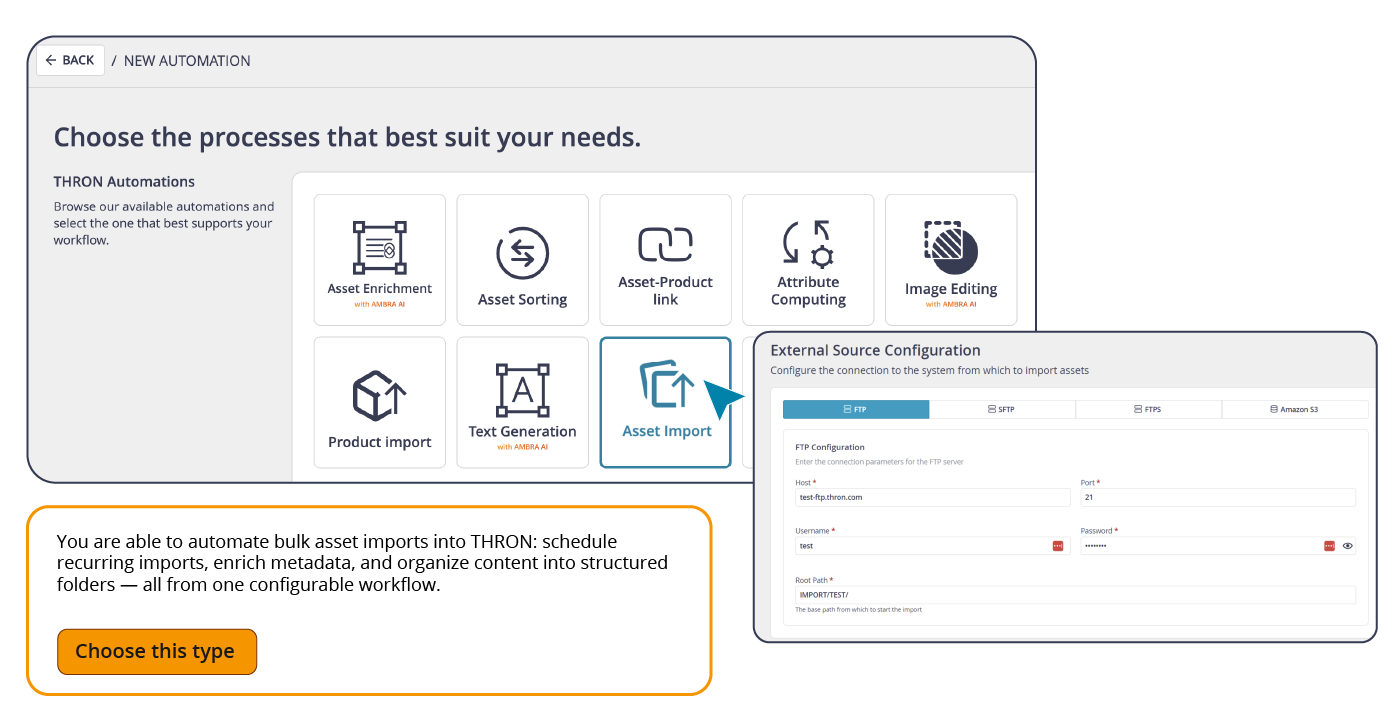
Starting with this release, files arriving from external sources enter THRON already cataloged and ready to use, with no need for anyone to import them manually or reorganize them after upload.
With the new Asset Import automation, you connect the external source, define where files should go and how they should be cataloged, and set the frequency. From that point on, THRON handles everything.
It works with the protocols already in use within your IT infrastructure (FTP, SFTP, FTPS, S3 buckets), requiring no changes to existing systems. For each imported asset, you can choose how to manage it:
Versioning: if a file with the same name already exists, the automation creates a new version of the asset while preserving the full history
New content: if the file is not present, or if you prefer to keep it separate, a new asset is created without touching the original
Attributes are mapped automatically based on the data in the configuration file, so every asset enters with the information your data model requires, already in place.
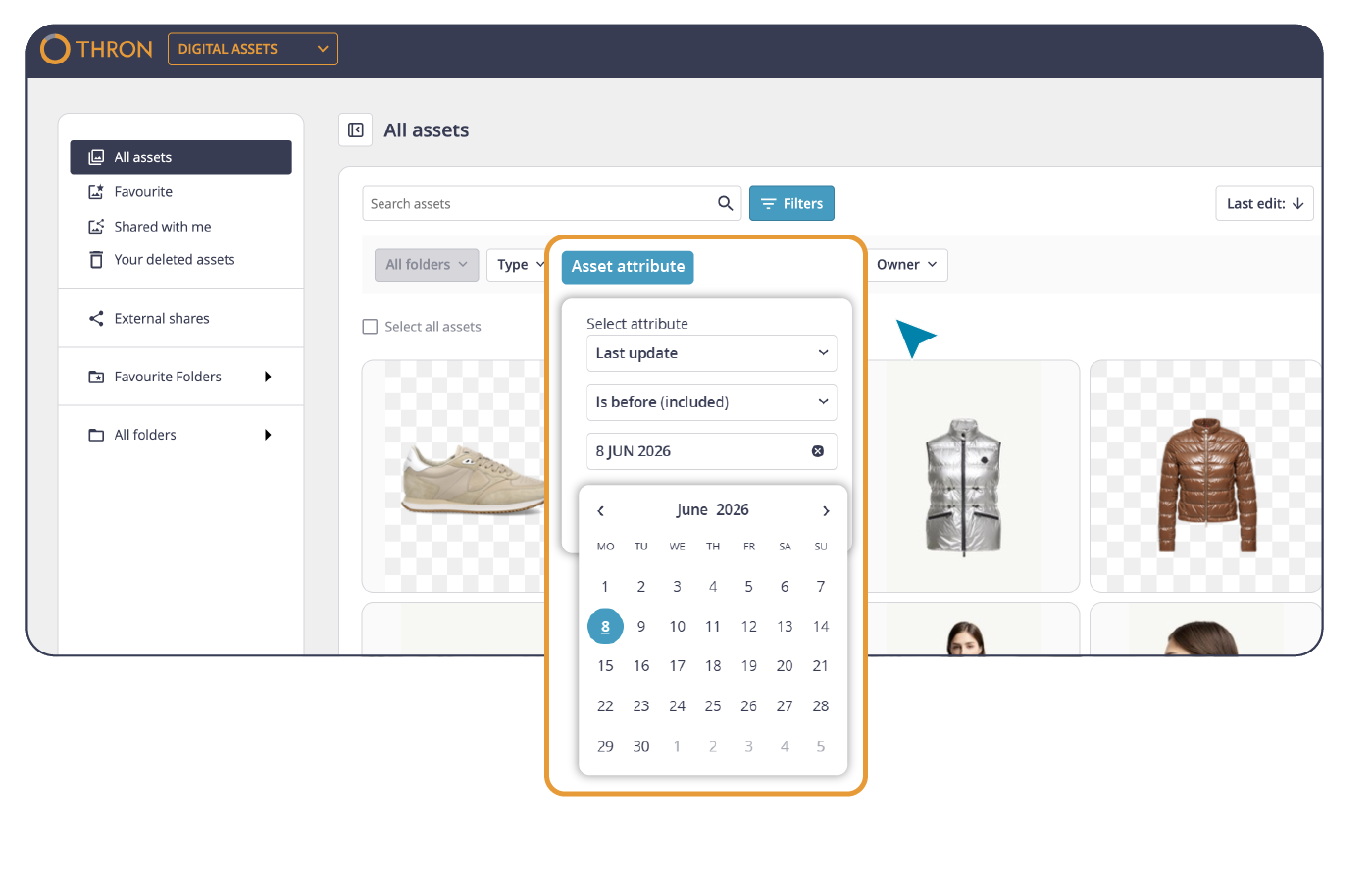
Some content has a direct relationship with time: images whose copyright expires within 30 days, assets uploaded during the last campaign, everything that was modified the week before a launch. Finding them, until now, meant scrolling, combining filters, and running manual checks.
Starting with this release, the Digital Asset Library lets you filter by date range on any date-type attribute. The filter offers three selection modes:
Specific date: to find assets tied to a particular day
Knowing which assets have copyright expiring soon, what has just arrived, and what has been updated becomes part of your daily workflow, letting you retrieve assets tied to campaigns, events, or seasonal needs with precision and in the shortest time possible.
When you already know the name of the file you’re looking for, browsing the entire Library is not the fastest route.
Starting with this release, the filename is available as a system attribute in the attributes section of the Digital Asset Library: filterable, visible, and non-editable.
Anyone working with defined naming conventions, files delivered by agencies, assets organized according to company standards, or content identified by name in external systems now has a direct link between the name they already know and the asset in the Library.
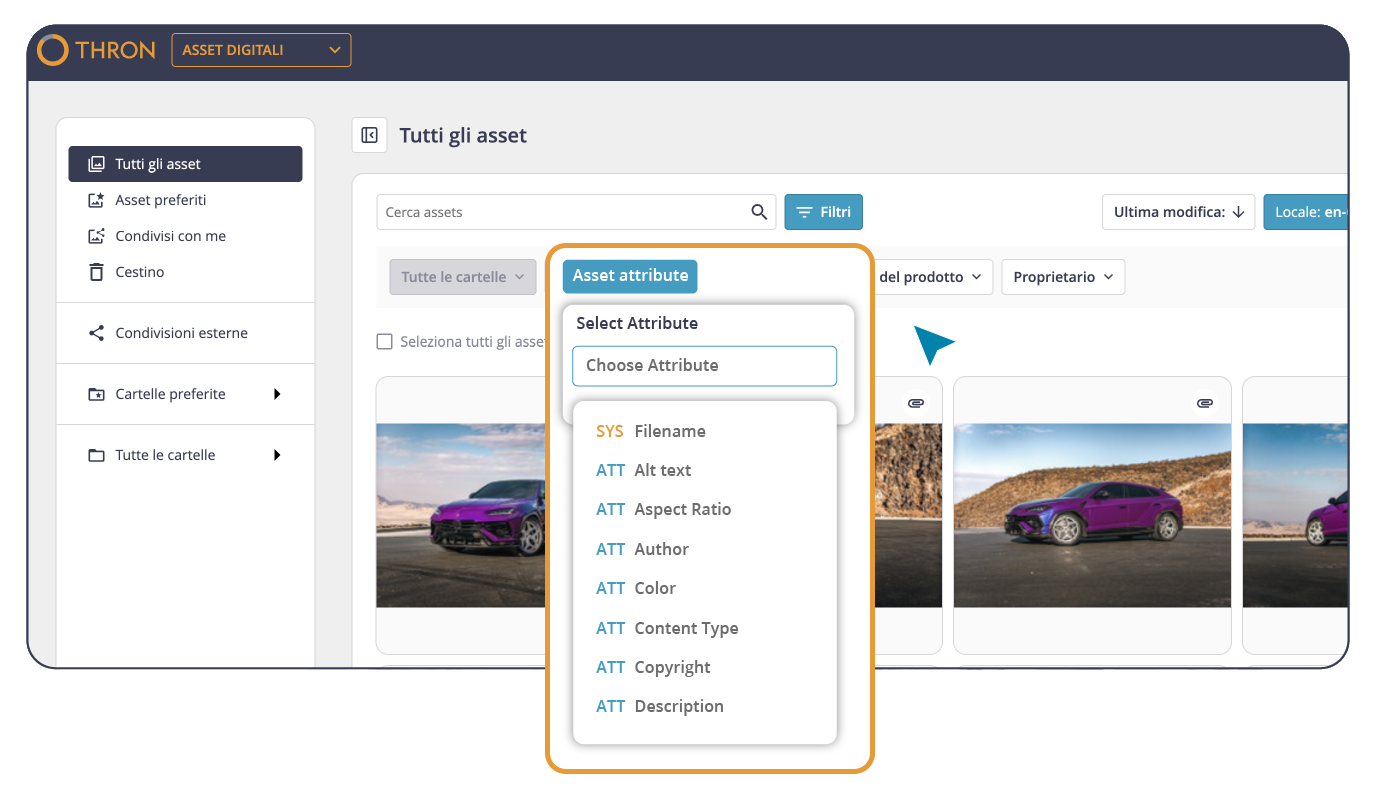
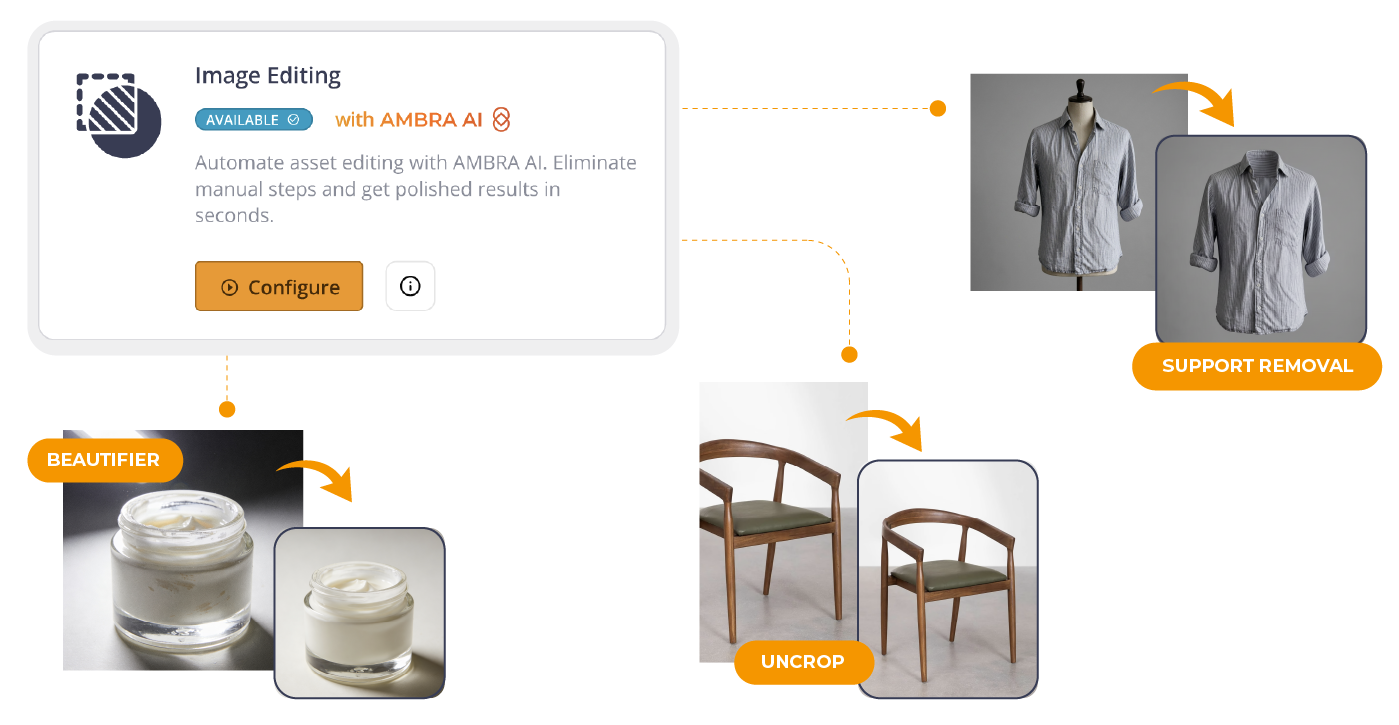
Image Editing automation already made it possible to apply visual transformations to entire folders without manual intervention: background removal, shadow, padding, centering, and margin.
With this update, the catalog of available transformations expands with three new Retouch features from AMBRA AI Transform:
Support Removal: removes hangers, mannequins, and other scene props
Uncrop: regenerates missing portions of a photographed product
Beautifier: automatically enhances the appearance of the subject
The configuration logic stays the same: choose the source folder, select the transformations to apply in combination, and set the frequency. The automation runs without any further input, ensuring visual consistency at scale.
You can also choose whether each transformation generates a new version of the original asset (so already-published channels update automatically without having to redefine references and integrations) or a separate new content item, keeping the original completely intact.
Before running the automation across the entire folder, you can test the transformations on a sample image and save the configuration only once the result is exactly what you were looking for.
AI Editing on THRON Platform is expanding. With AMBRA AI Transform, you choose the type of operation from seven structured modes, each built around a real-world use case. Optimized templates guide the workflow with no prompt engineering skills required. It’s also accessible directly from the asset list by clicking the three-dot menu and selecting Transform image.
Five AI-powered post-production tools, all brought together in a single workspace.
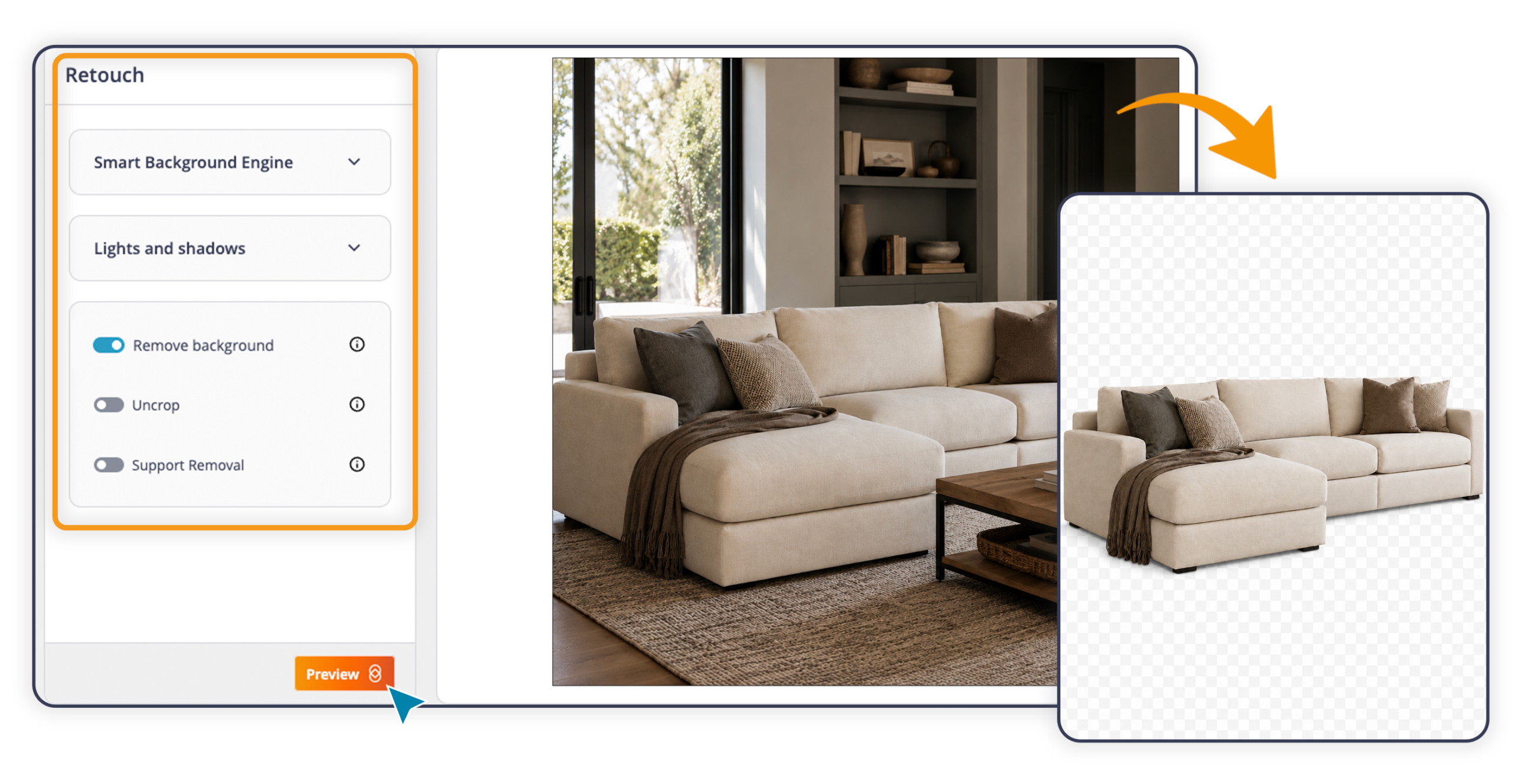
Smart Background: background removal or replacement, plus extension beyond the borders
Visual Composition: adjustment of lighting, shadows, and product placement
Product Beautifier: automatic enhancement of the product’s appearance
Support Removal: removal of mannequins, hangers, and props
Uncrop AI: regeneration of missing parts of the main product in the photo
 Human Touch
Adds a human presence to still life shots. Choose the model’s characteristics (gender, ethnicity, pose), decide whether to include a setting or keep a neutral background, and define the shooting angle. The AI generates the scene: a garment being worn, a cream held in hand, a tool in use. Particularly useful for fashion, beauty, grocery, manufacturing, and sporting goods.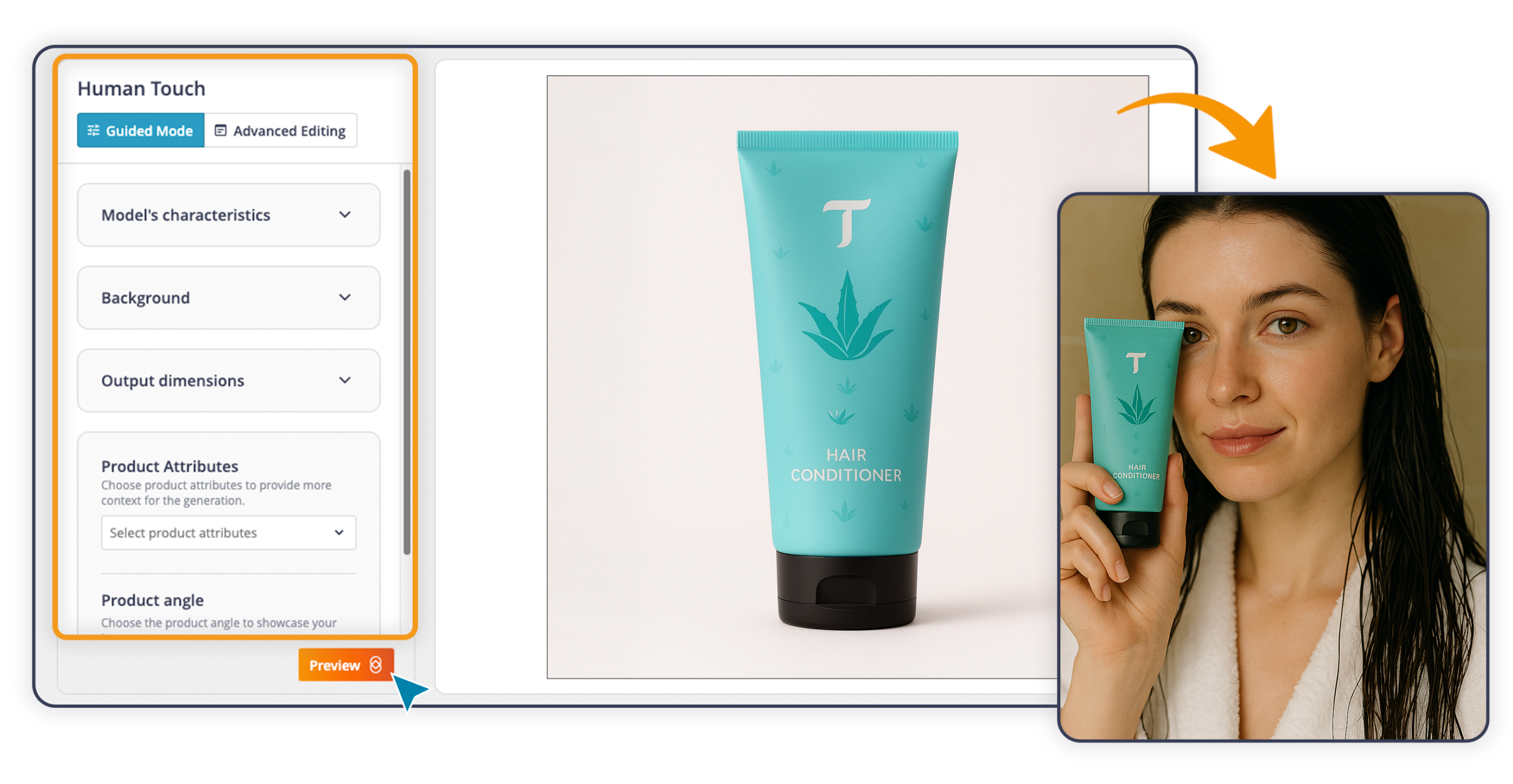
Place your product in an environment, indoors or outdoors. Define the type of setting and the framing characteristics, and the AI will position the product in the chosen context with full visual consistency. A sofa in a living room, a car in a showroom, an appliance in a kitchen.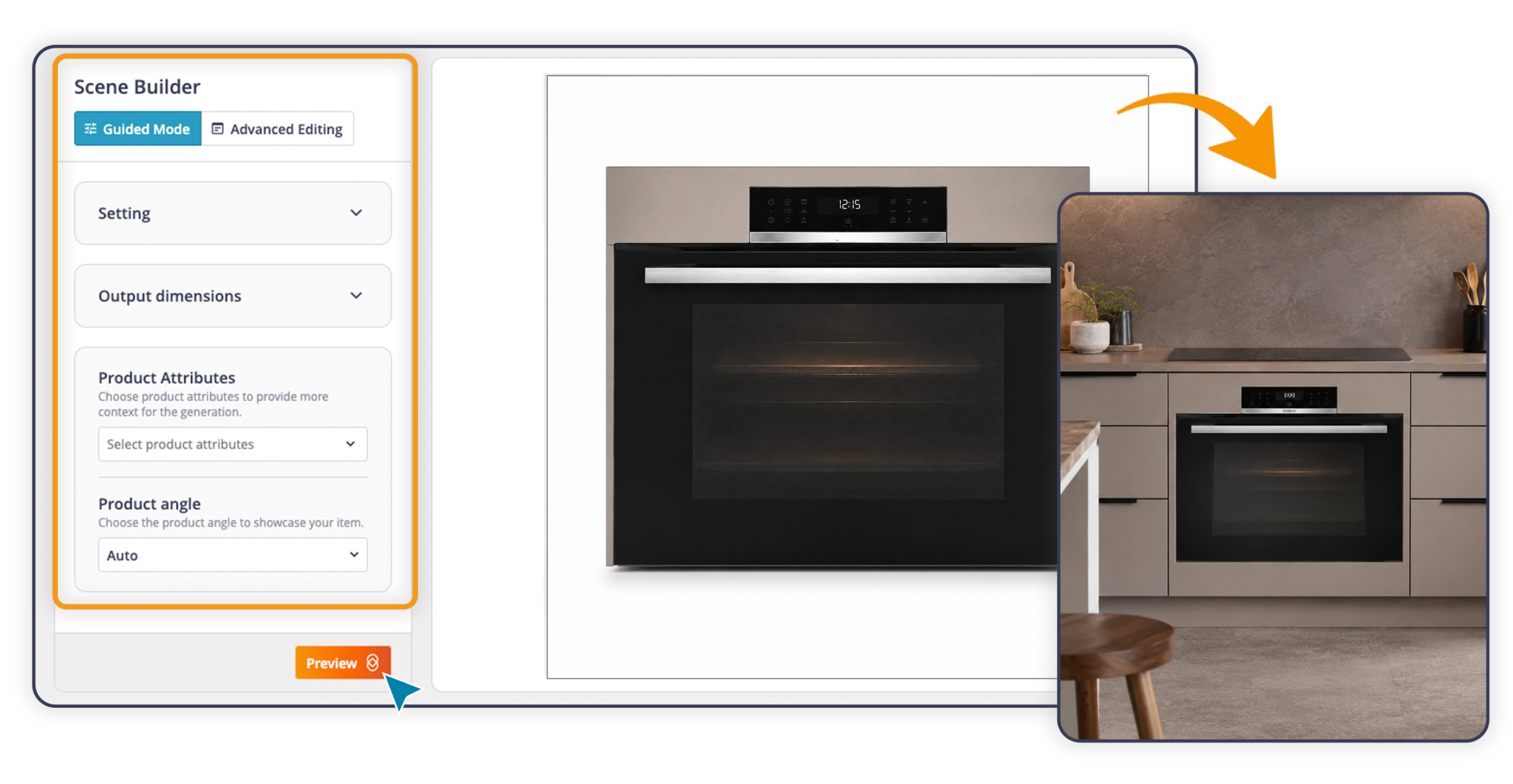
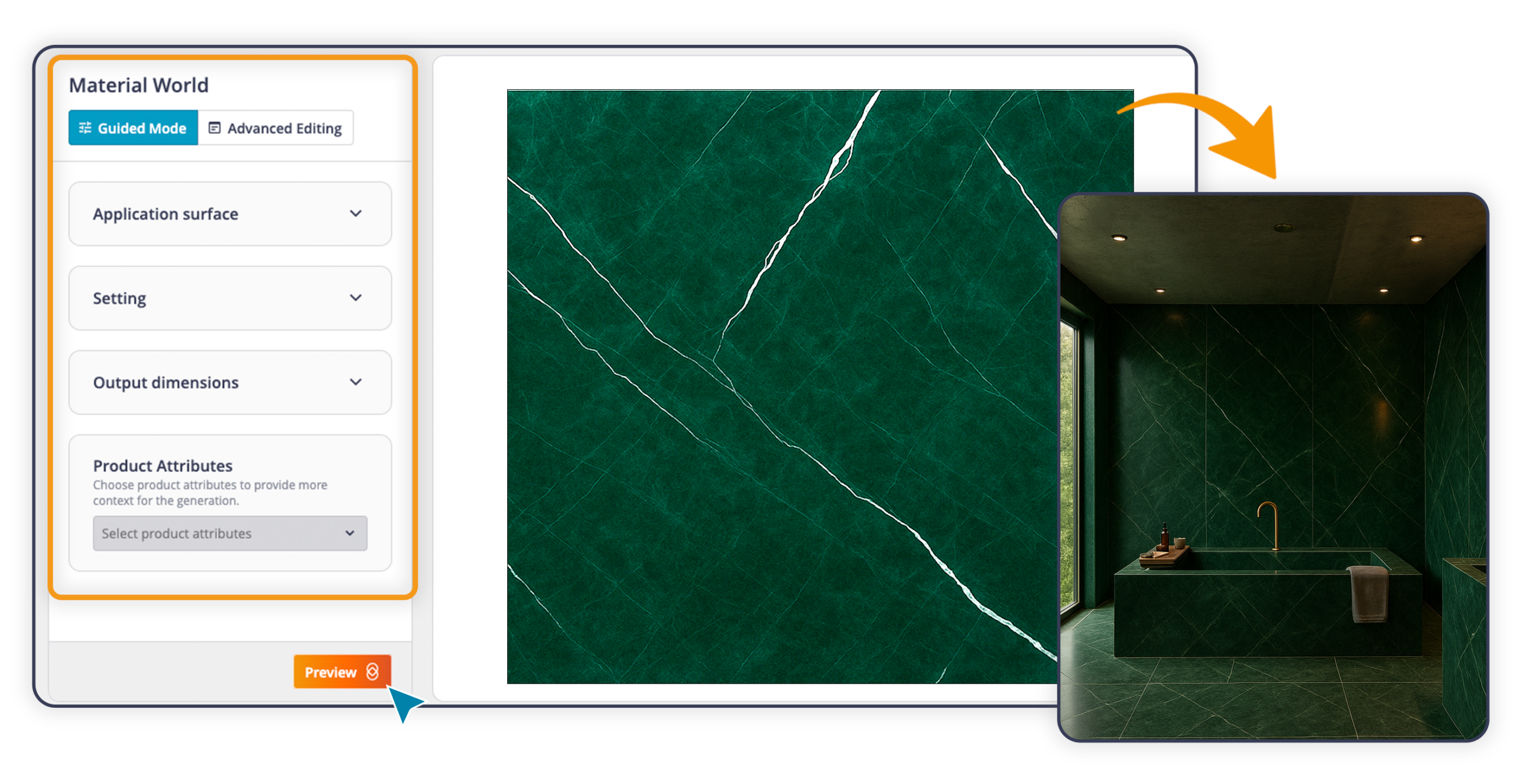
Starting from an image of a porcelain stoneware floor, a marble cladding, or a wood panel, the AI reads the visual characteristics of the material and generates a setting that shows it already installed. A tile becomes a bathroom; a parquet floor becomes a living room.
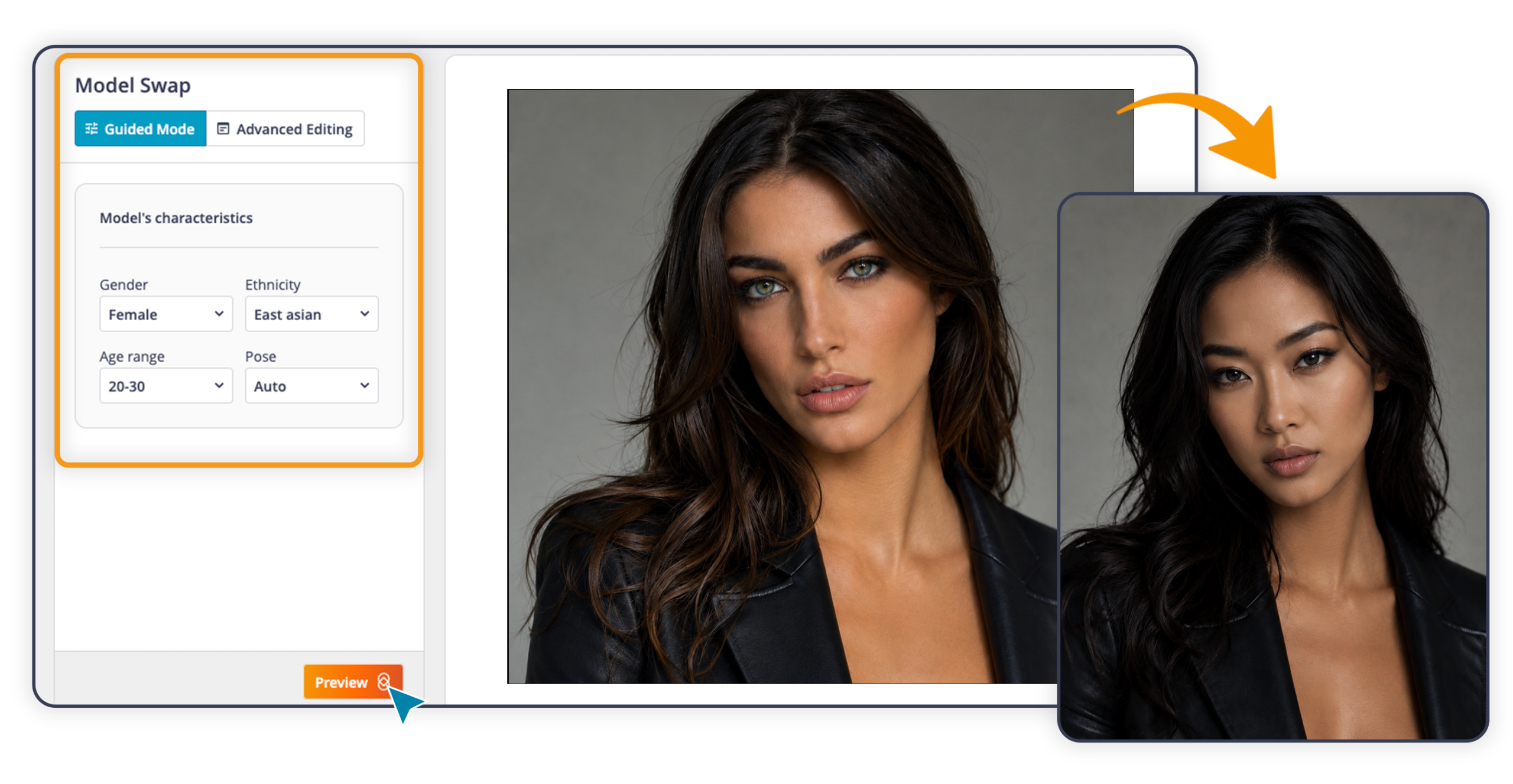
Replace the model in an existing shot while keeping the product unchanged, with the option to alter the pose as well. Useful when the usage rights for an image expire or when the same shot needs to be adapted for a different market.
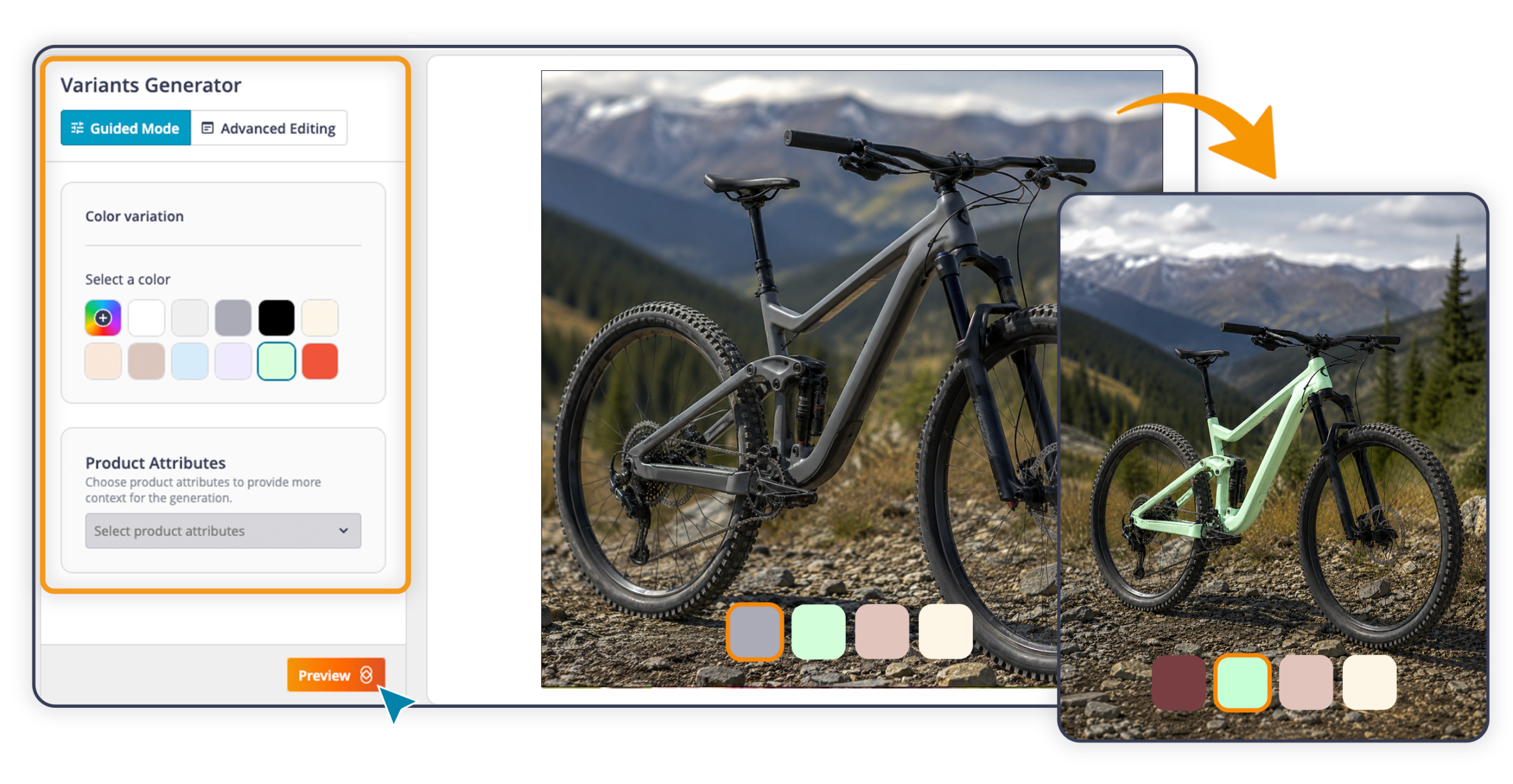
From a single shot, the entire color range. One image becomes the starting point for generating all color variants of a product, giving you a single source asset for the whole collection. You can select a preset, enter a color code (HEX), or describe it using advanced prompting.
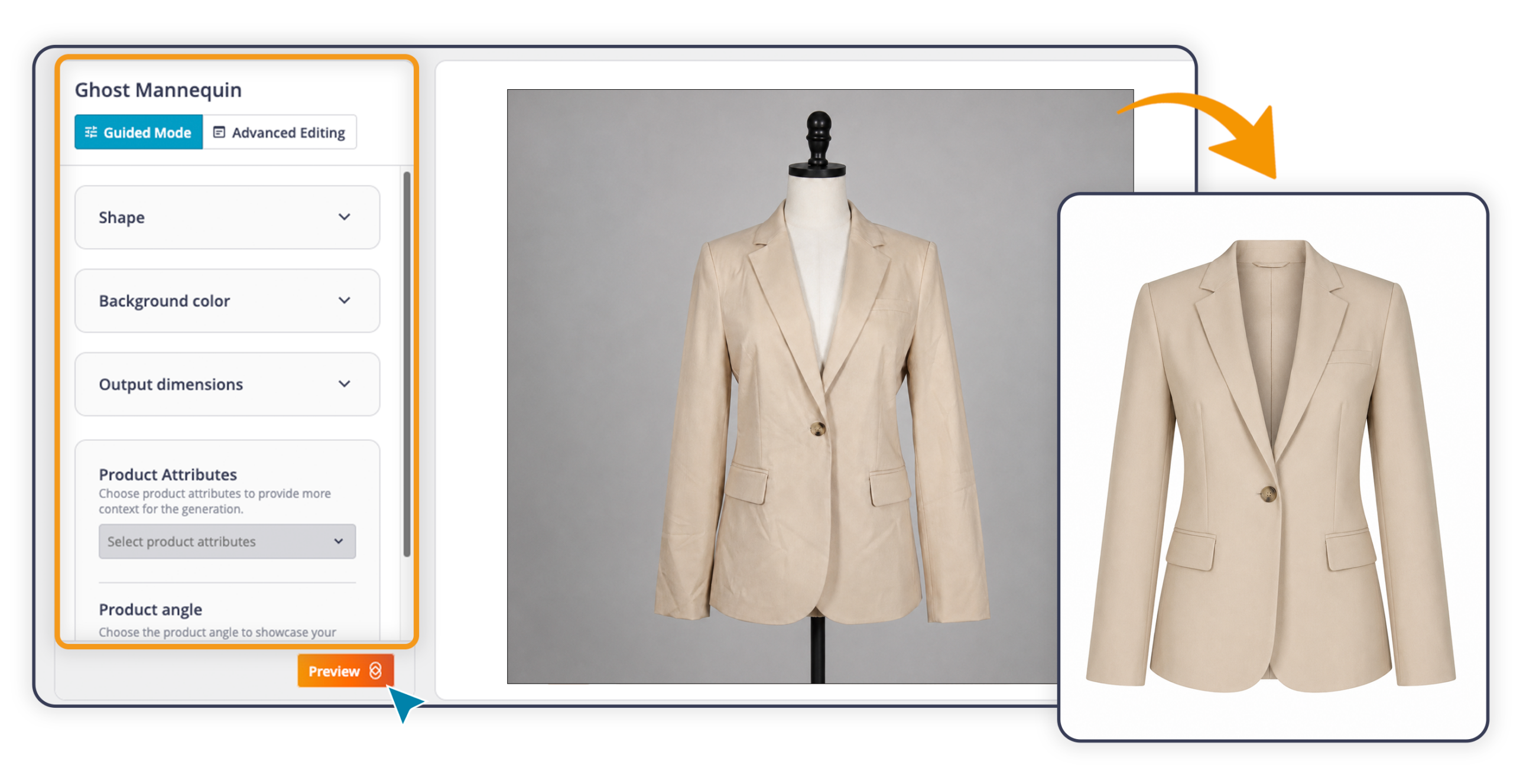
Turns a photo of a garment into a clean, professional image. Starting from the original shot, the AI corrects the lighting and removes creases and imperfections. Shape and fit are communicated clearly and professionally, in line with fashion catalog standards.
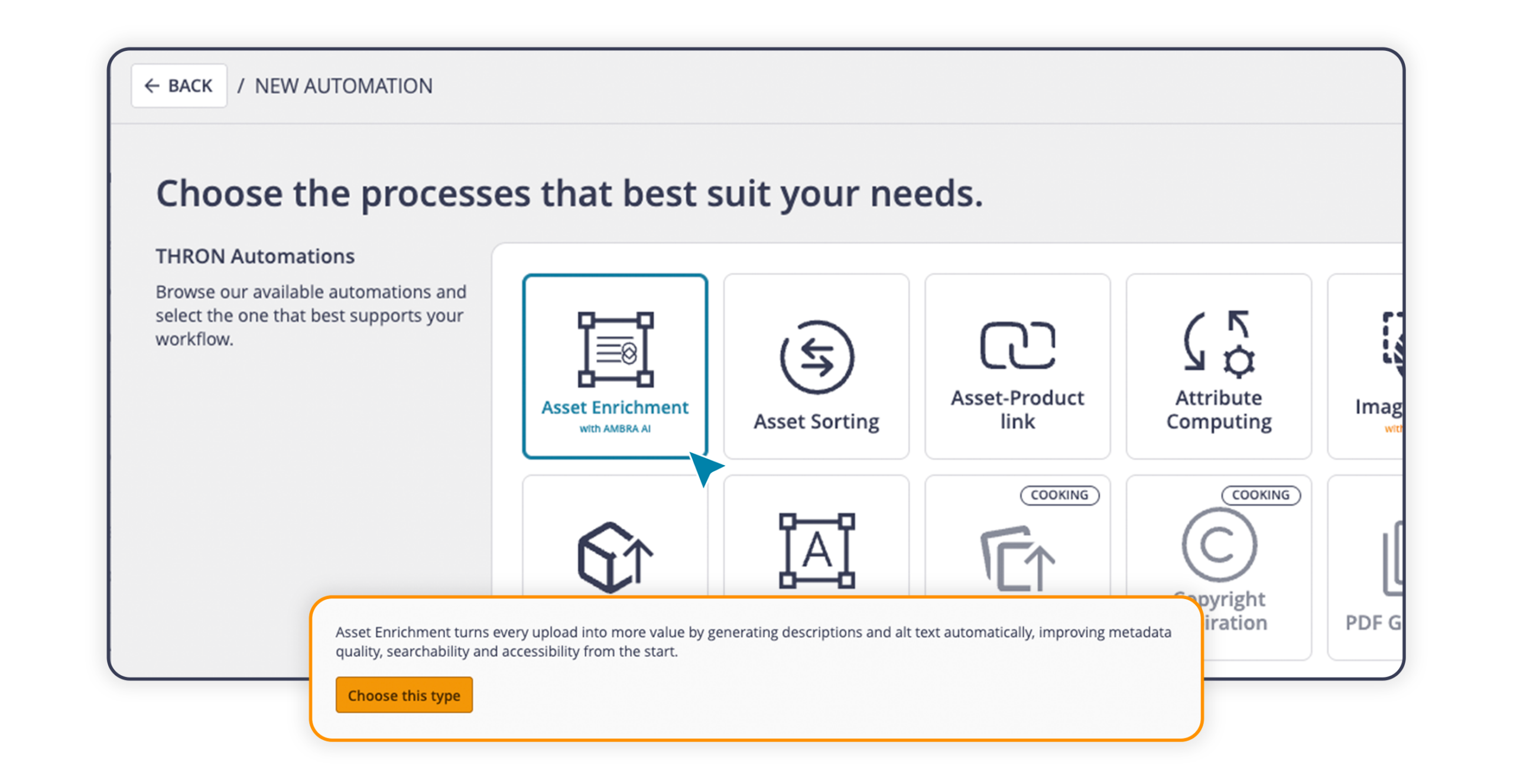
When images or documents are uploaded or updated in THRON Platform, the Asset Enrichment automation kicks in and AMBRA AI analyzes the content, automatically detecting color, type, orientation, and aspect ratio. At the same time, the AI fills in the text fields you’ve selected from your data model attributes. You can configure multiple automations, each with different inputs and purposes.
For teams managing large archives, metadata is complete from the very first moment. Consistent, structured descriptions improve asset searchability within the platform, and automatically generated alt texts support compliance with European digital accessibility regulations.
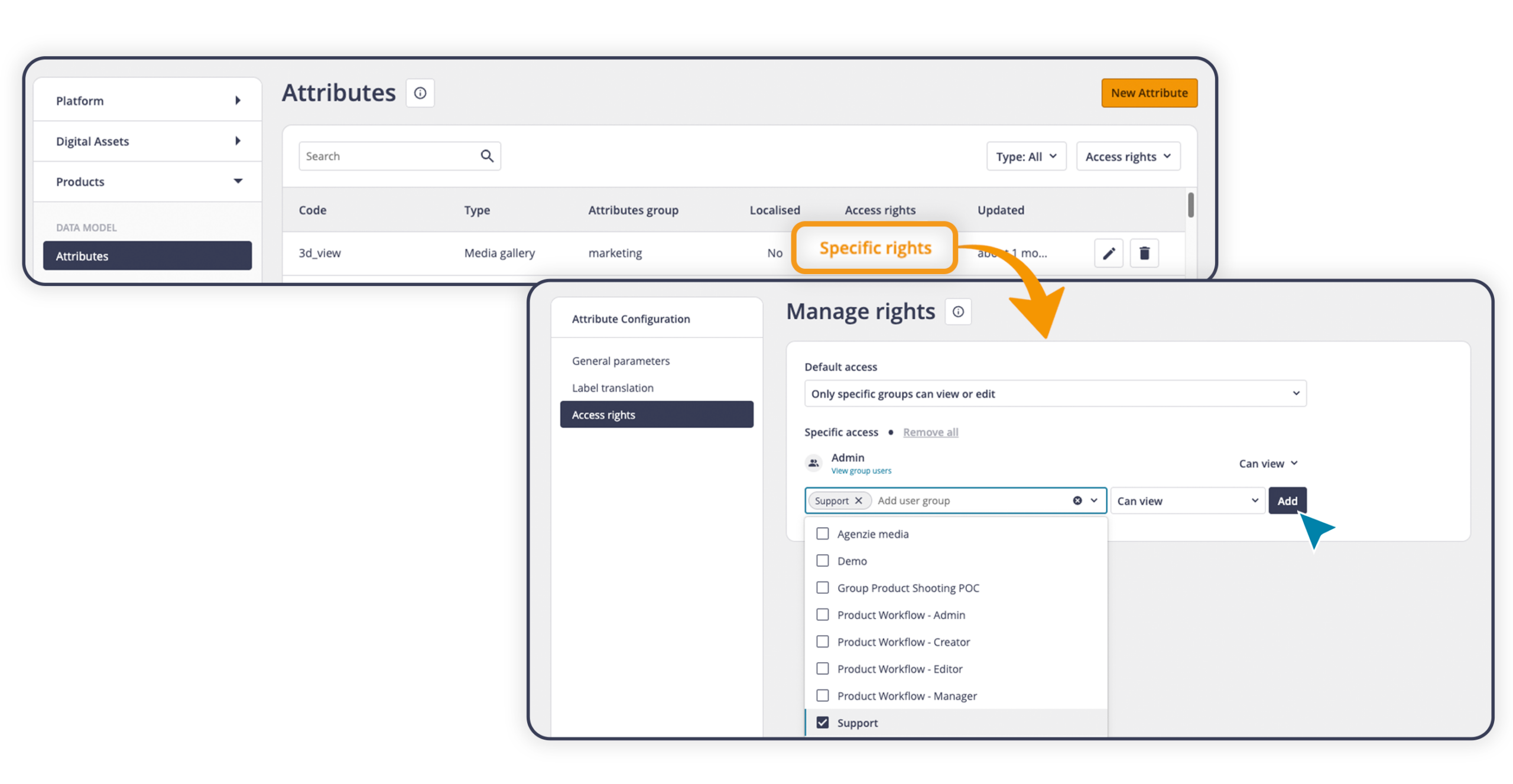
With selective attribute permissions, you can assign read or write access to each user group for every individual attribute. If no permission is assigned, the attribute won’t appear in the interface or in the export options.
Read: the attribute is visible but cannot be edited
Write: the attribute is visible and can be edited
Permissions are set on an attribute-by-attribute basis. This is because people doing a specific job often need to view information from multiple areas without necessarily being able to edit all of it. A marketing team member, for example, might read ERP data to write a product description without needing to update it.
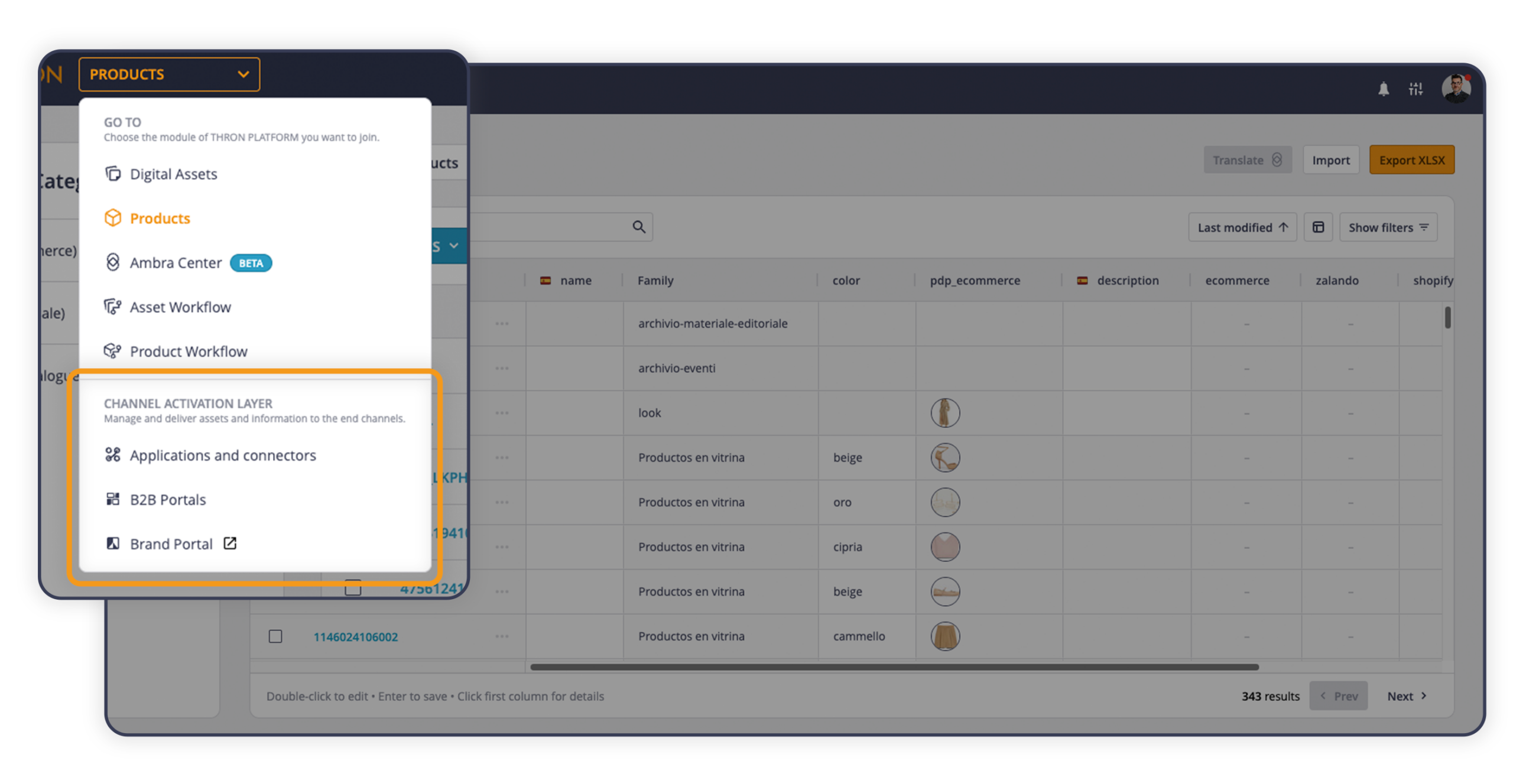
The B2B Areas, the portals that THRON provides for suppliers and resellers, are now accessible from the main menu under the new Channel Activation Layer section. If only one area is active, it opens directly with a single click; if more than one is active, a selection window lets you choose which one to open.
Also worth noting: Analytics moves to Platform Tools, alongside other platform configuration and monitoring utilities such as Users and Taxonomy. The everyday working menu becomes cleaner, with operational tools on one side and monitoring and configuration tools on the other.
In THRON Platform, there is a central repository that brings together all of the company’s products, along with all their information. From this release onwards, you can create separate catalogues for each operational context within that repository, each with its own categories. For example, the e commerce catalogue might include sections such as “New Arrivals”, “Outlet” and “2026 Catalogue”, while the catalogue for the reseller network could be organised by geographical area.
The same product can appear in multiple catalogues at the same time, because catalogues do not duplicate data. They all draw on the same central repository, organising products in different ways depending on who is viewing them and for what purpose.
Any products that have not yet been assigned remain available at all times in the “Not in Catalogue” section, which can be accessed from the left hand column alongside all the catalogues that have been created.
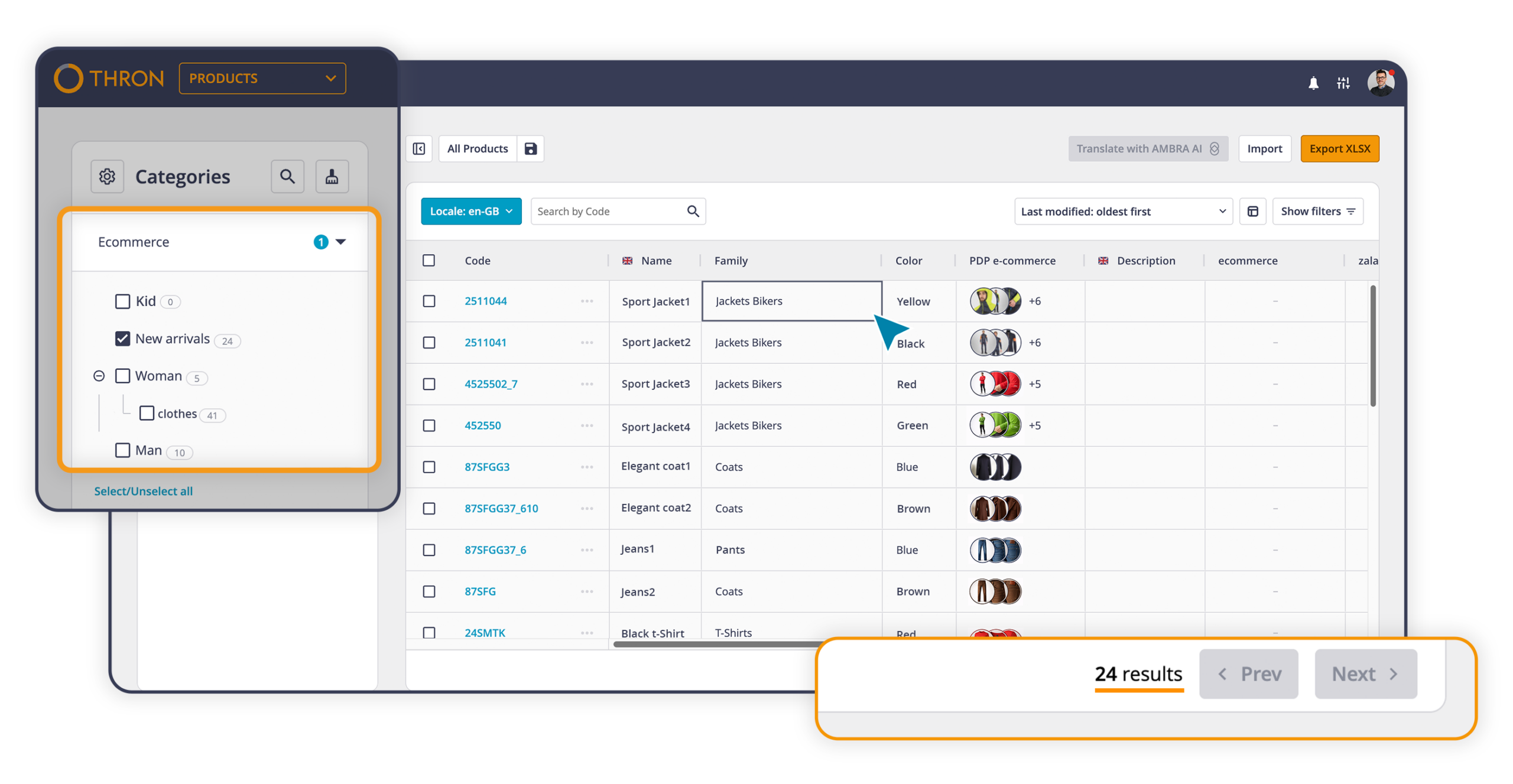
Some changes to the interface:
The catalogue configuration is available in the platform settings, immediately after Families.
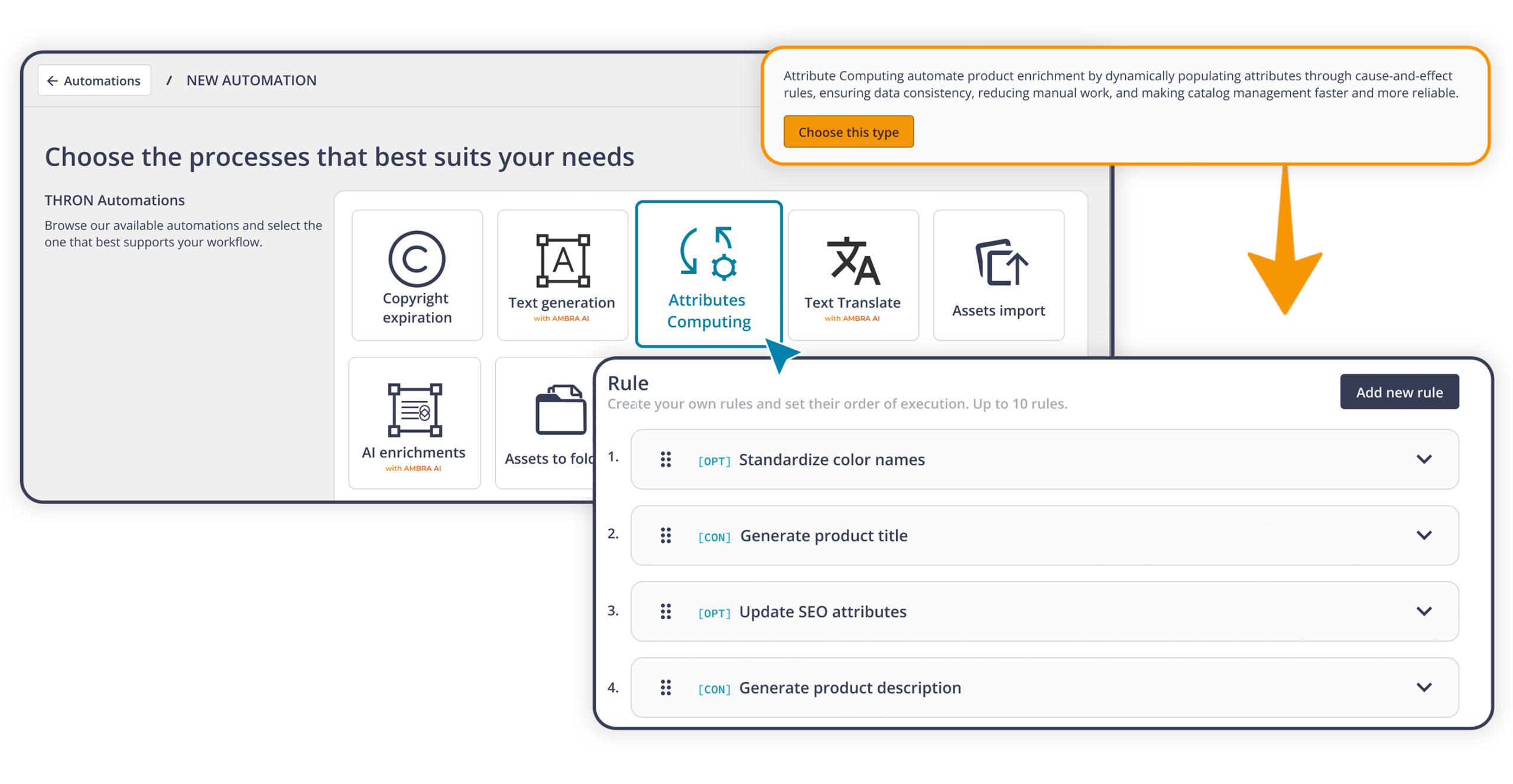
The first of the three Attributes Computing steps is now available, introducing the new Automation Studio automation designed to keep catalogue data consistent over time.
Many companies manage product information in separate business systems such as ERP software, PLM systems and MDM platforms. These systems often send technical codes that cannot be used directly in the catalogue as they are.
Conversion Rules automate this transformation process. Starting from a value already available in THRON Platform, such as a colour code like “000000” received from an external business system, they automatically convert it into the values needed for each use case. The same code can therefore become “Nero” for the Italian catalogue, “Black” for the English one, and also update the colour filter for e commerce, all in a single step.
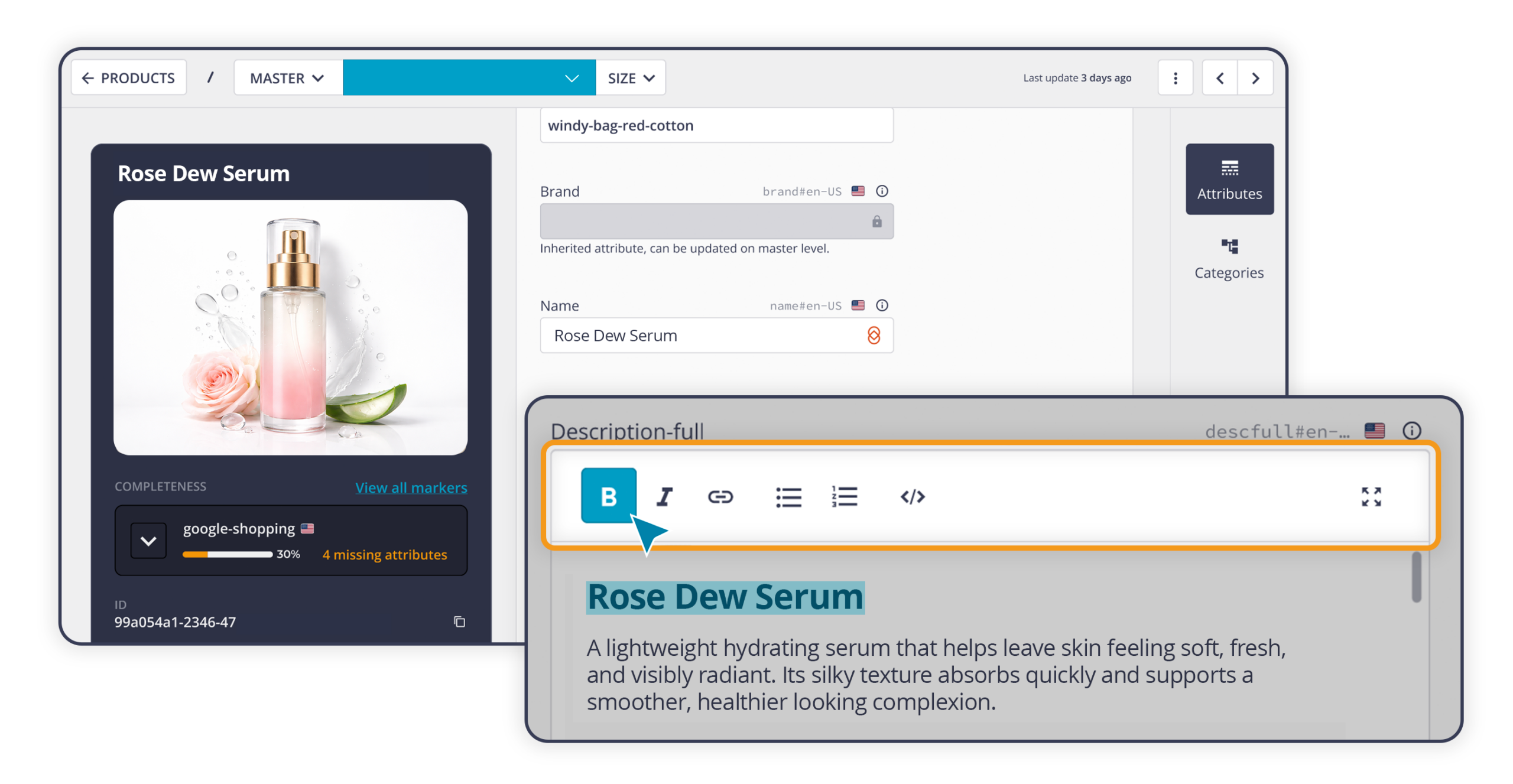
In product pages, some information benefits greatly from formatting: a bold heading, a bulleted list in the body text, a table with technical specifications, or a link to a more detailed page. Until now, adding this kind of content in THRON Platform required HTML to be written manually, which was both technical and prone to errors.
Long text fields can now be configured as visual editors: you write, select the text, apply bold, italics, bullet points, links or tables, and immediately see how the content will look once published. This is particularly useful, for example, for presenting sizes, measurements or comparative specifications in a clear format without having to rely on anyone else. The editor is available in a simplified version on the product page, and in an advanced version by expanding the field.
Anyone who previously used paglets to display data in tabular form will find this feature a more direct and fully integrated solution.
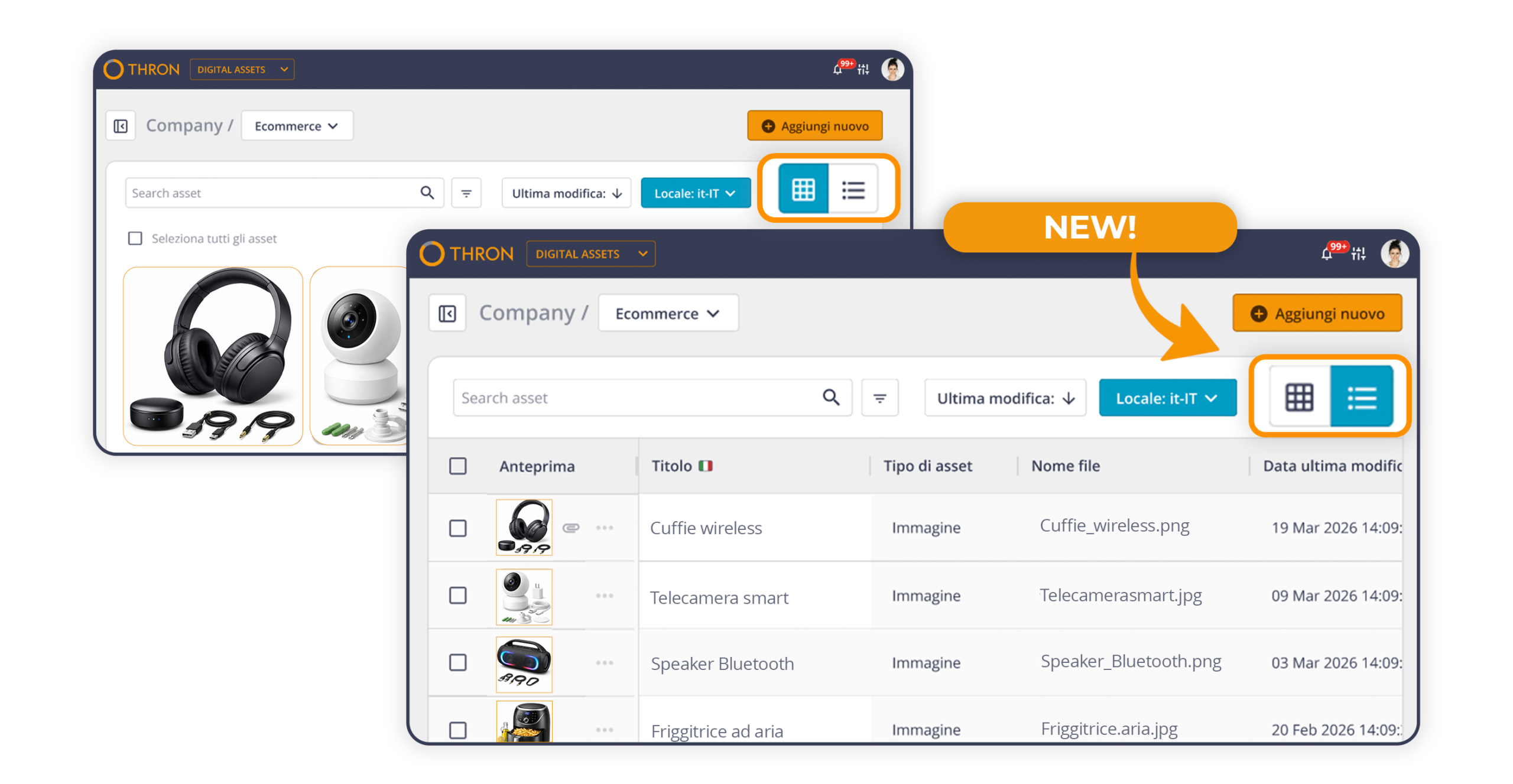
The Digital Asset Library now includes a table view, already familiar to anyone working with the Product Sheet Library, alongside the existing grid view.
Each user can choose which columns to display from attributes such as title, description and author, as well as system information such as modification date, file type and extension. You can select up to ten columns, and the configuration is saved even when switching browser or device.
Anyone with editing permissions can make changes directly in the cells: double click to open the field, edit it, then confirm by pressing Enter or clicking elsewhere. No need to open the detail page, and no interruption to the workflow.
The table view and grid view always stay in sync, so selections, filters and edits carry over seamlessly.
The THRON connector for Drupal, the open source content management system used to build websites and web portals, has been updated with a new interface and three operational improvements:
The result is a smoother media management experience, where searching, selecting and uploading all happen within the same area.
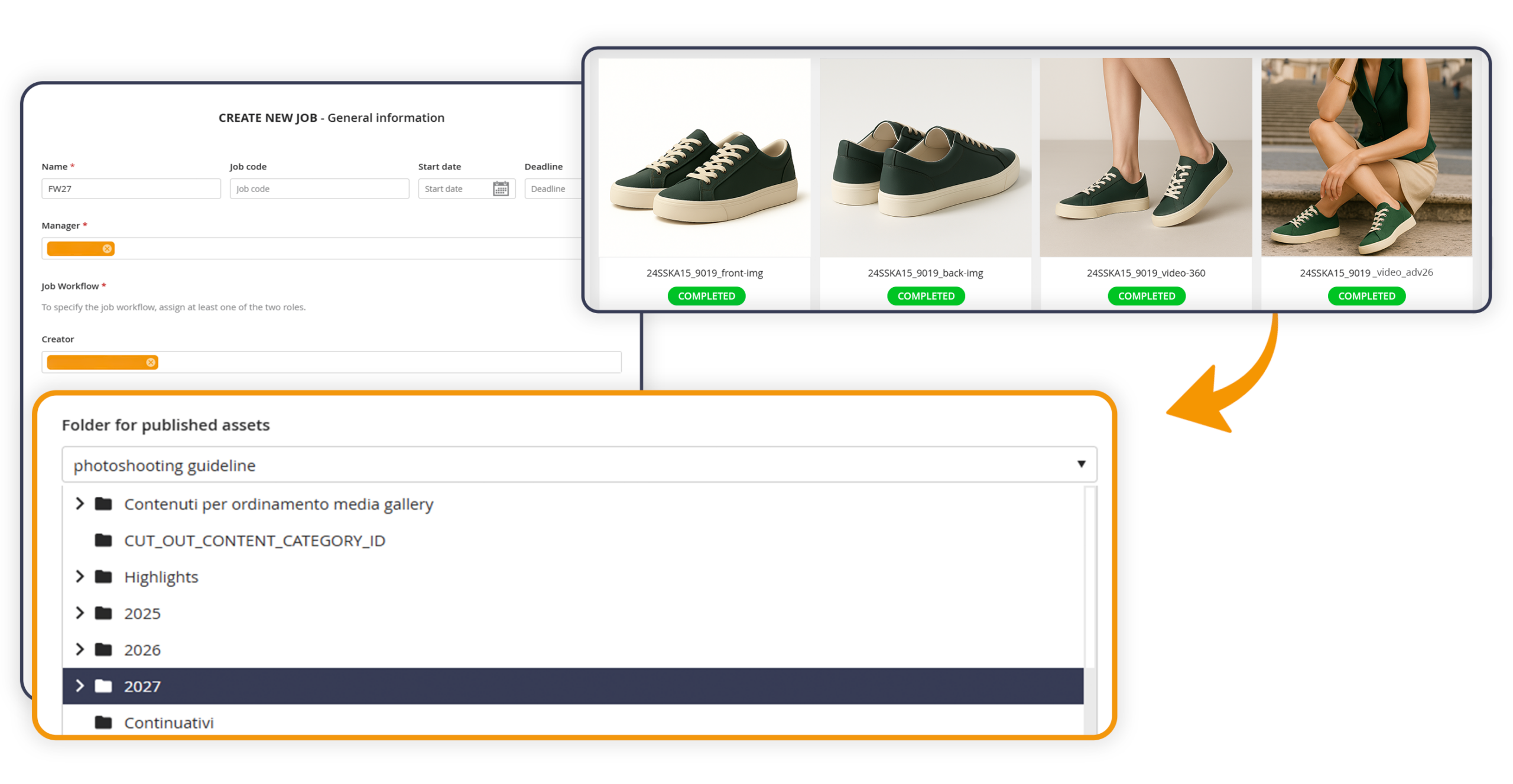
Product Workflow is the tool used to coordinate content production jobs, such as photo shoots, bringing together everyone involved in planning, shooting and approval.
When creating a job, it is now possible to specify a destination folder for approved shots. At the end of the approval process, each asset is automatically copied into a subfolder with the same name as the job, within the selected folder. A copy still remains in the original “Published” folder, so no existing reference is disrupted. The destination folder can be chosen from those you have access to and where you have permission to add content.
This is optional, so anyone who does not configure it can continue working as before.
THRON Drive is a new feature that allows you to access THRON Platform assets directly from Mac Finder and from major creative and productivity software. The integration is made possible by CI HUB, an in-app connectivity platform for digital assets.
THRON folders become navigable in the file system, with the same structure, the same filters and the same search logic as the platform. You can open a file, edit it with software and save directly, without having to re-upload or change tools: the new version is updated in THRON automatically, respecting the defined permissions.
Thanks to CI HUB, the following application connectors are available for all operating systems:
Adobe Creative Cloud (InDesign, Photoshop, Illustrator, Premiere and others)
Canva, Figma, Sketch, Adobe Express
Microsoft 365 (Word, Excel, PowerPoint, Outlook), SharePoint
Google Workspace
WordPress, Salesforce
No training is required: it’s like working locally, but you’re inside THRON.
On our blog you can learn more about how THRON Drive accelerates the work of marketing teams and how it simplifies sales and wholesale operations.
Product Workflow introduces an email notification system that automatically updates every participant on relevant project events in which they are involved.
When a new project is created, those with an assigned role receive a summary with name, dates, people involved, guidelines and number of tasks. From that moment, notifications are collected and sent in a single email every ten minutes in case of actual updates, avoiding information overload even for those participating in multiple projects simultaneously.
Each notification reaches the relevant role based on the project status:
Creator: receives notification when the project is created, when new products are added, when their content is rejected and when a shot is approved and moves to the editing phase.
Editor: is notified when a shot is approved and assigned for editing, and when their revision is rejected.
Manager: is notified when a shot is ready for approval and when a revision arrives for evaluation.
All participants: receive notification upon project completion.
The result is smoother collaboration between internal teams and external agencies, with less need to access the platform to check work status.
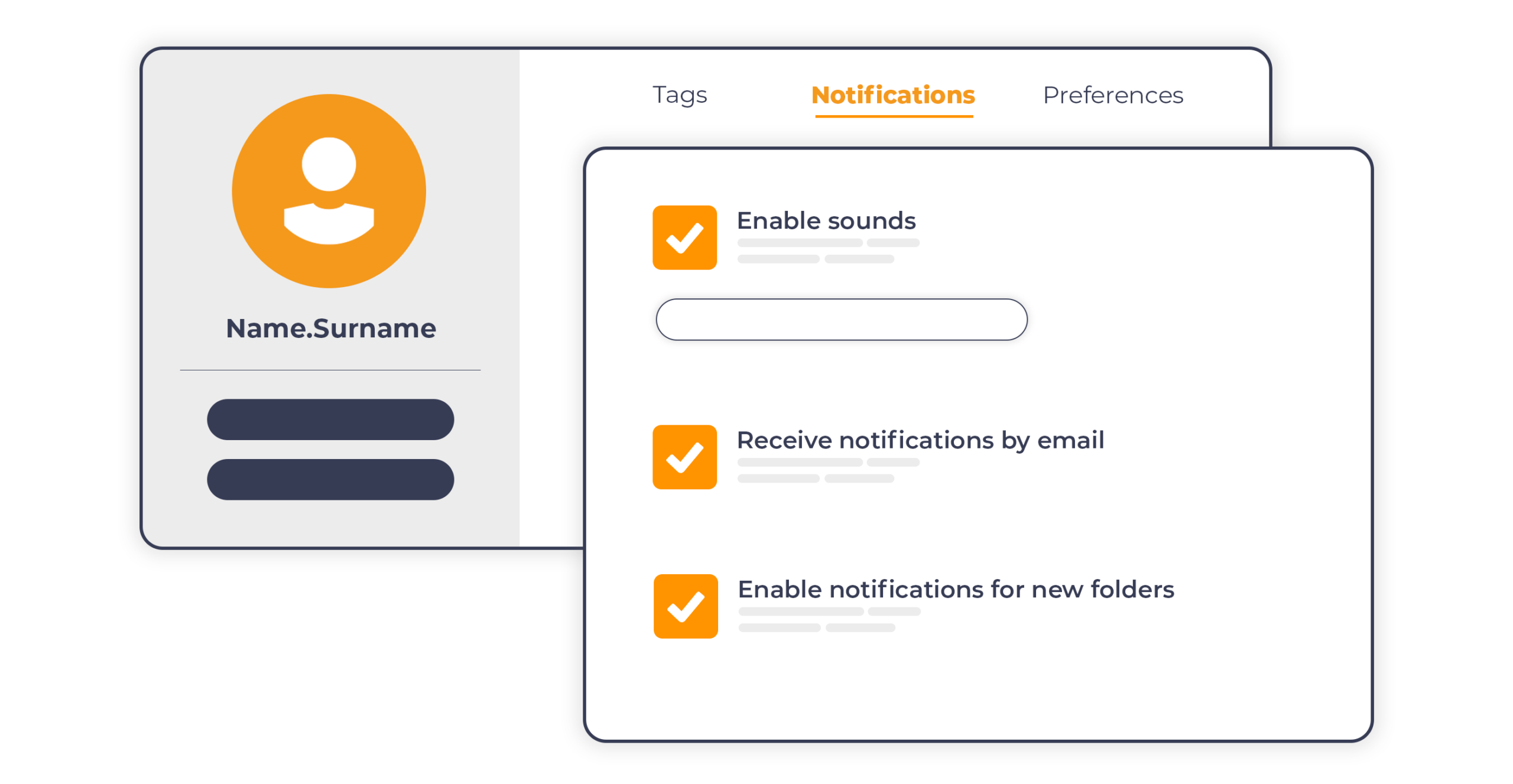
The THRON Universal Player becomes a native event emitter for Google Analytics 4.
In practical terms, an event emitter is a component that detects user interactions with content and automatically sends them to an external analytics system. With this release, THRON’s Universal Player autonomously manages the transmission of events to GA4, covering every user interaction with the content:
when they start, pause or finish playback
when they download a file
when they change quality, speed or volume
when they enable or disable subtitles
when they switch to full screen mode
when they zoom, resize or rotate content
when they navigate between contents of a gallery
No custom development is required anymore: it is sufficient for GA4 to already be configured on the page hosting the Player for all events to be transmitted automatically.
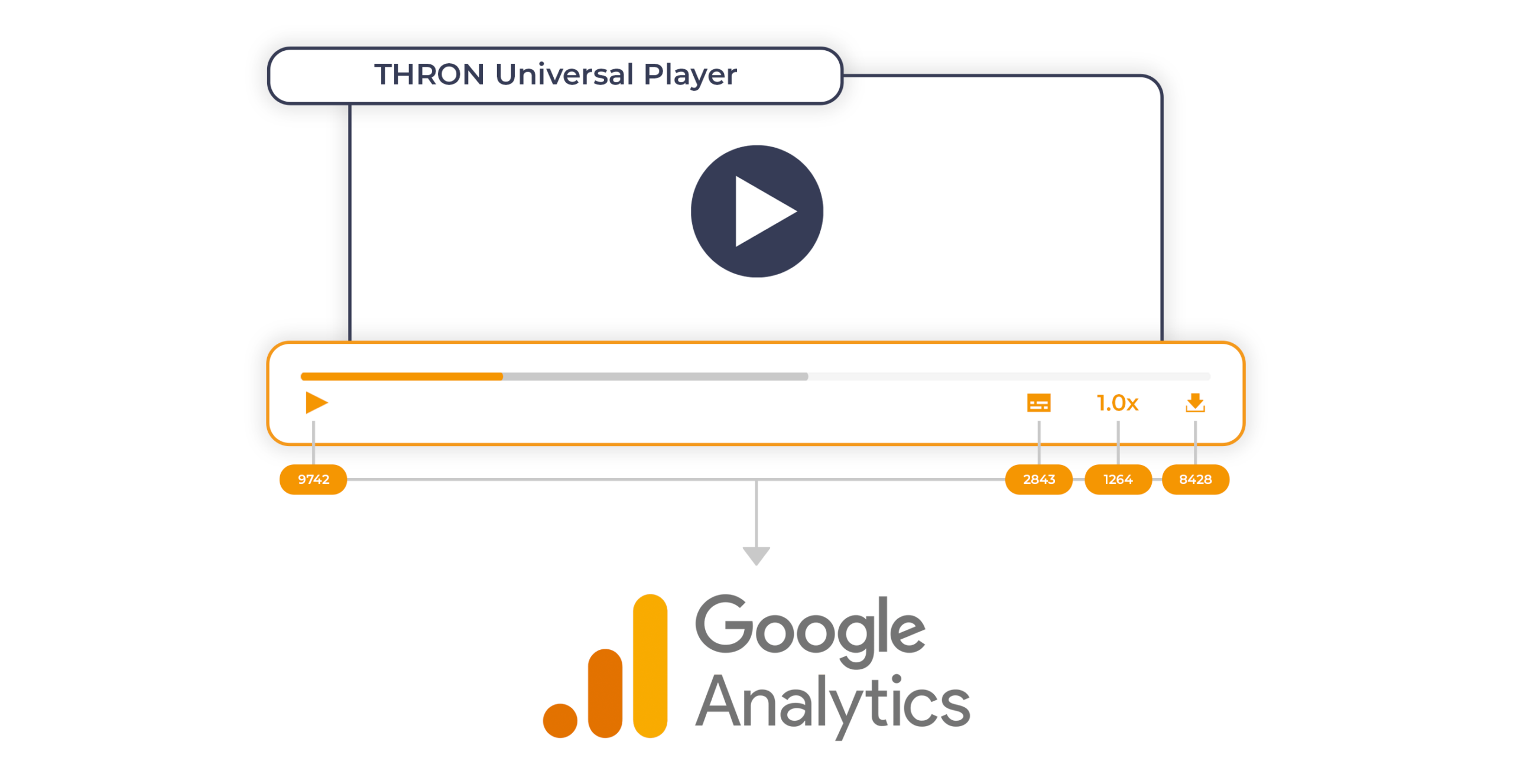
The Digital Asset Library filtering system has been revised to make the most frequent operations even faster and more direct. The available options are now immediately accessible, without intermediate steps, and easier to discover.
In detail:
active filters can be modified directly, without having to remove and reset them from scratch
each filter can be reset independently
the filter panel can be hidden or shown according to needs
it is possible to create new custom extensions on the fly, to meet specific needs without prior configurations
A more fluid navigation, designed for those who work on the Library every day and know exactly what they’re looking for.
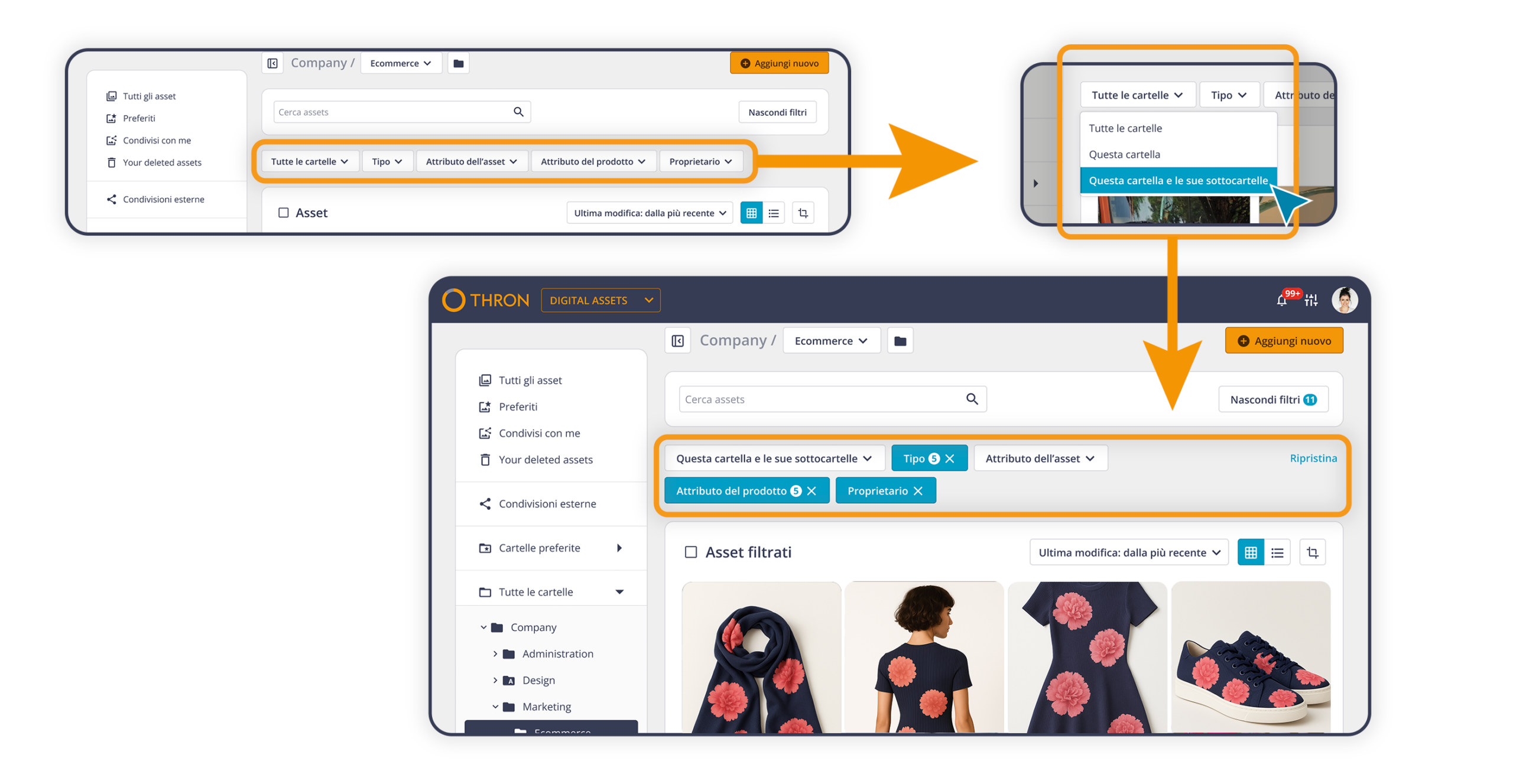
Those who access the B2B area can now download each asset in the resolution most suitable for their use.
The materials uploaded to the platform, often in high resolution to ensure maximum quality across every channel, now also become available in lightweight formats optimized for web and eCommerce.
Based on the permissions of their group, those who download can access the original or limit themselves to derived versions: they select the desired format and proceed, without intermediate steps. The same logic already present in the Digital Asset Library is thus replicated in the B2B portal, ensuring a consistently coherent user experience.
The result:
More autonomous partners in choosing materials
Governed distribution through group permissions
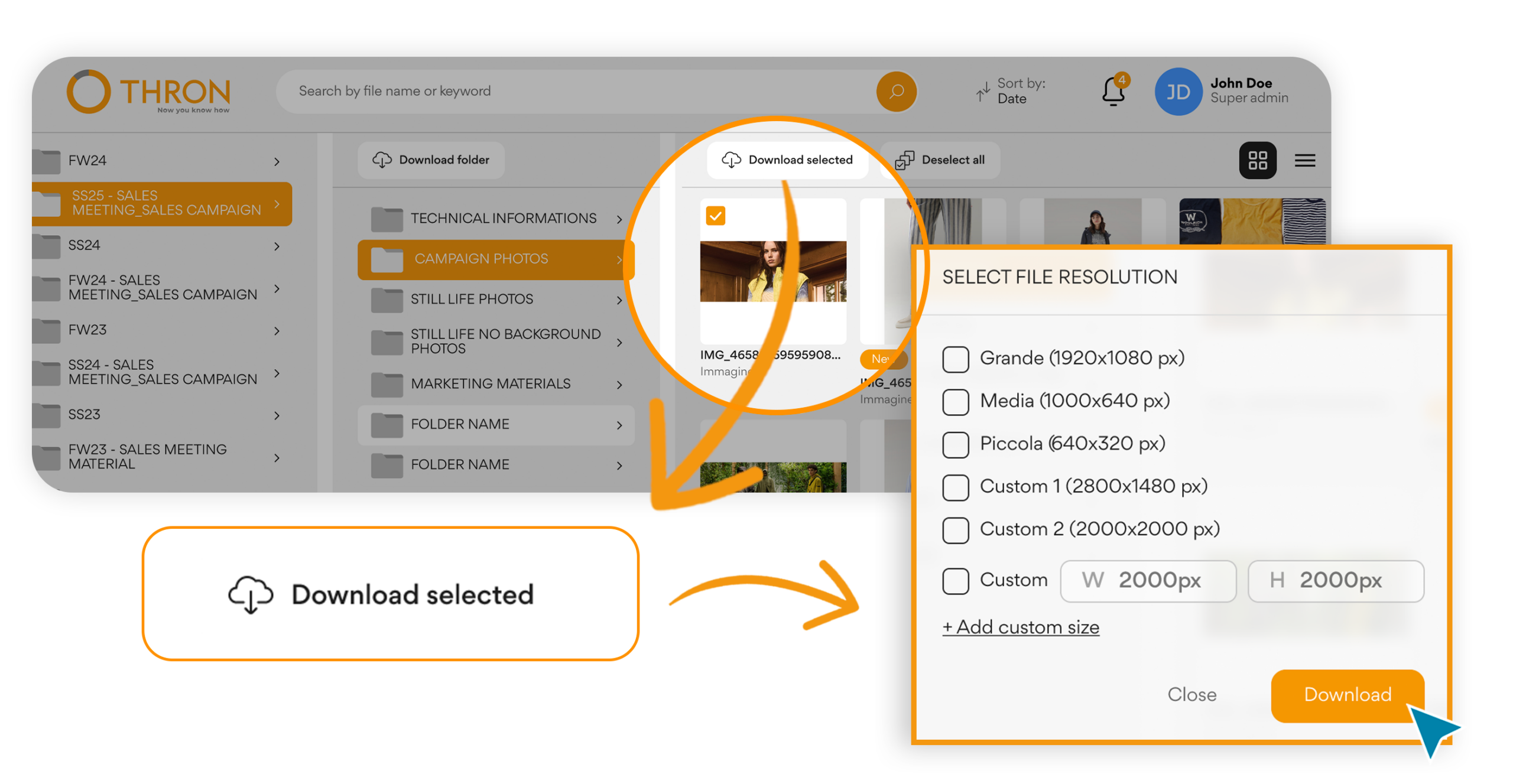
The B2B portal becomes more open to the outside, but always under full control.
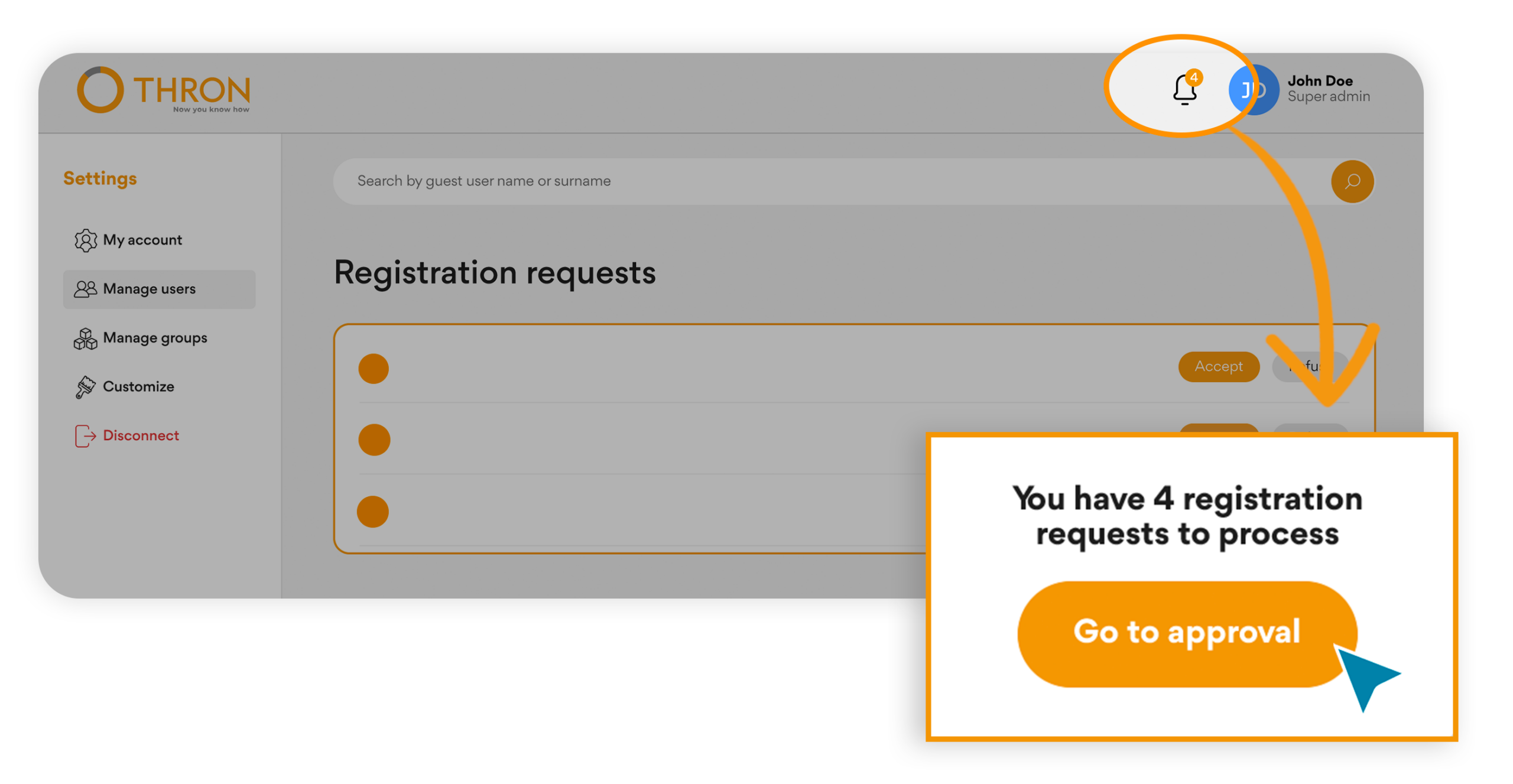
New partners or new operational figures can request access directly from the portal, without email exchanges or manual steps.
Admins and Super Admins receive all requests in a dedicated section, with email notifications and visible alerts on every page. From here they can approve or reject with one click, and those who submitted the request automatically receive notification of the outcome.
An evolution that brings:
An orderly and transparent flow for those entering and those managing
Reduced activation times thanks to automated communications
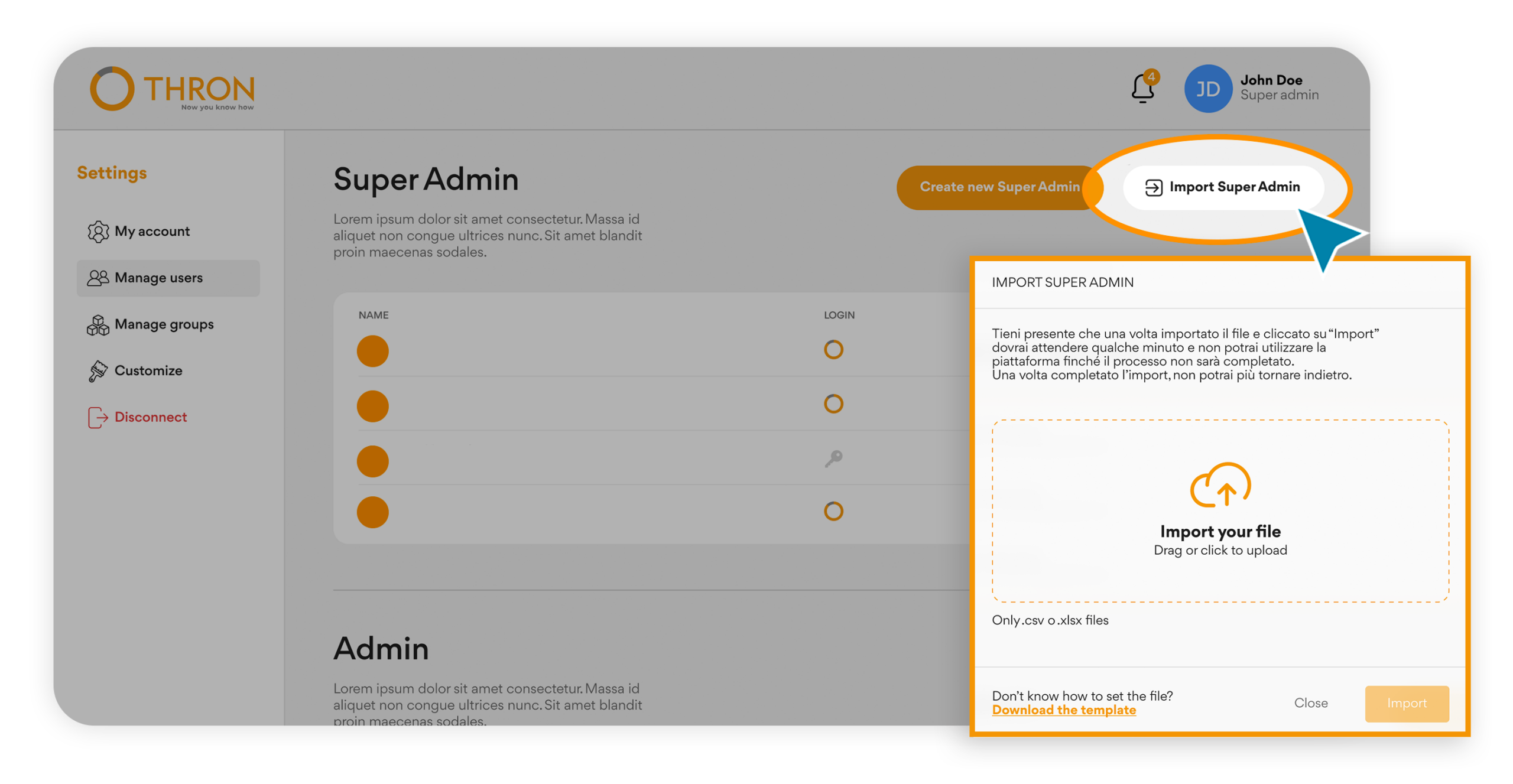
From the management section, you can download a template, fill it in with the necessary information, and upload it to automatically generate all accounts, even of different types.
Super Admins and Admins can now quickly enable entire partner networks in a single operation, facilitating commercial expansion.
The advantages for those coordinating commercial activities:
Scalability without additional effort: the network grows, the operational structure stays the same
No slowdown during commercial expansion periods
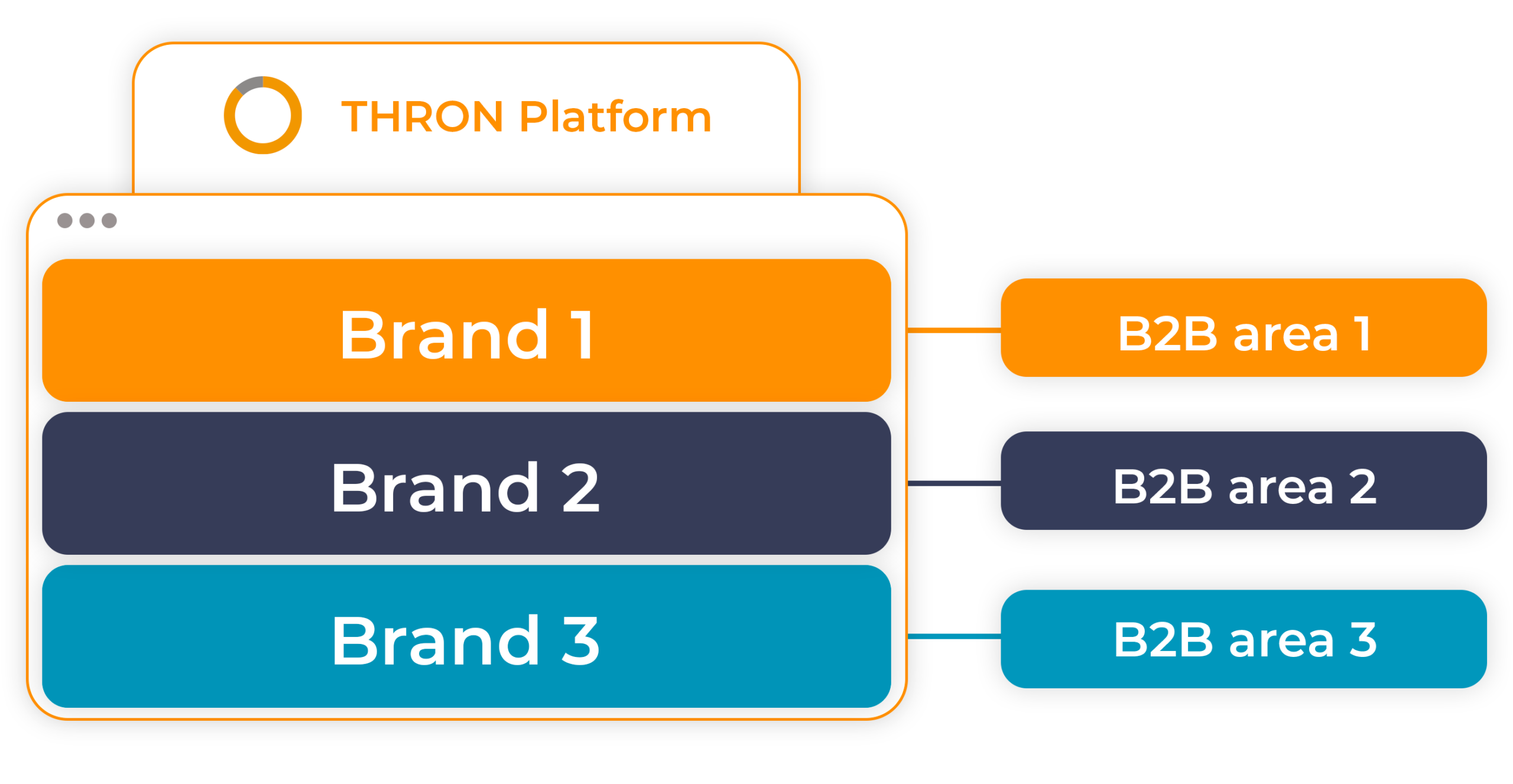
For organizations managing multiple brands within the same THRON environment, this evolution introduces the ability to create dedicated B2B portals for each brand.
Each portal displays exclusively the products of its reference brand, customizable with colors and logo for an experience consistent with the brand.
The mechanism is simple: an attribute valued at the product level determines in which portal it will be visible, and within each portal, administrators decide which catalogs to make accessible to different groups.
Products continue to reside all in the same environment, without duplicates: it’s the attribute configuration that governs what appears in each portal.
This architecture offers:
Simplified governance: each brand manager operates within their own perimeter, without interference
A single data source: products reside in the same THRON environment, visibility is governed by the membership attribute
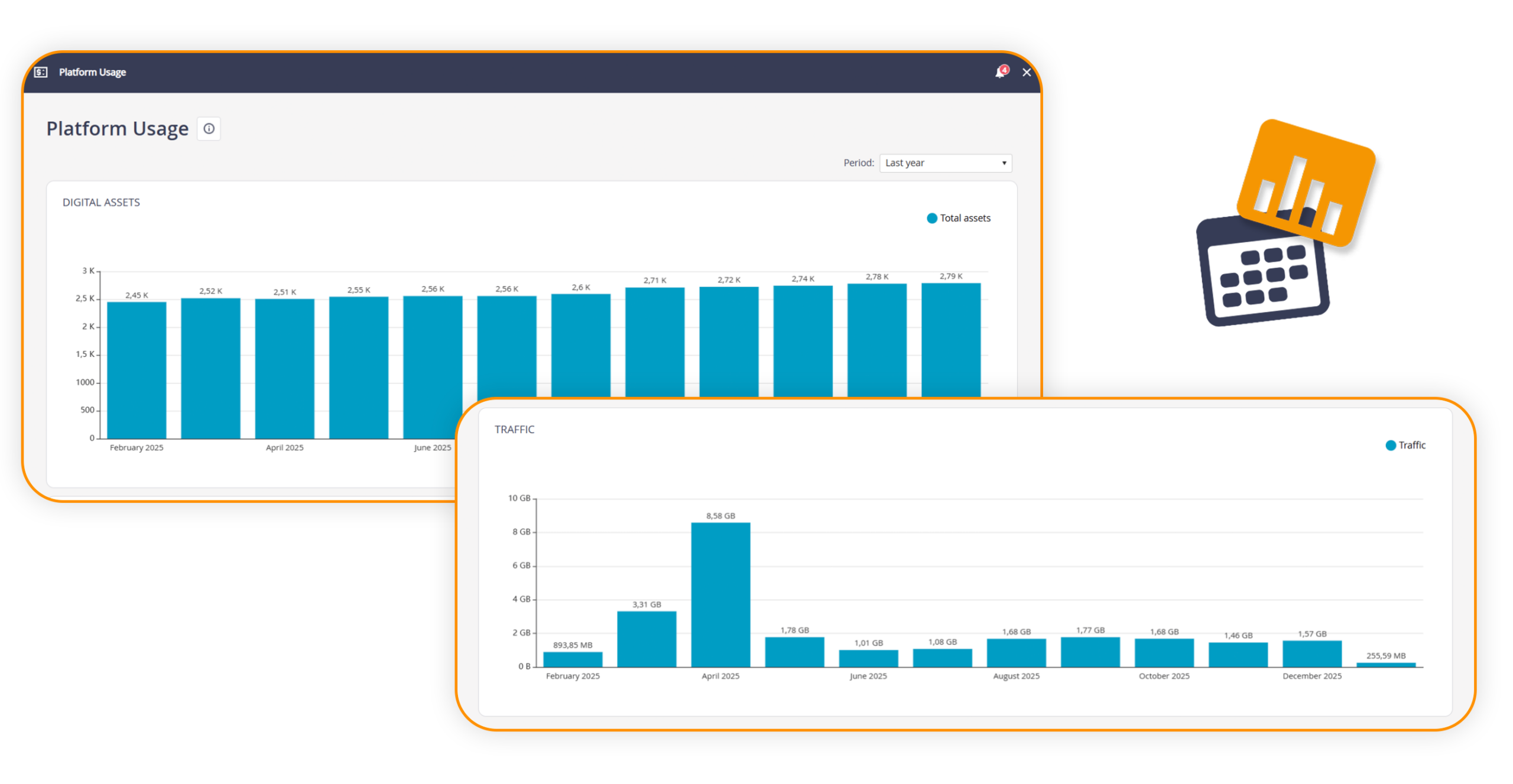
The section previously called Account & Billing has been renewed and becomes Platform & Usage.
The interface has been updated to offer a clear and immediate view of the main consumption parameters related to Fair Usage Policies, eliminating information that is no longer relevant. The section now shows exclusively the graphs related to the number of assets and traffic, making the monitoring of usage metrics simpler and more focused.
This evolution represents a further step forward towards an increasingly transparent platform management oriented to what really matters.
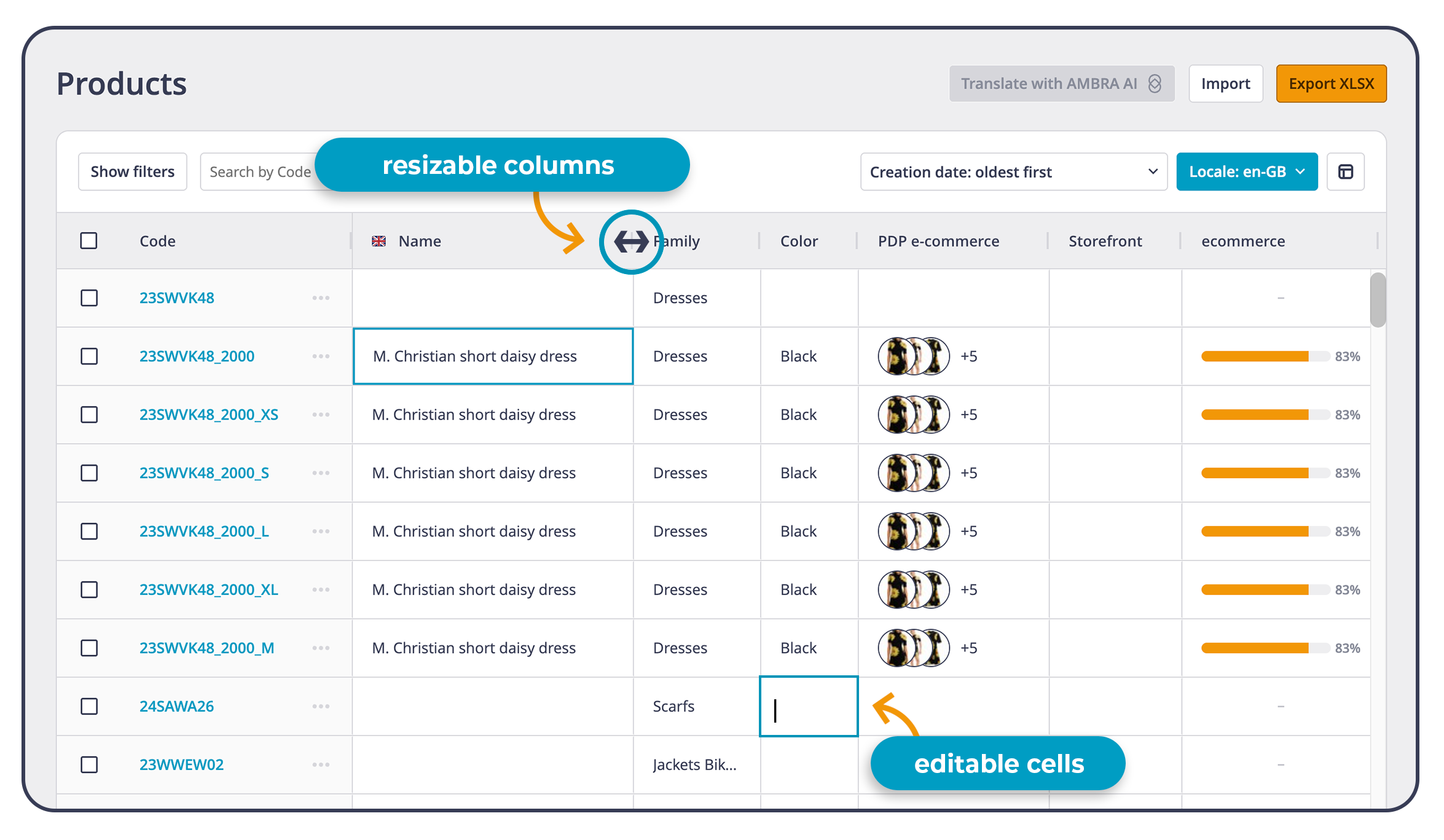
Managing a large catalog means working daily on a lot of information, often with the logic of Excel: rows, columns, filters, quick edits, continuous checks. From today, this way of working finds space where it produces the most value: in THRON Platform.
SpeedSheet is here: the new product list view in THRON, designed for those who manage a lot of catalog information and want to operate as in a spreadsheet.
For those who still work a lot in Excel, it means entering a complete catalog management without changing habits, gaining speed, control and data reliability across all connected channels.
What SpeedSheet enables in daily work:
A working view in Excel style: organizable and configurable columns to get a table that reflects the way you actually work on the catalog.
Clearer reading even with many fields: natural scrolling, resizable columns and a more stable structure to always keep all information clear.
Direct editing in cell, as in a spreadsheet: enter the field of interest with a double click, edit, confirm and continue even via keyboard.
Mass updates up to twice as fast: fewer repetitive steps, more operational continuity even when the catalog grows.
Reliable data at the center of the supply chain: changes live at the heart of THRON Platform and promote consistency between teams, so that information and content are ready to reach eCommerce, marketplaces and touchpoints.
During the daily update of availability, variants, short descriptions or detailed information, SpeedSheet allows you to intervene in sequence on multiple products, maintaining a continuous and focused workflow.
This evolution brings the product list experience closer to the logic of spreadsheets, reducing manual work and making the interface more fluid and guided, so as to accelerate time to market and free up time along catalog management processes.
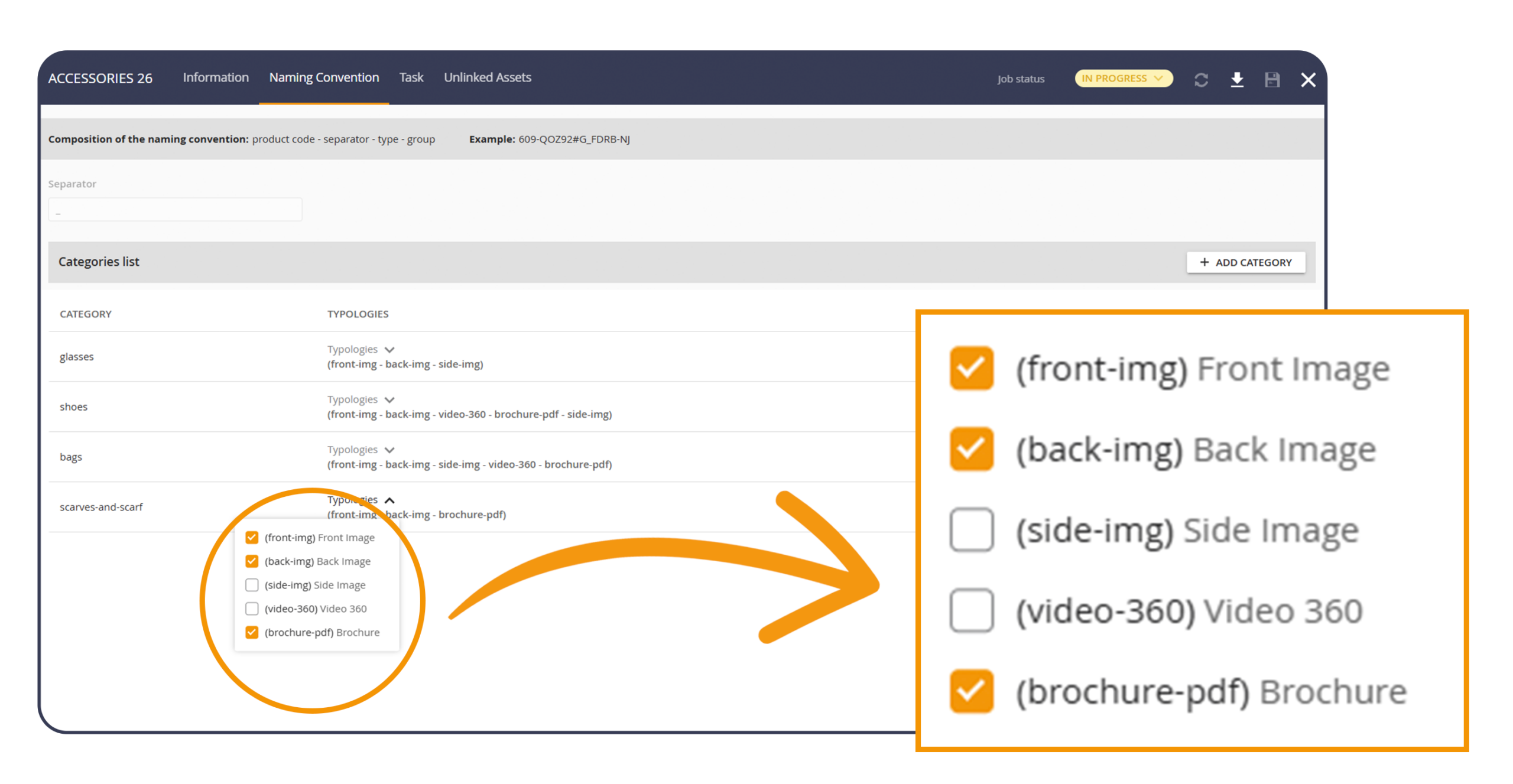
Product Workflow introduces the ability to expand an already started job, adding new typologies and new operational spaces to be associated with products already in progress.
From now on you can:
Expand during the work: add new typologies during processing with related slots for resources, so that the same container remains valid even when additional requests emerge or corrections are needed.
Have a single job as an operational reference, even when integrations or corrections are needed, with consistent rules and assignments.
Consult more linear traceability: activities, history, progress and responsibilities remain readable along the entire path, with fewer fragmentations.
To add new typologies to an ongoing job, simply open the Naming convention section and use the dedicated dropdown for typologies to select those to include. Saving immediately updates the job, making the new typologies operational while respecting already set rules and assignments, so that the flow remains unique and consistent.
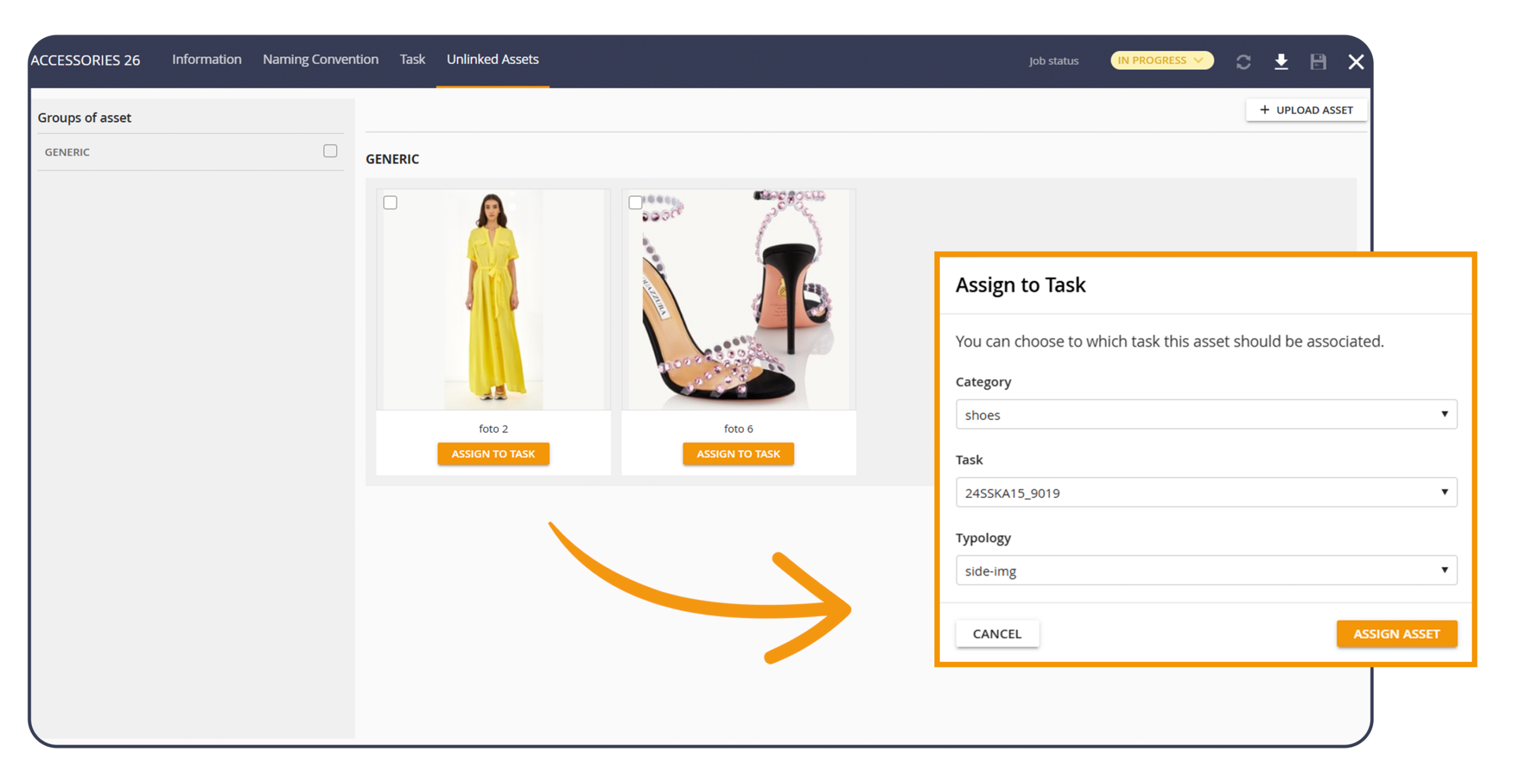
In content production, shots often arrive in advance of the definition of the final product code. Product Workflow introduces dedicated management for content still waiting to be linked to a product, so that uploading can happen immediately and association can be completed when information and codes are ready.
Benefits of the new update:
Early content upload: resources enter the job even when the final reference product code still needs to be finalized.
A dedicated section to govern what is pending: content awaiting association remains visible, filterable and manageable with clarity in the “Unlinked content” section.
Precise association: when the final product code is available, each pending content is linked to the correct product, one by one, without having to repeat the upload.
Consistent history along the lifecycle: progress and annotations follow the transition from “pending” content to linked content, supporting control and collaboration between teams.
Both Product Workflow evolutions reduce operational friction typical of production flows, keep activities focused on a single, readable path and support a faster time to market, because data and content remain governed in THRON Platform with continuity and consistency.
In the Digital Assets area, the folder column is now more flexible and adaptable to the working context. It is now possible to expand it up to one third of the screen, so as to read and manage complex structures more comfortably, or compress it to give priority to asset display.
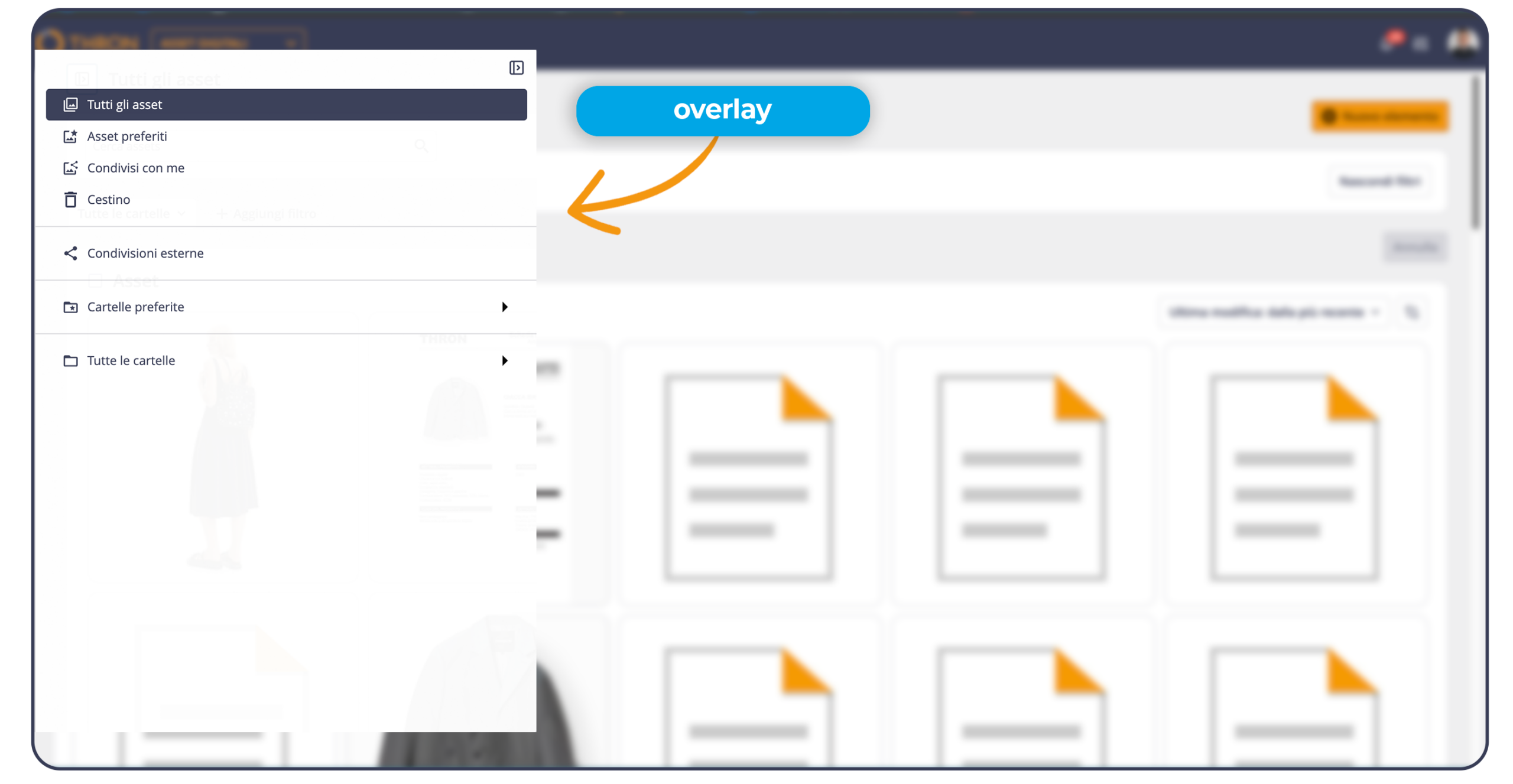
When the column is compressed, simply hovering the cursor over the left edge makes it appear in overlay maintaining the same width previously set, so that navigation between folders does not interrupt the workflow. The same applies to drag and drop, ensuring immediate and continuous movements into folders.
The chosen size is also maintained between sessions, so that browsing is always consistent with your preferences during the session.