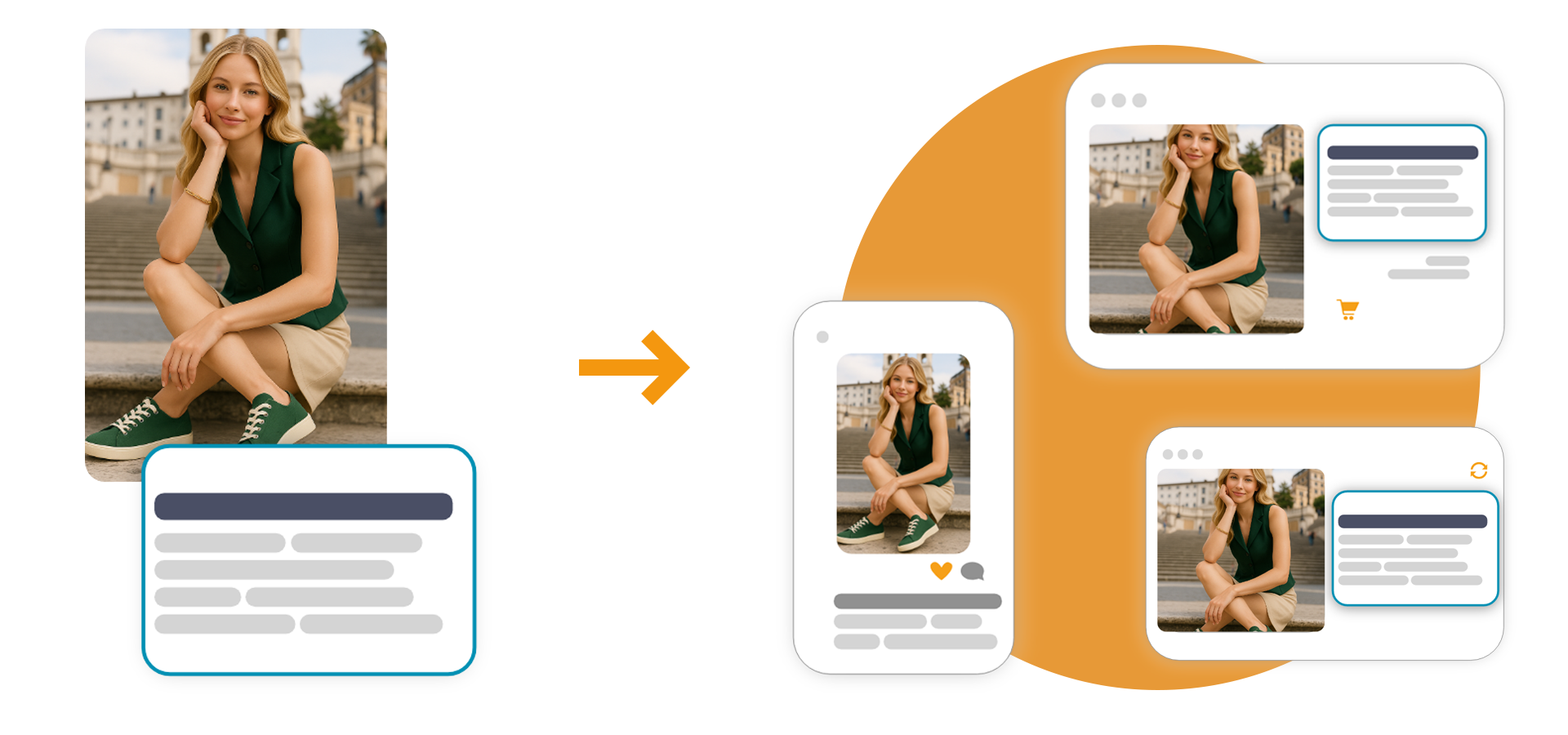
Product Information: DAM, PIM, and Unified Platforms
What is a Digital Asset Management (DAM) system?
A Digital Asset Management (DAM) system is a centralized platform that stores, manages, and distributes multimedia content such as images, videos, graphics, documents, presentations, and audio files. DAM systems organize assets, enrich them with metadata, and ensure that teams always access the correct, most updated versions for use across physical and digital channels. (Source)
What is a Product Information Management (PIM) system?
A Product Information Management (PIM) system is the single source of truth for product information, including localized attributes, descriptions, variants, translations, and technical requirements for each channel or market. PIM centralizes and organizes product data into clear, compliant product sheets and distributes this information to e-commerce, marketplaces, B2B portals, catalogs, and technical sheets. (Source)
What are the main differences between DAM and PIM?
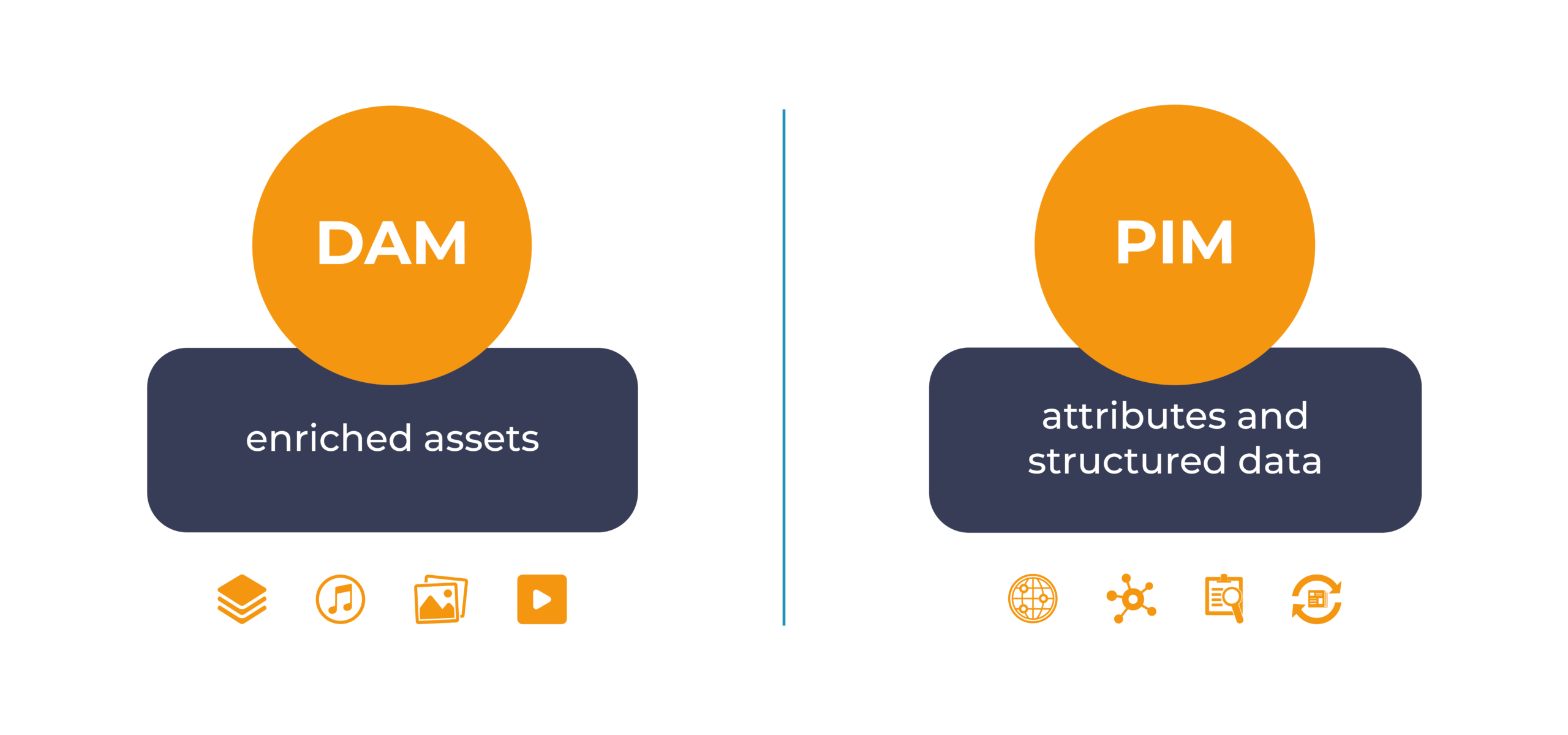
DAM manages enriched assets (such as images and videos), focusing on content organization, approval, and reuse, while PIM manages structured product data (attributes, descriptions, variants) for multichannel distribution. DAM outputs approved, updated content, whereas PIM outputs complete, compliant product sheets. Typical risks for DAM include outdated files and inconsistent brand communication; for PIM, risks include incomplete or inconsistent product data. (Source)
Why should companies unify DAM and PIM into a single platform?
Unifying DAM and PIM reduces manual steps, delays, and rework by allowing content and product data to be updated once and reflected everywhere. This shortens time-to-market, lowers operational costs, and ensures consistent, compliant information across all channels. Unified platforms also enable automation, eliminate repetitive tasks, and improve collaboration between teams. (Source)
How does a unified DAM+PIM platform improve product experience?
By combining assets and product data within workflows, a unified DAM+PIM platform ensures that every product is accompanied by up-to-date visuals and accurate information. This enhances the product experience across all channels, making content easily findable, reusable, and consistent for end users. (Source)
What are some real-world use cases for unified DAM+PIM platforms?
Unified DAM+PIM platforms are especially valuable in industries like fashion (automatic association of product shots to variants), design and ceramics (dynamic settings and catalog publishing), and manufacturing (catalog and product sheet management, B2B portals with updated assets and technical data). (Source)
How can you measure the ROI of a unified DAM and PIM approach?
ROI can be measured by evaluating KPIs such as time-to-market for campaigns, rework avoided, completeness and performance of product sheets per channel, and man-hours gained on repetitive tasks. Measuring these impacts over 8–12 weeks and projecting them annually provides useful business case insights. (Source)
How soon can you see ROI after implementing a unified DAM+PIM platform?
ROI can often be observed within the first 6–8 weeks, depending on project complexity. Time savings and workflow simplification become evident as soon as key teams complete onboarding. (Source)
How do you adopt DAM+PIM unification without redoing everything?
Start by mapping existing workflows, defining a shared minimum taxonomy, and connecting main data sources (ERP, PLM, e-commerce). Begin with a pilot (such as a product line or brand) and scale gradually to minimize disruption. (Source)
How many SKUs are needed to justify unification of DAM and PIM?
There is no minimum SKU threshold. What matters is the complexity—such as variants, channels, languages, and markets. Even companies with few SKUs but many channels or market diversifications benefit from unification by eliminating manual steps and bottlenecks. (Source)
Features & Capabilities
What features does THRON offer for managing digital assets and product information?
THRON provides a unified platform that centralizes and manages photos, videos, documents, and product data. Key features include Digital Asset Management (DAM), Product Information Management (PIM), AI-powered automation, omnichannel content delivery, monitoring dashboards, and seamless integrations with company systems. (Source)
Does THRON support automation and workflow management?
Yes, THRON automates workflows, asset distribution, and content optimization using AI and no-code tools. This reduces manual work, eliminates repetitive tasks, and accelerates time-to-market. (Source)
How does THRON ensure omnichannel content delivery?
THRON automates asset delivery across all channels, ensuring that content and product information are optimized and updated in real-time for every touchpoint. This guarantees consistent brand communication and improved user experience. (Source)
What integrations does THRON offer?
THRON offers next-generation API connectors and certified integrations for platforms such as AEM, Magento, Shopify, Drupal, WordPress, and Salesforce Commerce Cloud. It also integrates with ERP systems, creative suites like Adobe CC, IT security tools, and user experience platforms. (Source)
Does THRON provide APIs for custom integrations?
Yes, THRON provides modern, robust, and easy-to-implement APIs that allow integration with any system or endpoint, ensuring secure and high-performance communication. (Source)
What monitoring and analytics capabilities does THRON offer?
THRON provides monitoring dashboards that track the volume and quality of digital asset usage, offering content intelligence to optimize strategies and improve user experience. (Source)
What technical documentation is available for THRON?
THRON offers detailed technical documentation, including platform architecture, security, and data management white papers. These resources are available for download and provide valuable insights for IT and digital leaders. (Source)
Use Cases & Benefits
Who can benefit from using THRON?
THRON is designed for marketing, e-commerce, operations, digital/CIO, and IT teams across industries such as fashion, ceramics, beauty & pharma, sporting goods, manufacturing, interior design, retail, and automotive. The platform addresses the specific needs of these roles and industries, ensuring efficiency, brand consistency, and streamlined workflows. (Source)
What business impact can customers expect from THRON?
Customers can expect measurable performance improvements, including 90% time savings in asset search, 50% of time reallocated to strategic activities, 99.9% service availability, and a 317% ROI with a payback period of less than 6 months (Forrester TEI study). Automated asset delivery alone can provide a financial benefit of 7,000 over three years. (Source)
What pain points does THRON address for its customers?
THRON addresses pain points such as excessive manual work, inconsistent brand communication, scattered product content, slow time-to-market, workflow inefficiencies, and the need for secure, centralized asset management. The platform centralizes content, automates workflows, and ensures robust governance and security. (Source)
Can you share specific case studies or customer success stories?
Yes, THRON has numerous customer success stories across industries. For example, Selle Royal Group achieved brand consistency across 80 markets, Whirlpool reduced e-commerce update time by 99%, and LAGO eliminated catalog launch delays. More case studies are available on the THRON customers page.
What feedback have customers given about THRON's ease of use?
Customers praise THRON for its user-friendly design and automation. For example, a Chief Marketing Officer at a manufacturing company noted that asset searches now take "two clicks," and a Digital Product Manager from a fashion company highlighted the elimination of manual channel updates. (Source)
How quickly can THRON be implemented?
THRON's B2B Area can be activated in less than a week. Customers receive dedicated onboarding, training, and resources to ensure a smooth and efficient start. (Source)
What support and services does THRON provide?
THRON offers technical assistance, a Customer Success Program with personalized onboarding and training, self-service resources, and monthly release notes to keep customers informed about platform updates. (Source)
What industries are represented in THRON's case studies?
Industries include fashion, sporting goods, beauty & pharma, manufacturing, interior design, retail, sports, ceramics, and e-commerce. Examples include Twinset (fashion), Dainese (sporting goods), Pettenon Cosmetics (beauty), Selle Royal Group (manufacturing), and Atlas Concorde (ceramics). (Source)
Security, Compliance & Technical Requirements
What security and compliance certifications does THRON have?
THRON is fully compliant with GDPR and holds internationally recognized certifications, including ISO 27001:2022 (information security), ISO 9001:2015 (process quality), ISO 27017:2015 (cloud service security), and ISO 27018:2019 (personal data protection in virtualized environments). (Source)
How does THRON ensure data security and integrity?
THRON follows OWASP principles for secure development, uses automated infrastructure management, advanced XDR threat detection, customizable password policies, data encryption, and HTTPS for distribution. Data is replicated across multiple AWS data centers for integrity and disaster recovery. (Source)
What infrastructure does THRON use for hosting and security?
THRON leverages Amazon Web Services (AWS) for secure data centers, DDoS protection, and automatic scaling. Data is replicated across multiple AWS centers to ensure availability and integrity. (Source)
Is THRON GDPR compliant?
Yes, THRON is fully compliant with the General Data Protection Regulation (GDPR), ensuring data protection and privacy for all customers. (Source)
Competition & Comparison
How does THRON differ from other DAM and PIM solutions?
THRON uniquely combines DAM and PIM functionalities into a single platform, eliminating the need for costly integrations and reducing complexity. It offers automation, a single source of truth, omnichannel capability, and a Customer Success Program to accelerate ROI. (Source)
Why choose THRON over alternatives?
THRON offers a unified DAM and PIM platform, automation, centralized asset and data management, omnichannel delivery, and a dedicated Customer Success Program. These features simplify processes, improve efficiency, and maximize ROI for marketing, e-commerce, operations, digital, and IT teams. (Source)
What are the key differentiators of THRON for different user segments?
For marketing teams, THRON centralizes content and automates workflows. E-commerce teams benefit from improved time-to-market and user experience. Operations teams use no-code tools to streamline workflows, while IT and digital teams leverage APIs and connectors for seamless integration and governance. (Source)
Implementation & Onboarding
What is the onboarding process like for new THRON customers?
New customers are supported by a dedicated Customer Success Manager who provides customized onboarding, training, and access to guides and videos. This ensures a smooth start and helps flatten the learning curve. (Source)
How does THRON support ongoing customer success?
THRON pairs each customer with a specialist for ongoing onboarding, training, proactive monitoring, and consultancy. Customers also have access to self-service resources and monthly release notes. (Source)
Additional Product & Industry Information
What is the impact of unified DAM+PIM on e-commerce and marketplaces?
Unified DAM+PIM ensures that every update is made once and reflected everywhere, improving UX quality, reducing publishing errors, and accelerating cross-channel time-to-market. (Source)
How does THRON help with multichannel consistency?
THRON provides a single place to govern assets and data, guaranteeing compliance with requirements for each channel and reducing inconsistencies between websites, marketplaces, and trade materials. This results in a uniform experience and guaranteed compliance. (Source)
If you’re wondering what the difference is between DAM and PIM and, above all, when it makes sense to unite them in a single natively unified platform, this guide is for you. DAM organizes and distributes digital assets, while PIM governs product information for all channels; but the real breakthrough today is not choosing “DAM or PIM”, but unifying assets and product data to accelerate time-to-market, reduce errors and rework, and free up people’s time for strategy and creativity.
This article explores in 15 essential points the real differences between DAM and PIM, how and when to choose a unified platform, real benefits and concrete use cases of companies that can benefit from it.You’ll also find a valid method for measuring the ROI (Return on Investment) of a unified asset+product platform and a quick checklist to understand where to start.
Table of Contents
1) What is a DAM (in simple words)
According to the definition provided by Gartner, a Digital Asset Management is a system that stores, manages and reproduces in a centralized (and intelligent) way multimedia content such as images, videos, graphics, documents, presentations, audio files. The DAM stores them, organizes them, enriches them with information (editorial, but also product-related) and makes them findable and reusable, for all your company’s teams, always in the correct version — and most updated, ready to be used on physical and digital channels.
2) What is a PIM (in simple words)
The Product Information Management is the single source of truth for product information: localized attributes, descriptions, variants, translations and technical requirements, for each channel or target market. PIM centralizes information, organizes it into clear, complete and compliant product sheets, and then distributes data where needed: e-commerce, marketplace, B2B portals, catalogs and technical sheets.
3) DAM vs PIM: when does the difference matter?
If DAM = assets and PIM = product data, when is the first needed and when is the second more useful? Marketing, brand and communication teams work mainly on assets, while e-commerce, digital and product teams organize and manage a large amount of data (product data). All these teams, however, have a common goal: publish complete and consistent product sheets on all channels — which is why it’s essential that the two systems work together.
DAMvsPIM: summary of key differences
What they manage: enriched assets (DAM) vs attributes and structured data (PIM)
Output: approved, updated and reusable content (DAM) vs complete and compliant product sheets for multichannel distribution (PIM)
Typical risks: use of outdated files, inconsistent brand communication (DAM) vs product sheets with incomplete, inconsistent or non-compliant data (PIM)
4) When the focus is on assets (without forgetting data)
Brands with strong creative production, frequent campaigns and defined guidelines benefit from a DAM, which allows them to govern updates and versions, usage rights, approvals and content reuse in multiple contexts. But without a direct connection to product data (titles, descriptions, variants and attributes) publishing remains fragile and not immediate.
5) When the focus is on data (but with always consistent assets)
Extensive catalogs, numerous SKUs and variants require a PIM to centralize information and adapt it to different channels and markets. Product images, videos and related materials, however, are what converts: to work on sales channels and ensure the best UX, each product must be accompanied by its visual representation.
6) DAM+PIM for product experience
To amplify benefits and obtain real impacts, assets and data must therefore co-exist within workflows. Much content is born with an initial information set, which however does not replace the structured attributes of PIM, designed to enrich them and make them easily findable and reusable — just as product assets enrich and complete each SKU for end channels. Assets and data, DAM+PIM can therefore be seen as two layers of the same product experience.
7) Why unify them: effects on time-to-market and operational costs
When assets and data are natively unified, you reduce manual steps, delays and rework: content and information simultaneously feed all channels and you just need to update them once to update them everywhere. In this way time-to-market is shortened and operational costs are lowered. Unifying processes and reducing costs represent the number one priority in digital strategies.
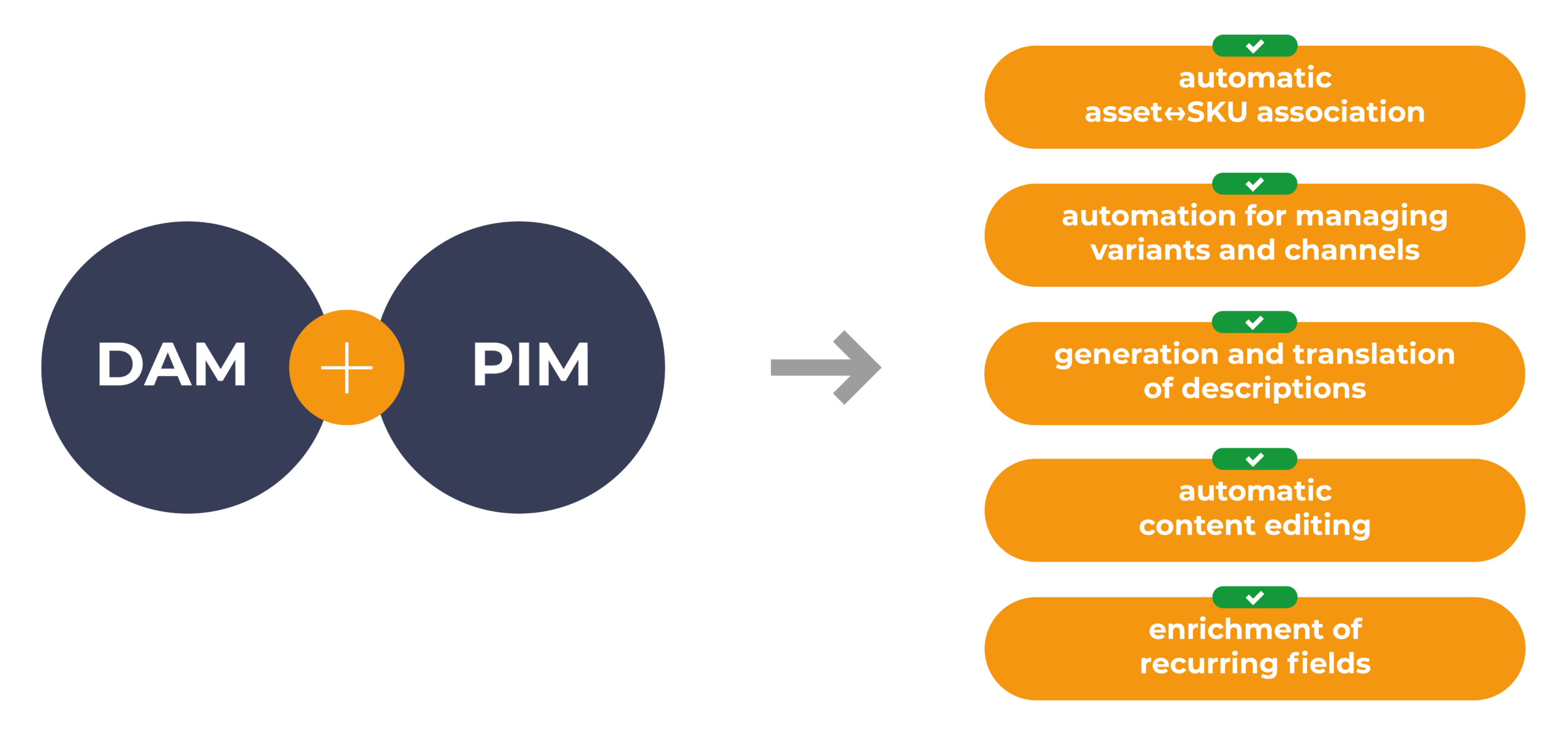
The unified approach represents the key to eliminate repetitive and time-consuming activities through automatic rules and AI. Automatic asset↔SKU association, automation for variant and channel management, generation and translation of descriptions, automatic content editing, enrichment of recurring fields and scheduled publishing. Fewer repetitive operations = more time for strategy and creativity.
9) Multichannel consistency: e-commerce, marketplace, catalogs and B2B
If the company vocabulary is simple and shared between marketing, e-commerce and IT, errors are eliminated. Product categories, “speaking” attributes, information for asset enrichment and usage. A few clear rules simplify internal communication and facilitate the achievement of common goals: finding content and information and reusing it wherever needed, quickly and without unnecessary costs.
11) DAM+PIM and unified workflows: clear roles, accelerated golive
When DAM+PIM merge, creative approvers and product owners work on the same information object (assets + data) with clear and consistent work states and permissions. Governance becomes linear and monitoring the completion status of each product sheet, as well as campaigns, shootings and projects, becomes simpler. Fewer parallel versions, zero duplications, clear responsibilities and accelerated golive.
12) DAM, PIM and unified delivery — assets and data on all channels
Unifying data and content in a single platform means unifying publishing as well, which becomes instant and omnichannel: through connectors and APIs, data and assets arrive everywhere, with a single click. Updates are also in real-time and on every touchpoint the latest version of each content or product sheet will always be present. It’s the key step that eliminates information “forks” and maintains consistency over time.
13) How to measure the ROI of a unified DAM and PIM approach
Unifying content and product data brings concrete and measurable benefits, not only for marketing, e-commerce and product teams, but also for those who, like IT Managers and CTOs, must ensure that every choice is cost-effective for the entire company. How do we measure, therefore, the ROI of a platform like this? By evaluating its impact on costs, benefits, flexibility and risksthrough the measurement ofpractical KPIs:
Time-to-market of campaigns and collections (days/weeks saved)
By measuring the impact over 8–12 weeks and projecting it annually, you’ll obtain useful indications for your business case.
14) DAM+PIM and use cases: fashion, retail, design, manufacturing
For which companies is a unified DAM+PIM approach most suitable? The choice of a single platform for content, products, workflows and multichannel distribution can represent the winning choice for various sectors.
Fashion: automatic association of product shots to color/fit variants; quick connection between products for looks and windows on e-commerce and marketplace
Design, Furniture and Ceramic companies: automatic content-product association for dynamic settings and navigable renders; publishing on sector marketplaces and layout of catalogs, technical sheets and price lists with precise and updated technical information
Manufacturing: content-product association for catalog and product sheet management; management of components, spare parts and replacement parts; updated assets and technical data for the development of B2B portals complete with manuals and video content.
15) Checklist: DAMvsPIM or DAM+PIM?
The natively unified DAM+PIM approach is always preferable to DAMvsPIM, in terms of time-to-market, time gained and costs saved. If you want to understand where to start to achieve goals and benefits quickly and scalably, here’s a quick checklist of what to consider.
SKUs and variants:
few and stable over time > asset focus
many and subject to changes and innovations > unification
Publishing channels:
max2 channels > asset focus
more than 2 channels among e-commerce, website,marketplace, catalogs and partner portals > unification
Recurring errors in terms of outdated content, obsolete data and risk of non-compliance with individual channels > unification
Time: if you often encounter slowdowns in creation, approval and publishing flows due to bottlenecks and interruptions between creativity and product sheets, the correct approach is unification of assets and SKUs
Team: if in your company marketing, digital and e-commerce often find themselves collaborating to bring campaigns and new collections online; if there are figures like IT and Innovation Managers, actively involved in simplifying the IT stack to reduce operational and maintenance costs, the unified approach is the choice that brings the greatest advantages, in the short and long term > assets and data in the same place means faster time-to-market and lower costs.
Frequently Asked Questions (FAQ)
DAM or PIM: where to start? It depends on priorities and bottlenecks: if the main difficulties revolve around assets (search times, versions and duplications, reuse and approval flows) start with DAM; if delays and friction involve data (centralization from ERP, completeness of product sheets, adaptation per channel or market, data quality before publishing), start with PIM. Choose a platform that natively unites DAM+PIM anyway and put the adoption of the unified approach on your roadmap: that’s where value is maximized.
How to adopt unification without redoing everything? Map existing flows, define the shared minimum taxonomy and connect the main sources (ERP, PLM, e-commerce). Start with a pilot (a line or a brand) and scale gradually.
How many SKUs are needed to justify unification? There’s no minimum threshold: what matters — and needs to be managed — is complexity: variants, channels, languages and markets. If your company has few SKUs, but many channels and diversifications per market, unification eliminates manual steps and bottlenecks in the review and data quality phase.
What is the impact on e-commerce and marketplace? Among the major and quickest impacts is the one on end channels, because every update is done only once and is reflected everywhere. Consistent product sheets + media updated in real-time improve UX quality, reduce publishing errors and accelerate cross-channel time-to-market.
How soon do I see ROI? Often already in the first 6-8 weeks, based on project complexity. Benefits in terms of time saved and simplification of flows and stack arrive as soon as the company’s key teams complete onboarding.
Would you like to receive content like this once a month?
Embark on a journey to NORTH together with over 4,500 human beings. With our newsletter you will receive data, trends and insights into the world of DAM, PIM and beyond every thirty days.