MarTech stands for Marketing Technologies and refers to the set of software tools that support marketers in achieving their goals. It is crucial because it enables organizations to streamline marketing operations, optimize campaigns, and leverage data-driven strategies. The annual Marketing Technology Landscape, published by Scott Brinker, tracks and ranks these tools, highlighting their impact on the industry. Source
How many MarTech tools are available in 2024?
According to the Marketing Technology Landscape 2024, there are 14,106 MarTech software tools on the market. This represents a 28% increase over previous years, with a compound annual growth rate of 41.8%. Source
What are the main categories of MarTech tools?
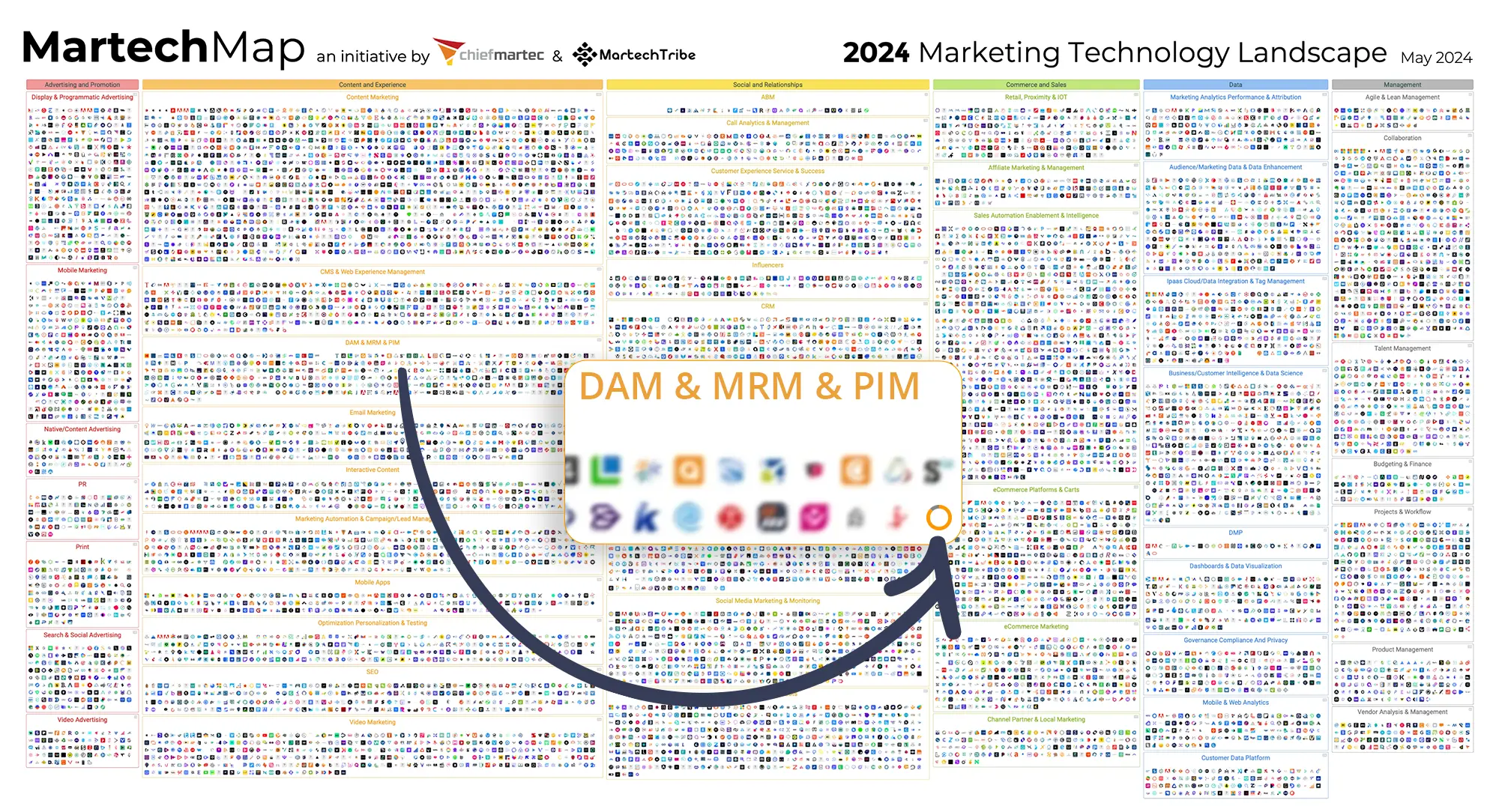
The MarTech Landscape divides tools into six macro-categories: Advertising & Promotion, Content & Experience, Social & Relationship, Commerce & Sales, Data Management, and Management. Each category contains numerous sub-categories, such as DAM & MRM & PIM under Content & Experience. Source
How is the corporate IT stack changing in 2024?
The corporate IT stack is consolidating, with organizations aiming to reduce complexity and budget. While the number of MarTech tools is growing, companies are seeking versatile platforms that minimize integration and maintenance costs. Marketing automation platforms are the most common (88%), followed by CRM (84%), BI (69%), DXP (54%), and CDW (48%). Source
What role does artificial intelligence play in MarTech?
Artificial intelligence is a major trend in MarTech, with over 3,000 GPT solutions focused on MarTech in OpenAI's GPT Store. One third of these tools focus on content marketing, reflecting the rapid advancement of generative AI. SMM, SEO, and collaborative tools are also prominent. Source
What is the Dunning-Kruger effect and how does it impact MarTech?
The Dunning-Kruger effect is a cognitive bias where individuals with limited skills overestimate their abilities, while highly skilled individuals underestimate theirs. In MarTech, studies show that companies deemed 'MarTech-mature' by experts often self-assess with lower scores than less mature companies, highlighting the importance of objective evaluation. Source
How does THRON fit into the MarTech Landscape?
THRON PLATFORM is included in the DAM & MRM & PIM sub-category of the Content & Experience category in the Marketing Technology Landscape. It offers a unified solution for digital asset and product information management. Source
What are the benefits of consolidating MarTech tools?
Consolidating MarTech tools reduces investment in software fees, minimizes development and maintenance costs, and simplifies IT stack management. Platforms like THRON help organizations centralize workflows and assets, improving efficiency and reducing complexity. Source
How can companies stay updated on MarTech trends?
Companies can stay updated by subscribing to newsletters like NORTH, published by THRON every third Wednesday of the month. NORTH provides data, trends, and insights into DAM, PIM, and digital transformation for marketers, IT, CIOs, e-commerce managers, and digital specialists. Source
What is the significance of niche MarTech solutions?
Niche MarTech solutions are developed by small technology providers who listen to and fulfill specific needs that large platforms may not address. This diversity supports innovation and ensures that organizations can find tools tailored to their unique requirements. Source
How can organizations objectively assess their MarTech maturity?
Organizations should compare their self-assessment with expert evaluations and industry benchmarks to avoid cognitive biases like the Dunning-Kruger effect. Regularly reviewing IT stack performance and seeking external feedback can help align perceptions with reality. Source
What is the impact of generative AI on content marketing?
Generative AI has significantly improved content marketing by automating content creation, personalization, and optimization. One third of MarTech tools in OpenAI's GPT Store focus on content marketing, demonstrating the technology's influence on the industry. Source
How does THRON help companies reduce IT complexity?
THRON provides a unified platform that centralizes digital asset and product information management, reducing the need for multiple tools and costly integrations. This approach simplifies IT stack management and minimizes maintenance costs. Source
What types of platforms are most common in corporate IT stacks?
Marketing automation platforms (88%), CRM (84%), BI (69%), DXP (54%), and CDW (48%) are the most common types of platforms in corporate IT stacks. Workflow platforms, CDP, and Digital Asset Management are also widely used. Source
How can THRON's newsletter NORTH benefit digital professionals?
NORTH provides monthly insights, data, and trends on DAM, PIM, and digital transformation, helping digital professionals stay informed and make strategic decisions. Over 4,500 subscribers benefit from its content. Source
What is the value of expert-led MarTech events like MarTechDay?
Events like MarTechDay, led by industry experts, provide valuable insights, trends, and benchmarking data for organizations. They help companies understand market dynamics and make informed technology decisions. Source
How does THRON support digital transformation?
THRON supports digital transformation by offering a single platform for managing digital assets and product information, automating workflows, and integrating with existing systems. This enables organizations to streamline operations and foster innovation. Source
Features & Capabilities
What features does THRON offer?
THRON offers a unified platform for Digital Asset Management (DAM) and Product Information Management (PIM), AI-powered automation, centralized repository, omnichannel delivery, content intelligence, seamless integrations, and robust security. Source
Does THRON support omnichannel content delivery?
Yes, THRON ensures consistent and updated content across all touchpoints, improving user experience and increasing conversions through omnichannel delivery. Source
What integrations are available with THRON?
THRON provides API connectors and certified integrations for platforms like AEM, Magento, Shopify, Drupal, WordPress, and SFCC. It also integrates with CMS, ERP, creative suites, IT security tools, and user experience tools. Source
Does THRON offer APIs for integration?
Yes, THRON offers modern, robust, and easy-to-implement APIs for secure and high-performance integration with any system or endpoint. Source
How does THRON monitor content performance?
THRON provides monitoring dashboards and content intelligence tools to track asset performance and usage, enabling data-driven strategies for optimizing information asset management. Source
What technical documentation is available for THRON?
THRON offers technical documents such as platform architecture infographics, white papers, and comprehensive guides on architecture, security, and data management. Source
How does THRON automate workflows?
THRON automates workflows, asset distribution, and content optimization using AI-powered tools and no-code workflows, reducing manual tasks and improving efficiency. Source
What is THRON's Customer Success Program?
THRON pairs each customer with a specialist who provides customized onboarding, training, proactive monitoring, and consultancy to ensure optimal use of the platform. Source
How does THRON ensure data security and compliance?
THRON is fully GDPR compliant and holds certifications including ISO 27001:2022, ISO 9001:2015, ISO 27017:2015, and ISO 27018:2019. It follows OWASP principles, uses XDR systems for threat detection, and partners with AWS for secure infrastructure. Source
Use Cases & Benefits
Who can benefit from THRON?
THRON is ideal for marketing, e-commerce, operations, digital & CIO, and IT teams across industries such as fashion, ceramics, beauty & pharma, sporting goods, manufacturing, interior design, retail, automotive, and more. Source
What problems does THRON solve?
THRON addresses efficiency, brand consistency, collaboration, automation, omnichannel delivery, and governance challenges by centralizing content and product information, automating workflows, and providing robust security. Source
What business impact can customers expect from THRON?
Customers can expect 90% time savings in asset search, 50% reallocated time to strategic activities, 99.9% service availability, 317% ROI with a payback period under 6 months, and IT budget reduction by 55%. Source
Are there any customer success stories with THRON?
Yes, THRON has success stories across industries, including Fiorentina (sports), Selle Royal Group (manufacturing), Chervò (fashion), CAME (manufacturing), LAGO (interior design), PLATUM (e-commerce), Whirlpool (appliances), Dainese (sporting goods), Pettenon Cosmetics (beauty & pharma), and Atlas Concorde (ceramics). Source
What feedback have customers given about THRON's ease of use?
Customers praise THRON for simplifying asset search and retrieval, automating channel updates, and enabling intuitive workflow management. Testimonials highlight reduced manual work and improved collaboration. Source
How quickly can THRON be implemented?
THRON B2B Area can be activated in less than a week. Customers receive dedicated onboarding, training, and access to guides and videos for a smooth start. Source
What industries are represented in THRON's case studies?
Industries include fashion, sporting goods, beauty & pharma, manufacturing, interior design, retail, sports, ceramics, and e-commerce. Source
What pain points do THRON customers typically face?
Customers often face excessive manual work, inconsistent brand communication, scattered product content, slow time-to-market, workflow inefficiencies, and challenges with secure asset management. THRON addresses these by centralizing and automating processes. Source
Competition & Comparison
How does THRON compare to other MarTech solutions?
THRON differentiates itself by combining DAM and PIM functionalities into a single platform, automating workflows, providing a single source of truth, and offering omnichannel capability. This reduces complexity and integration costs compared to solutions that require multiple tools. Source
Why choose THRON over alternatives?
THRON offers unique advantages such as unified DAM and PIM, automation, centralized repository, omnichannel capability, and a dedicated Customer Success Program. It is designed to simplify processes, improve efficiency, and foster innovation. Source
What are THRON's key differentiators for different user segments?
Marketing teams benefit from centralized content and automated workflows; e-commerce teams gain improved user experience and faster time-to-market; operations teams streamline workflows with no-code tools; digital & CIO roles achieve seamless integration; IT teams simplify technology stack management. Source
Technical Requirements & Support
What security certifications does THRON hold?
THRON holds ISO 27001:2022, ISO 9001:2015, ISO 27017:2015, and ISO 27018:2019 certifications, and is fully GDPR compliant. Source
How does THRON ensure secure development and infrastructure?
THRON follows OWASP principles for secure code, uses infrastructure as code for automated server management, employs XDR systems for threat detection, and partners with AWS for secure data centers and DDoS protection. Source
What support resources are available for THRON customers?
Customers can access technical assistance, open support tickets, use self-service resources like guides and videos, and stay updated with monthly release notes. Source
How does THRON maintain data integrity?
THRON replicates data across multiple AWS data centers to ensure integrity even after catastrophic events, and uses encryption and HTTPS for secure distribution. Source
MarTech 2024: 5 trends to understand how and where the market is going
Like every year, the first Tuesday in May is MarTechDay, an event where industry experts Scott Brinker and Frank Riemesma take stock of the situation in the market. Here is a summary of the most interesting trends and thoughts.
What does MarTech mean and why are we talking about it?
Before delving into the data we have selected, a necessary premise on the meaning of the term MarTech.
MarTech stands for Marketing Technologies and refers, as you might guess, to the set of software that supports marketers in achieving their goals.
Scott Brinker, VP of HubSpot and author of chiefmartech.com, has been analysing the global marketing tools landscape for years and has been publishing the annual Marketing Technology Landscape since 2011.
The map tracks and ranks these tools and, together with surveys and insights, is released on MarTechDay, a much-awaited event for those involved in technology and/or marketing.
In particular, the Landscape divides the MarTech tools into six macro-categories:
Advertising & Promotion
Content & Experience
Social & Relationship
Commerce & Sales
Data Management.
Each of them contains within it numerous sub-categories; for example, THRON PLATFORM has been included in the DAM & MRM & PIM sub-category of the Content & Experience category for years.
From the insights of the 2024 edition, streamed on 7 May, we have selected five; and the first is based on the Landscape volumes.
The number of MarTech tools no longer stops
Landscape 2024 found 14,106MarTech software on the market.
A gigantic number, the size of which is even more appreciable in perspective. Compared to 2023, the increase is about 28% over previous years, with a compound annual growth rate of 41.8%.
The size of the corporate IT stack is getting smaller
In a few issues ago of NORTH – our 50% newsletter and 50% North Star – we discussed market consolidation, i.e. the reduction of MarTech tools available to companies. Were we wrong? Not really.
Although it appears to be a concept at odds with the figure above, Brinker and Riemesma agree that the competitive landscape of marketing technologies will increasingly tend to consolidate, i.e. stabilise first and then shrink slightly.
This is a process that in part is already underway – albeit eclipsed by the countless start-ups that have entered MarTech in recent months – supported by the acquisitions of the Big Players and, above all, stimulated by the goal of organisations to contain the complexity and budget of their IT ecosystem.
If supply grows and demand for MarTech solutions falls, then what can we expect?
The report is clear: despite the ongoing simplification of IT stacks, it is pure utopia to think of a very small number of large platforms offering a wide range of features and satisfying all business needs.
The long tail of solutions populating the market is fuelled by small, sometimes very small, technology providers that listen, interpret and innovatively fulfil niche needs that could hardly be met by MarTech giants such as Adobe, Google, HubSpot and Salesforce, to name a few.
However, in order to support digital simplification and the alleviation of IT costs, MarTech providers are – and will increasingly be – called upon to ensure increasing levels of versatility in their product offerings.
We ourselves have noticed, for example, that from the very first contacts, companies that choose us as their provider are increasingly aware of the benefits to the digital ecosystem provided by a single platform such as THRON, which includes DAM software and PIM software.
Concentrating a substantial amount of workflows in a single solution not only reduces investment in software fees, but also minimises the development and maintenance costs of integrations.
What does the corporate IT stack look like?
Marketing automation platforms are the most common type of MarTech solutions in the companies’ IT stack (88%), followed by CRM (84%) and BI (69%), trailing DXP (54%) and CDW (48%).
In more than one in three of the surveyed companies’ stacks, workflow platforms, CDP (both 37%) and Digital Asset Management (36%).
Artificial intelligence is the undisputed star of the last few months.
Of the 159,000 solutions in OpenAI’s GPT Store, Brinker and Riemesma identified more than 3,000 focused on MarTech, although they chose to include only a few of them in the MarTech Landscape count.
In any case, the overall breakdown of the types of functionalities offered is interesting, with one third of GPTs’ MarTech tools focusing on content marketing, no doubt due to the enormous leap in quality of generative AI.
This is followed, far behind, by SMM, SEO and collaborative tools.
We close this round-up by talking about what is commonly called the Dunning-Kruger effect, a cognitive bias whereby people with limited skills in a specific area tend to overestimate their capabilities, while those with high skills, on the contrary, underestimate them.
The MarTech experts noted this by asking a thousand companies to self-assess their IT stack after deploying it; they found that 30 per cent of companies deemed more ‘MarTech-mature’ by the experts who conducted the study self-assessed with lower average scores than the 70 per cent of companies deemed more ‘MarTech-immature’.
MarTech maturity perceived by truly mature (top 30%) and immature (70%) companies – MarTechDay 2024
Our advice? Lift your head and look around
Sometimes, therefore, abstracting one’s gaze from the particular to focus on the general can be indispensable in order to have a perception of one’s organisation more in line with reality. Whether one tends to overestimate it or underestimate it.
That is also why every third Wednesday of the month we publish NORTH, our newsletter for marketers, IT, CIOs, e-commerce managers and digital specialists who want to keep an open window on what is going on around them.
Would you like to receive content like this once a month?
Embark on a journey to NORTH together with over 4,500 human beings. With our newsletter you will receive data, trends and insights into the world of DAM, PIM and beyond every thirty days.